
Workshop leaders sharing a workspace
If participants take turns using the same scale, weighing ingredients in bowls and being able to clean the surface between uses are real advantages.


A digital kitchen scale with a tare function and gram display is a practical choice for weighing honey in a bowl. Check that the bowl doesn’t obscure the display and that the bowl and ingredients together stay within the scale’s maximum capacity. For shared use, a clear display and a surface that the manufacturer says can be wiped clean are useful. A finer weighing increment matters most when the recipe calls for very small quantities and the bowl fits on the weighing platform.
If participants take turns using the same scale, weighing ingredients in bowls and being able to clean the surface between uses are real advantages.
A visible display is helpful when there’s a bowl on the scale. The Consumers’ Association assesses readability and ease of use separately.
If you use larger bowls, compare the weight of the bowl and ingredients combined with the scale’s maximum capacity.
First check that the scale suits the bowl and the quantity you want to weigh. Then consider how easy it is to read and clean, especially if it will be shared. The model specifications listed are supplied by the manufacturer and don’t, by themselves, tell you how accurately a scale measures in practice.
| Buying concern | What to look for | Which consumers is this relevant to? |
|---|---|---|
| Weighing honey without including the bowl’s weight | Check for a tare function and gram display; place the empty bowl on the scale and reset it to zero. | If I want to weigh honey directly into the mixing bowl, tare is important so I can track only the weight I add. Around 36% of consumers say this is their main buying concern. |
| Being able to read the display | Check that the bowl doesn’t cover the screen, and see whether the display is backlit if that’s needed for your workspace. | When several participants need to see the weight, I want the figures to remain readable with the bowl I’m using. Around 29% of consumers give readability top priority. |
| Removing sticky residue | Check which parts the manufacturer says can be wiped clean, and follow the model’s cleaning instructions. | When people are taking turns, I want to be able to remove honey residue after each turn and use clean utensils. Around 21% of consumers put ease of cleaning first. |
| Capacity for a larger bowl | Compare the total weight of the bowl and its contents with the scale’s maximum capacity. | If I’m weighing a large mixing bowl or batch, I want to make sure the total weight doesn’t exceed the stated capacity. Around 14% of consumers say batch size is their main buying concern. |
The displayed increment alone doesn’t tell you how large measurement errors are or how consistent repeated readings will be. The Consumers’ Association assesses measurement error and consistency separately.
If a claim about accuracy matters to you, compare the measurement method and results for the exact model, rather than looking only at the display increment.
The bowl and other ingredients also add to the load on the scale. A model with a small platform or lower maximum capacity may be impractical with a large mixing bowl.
Check the expected total weight and make sure your bowl fits securely without obscuring the display.
For the Tasty+ model tested, Brabantia says to wipe the glass surface clean; this doesn’t mean the entire electronic appliance can be submerged. The Netherlands Nutrition Centre recommends using clean utensils to prevent cross-contamination.
Follow the cleaning instructions for the specific model and use clean materials between participants.
HEMA’s digital kitchen scale, which was tested, is designed for weighing ingredients in a bowl and has a stated maximum capacity of 5 kg.
The battery-powered Tasty+ model tested combines a backlit display with a glass platform, making it suitable for a shared workspace.
The KS 34 model tested is designed for larger bowls; the KS 36 has a finer display increment, but a lower maximum capacity and smaller platform.
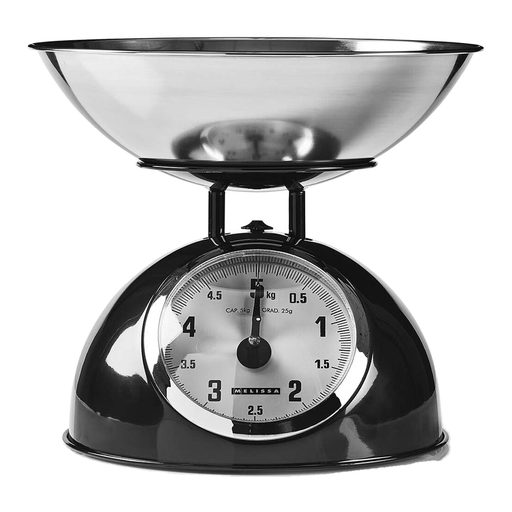
This product is a related option for weighing ingredients in a workshop, but it’s analogue, so it doesn’t meet the need for a digital kitchen scale.
 No image available
The removable bowl can be useful for weighing and transferring ingredients, but this analogue model isn’t a digital scale for anyone who needs a digital display.
The product name lists a maximum capacity of 5 kg and increments of 25 g. Bear this in mind if your recipe calls for smaller differences in weight.
Put the empty mixing bowl on the scale, use the tare function and add honey until the desired weight in grams appears. Don’t assume, without a reliable conversion, that a millilitre reading for another liquid will give the same result as weighing honey in grams.
Use clean materials between users and follow the instructions for the specific model. For the Tasty+ model tested, Brabantia recommends wiping the glass surface clean; don’t submerge an electronic scale unless the manufacturer explicitly says you can.
Not by itself: a finer display increment doesn’t prove how large measurement errors are or how consistent repeated readings will be. The Consumers’ Association assesses these aspects separately, so compare test results for the exact model if measurement accuracy is crucial.
A higher maximum capacity is useful when the bowl and all the ingredients together could be heavy. Compare that total weight with the specification for the exact model; extra capacity doesn’t, by itself, tell you how well the scale displays small quantities.