
Participants weighing recipe portions
If you weigh walnuts in grams, a clear grams display and a tare function are useful for keeping the bowl’s weight out of the reading.


Choose a digital kitchen scale that displays grams and has a tare function to zero the weight of the bowl. Check that the bowl and ingredients together are within the weighing capacity, that the display is easy to read, and that the cleaning instructions suit shared use. A 1 g graduation is a product specification, not proof of a particular level of accuracy; Consumentenbond assesses deviation and consistency separately.
If you weigh walnuts in grams, a clear grams display and a tare function are useful for keeping the bowl’s weight out of the reading.
When several people use the scale, cleaning instructions for both the scale and the bowl matter. If cake is offered to consumers, the NVWA also sets out requirements for providing allergen information about unpackaged food.
Check that the bowl and ingredients are within the weighing capacity, and that you can still see the display with the bowl on the scale.
Start with the grams display and tare function, then check the total weight, readability with your bowl, and cleaning instructions.
| What to consider | What should you check? | Who should pay extra attention? |
|---|---|---|
| Weighing walnuts according to the recipe | Check that the scale displays grams and note its stated graduation; this is not proof of its accuracy. | If I’m following a recipe in grams, I want to read the weight of the walnuts straight away. Around 36% of consumers say this is their main buying concern. |
| Zeroing the bowl and adding ingredients | Check that the scale has a tare function and that the bowl and ingredients together stay within the maximum capacity. | If you weigh ingredients one after another in the same bowl, you’ll want to exclude the bowl’s weight from the reading. Around 29% of consumers say this is their main buying concern. |
| Cleaning between users or preparations | Check the instructions for the bowl and scale separately. If cake is offered to consumers as unpackaged food, follow NVWA guidance on allergens and naming the specific type of nut. | In a shared workspace, I want to know how each part can be cleaned. Around 21% of consumers prioritise cleaning when a scale is shared. |
| Reading the weight with a mixing bowl in place | Compare the dimensions of the bowl and weighing surface, and check the position of the display. If the scale has a hold function, check how the reading is held. | When I’m using a large mixing bowl, I want to be able to keep seeing the weight as I weigh. Around 14% of consumers say readability with a large bowl is their main buying concern. |
A 1 g increment doesn’t, by itself, tell you how large the measurement deviation is or how consistent a model is. Consumentenbond assesses deviation and consistency as separate test criteria.
Use the stated graduation to narrow down your options, but don’t draw conclusions about measurement deviation based on that specification alone.
Even when tare sets the reading to zero, the bowl’s actual weight still counts towards the maximum capacity.
Compare the maximum capacity with the combined weight of the bowl and ingredients.
Cleaning instructions can vary by part and model. Beurer says the bowl of the KS 25 is dishwasher-safe; that doesn’t mean the electronic scale itself can go in the dishwasher.
Before buying, check the instructions for the bowl and scale separately, especially if several participants will be using the set-up.
The brand offers compact Page Compact models as well as larger Page Profi models.
The WS305 is a flat digital scale designed to be used with your own bowl.
The Optiss BC5000V2 is a flat scale designed for weighing ingredients in your own bowl.
The KS 25 has a removable bowl, while the KS 34 is a different model with a higher stated capacity.
The Tasty+ is a flat digital scale with a backlit display, designed for use with your own bowl.
These products are digital kitchen scales for weighing ingredients. Check each model’s tare function, weighing capacity, size and cleaning instructions.
 No image available
The size may suit anyone looking for a compact scale; check that the bowl and display work with your set-up.
Dimensions: 17 × 13 × 2 cm. Material according to the product name: stainless steel.
Before use, check that the tare function and weighing capacity meet the needs of your recipe and bowl.
 No image available
Worth considering if you’re looking for a digital kitchen scale with Bluetooth; check that the stated app integration suits the way you plan to use it.
The product name lists a 10 kg capacity, Bluetooth, app integration and a tempered glass surface.
Before buying, check which units and functions are available for your intended use.
 No image available
An option if you want to weigh walnuts in your own bowl; the product name lists a tare function.
The product name lists a 5 kg capacity, 1 g increments and a glass weighing surface.
The usage information states that this model is for domestic use only and excludes commercial or industrial weighing. The instructions recommend a soft, damp cloth and say not to immerse it in water; check that these conditions suit your workshop set-up.
 No image available
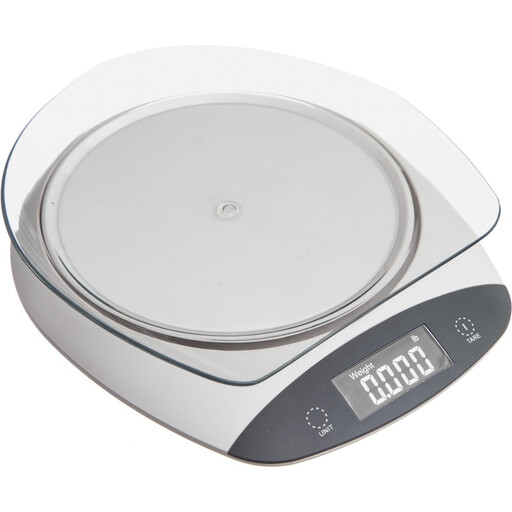
The included removable bowl may suit a shared workspace where participants would rather not all use their own bowls.
Dimensions according to the product name: 20.5 × 18 × 4.5 cm.
Two AAA batteries are required for use; these are not included.
Place the bowl on a flat, stable scale and use the tare function until the display reads zero. Then add the walnuts. Check that the bowl and its contents together are within the model’s maximum capacity.
It depends on the model and the part. Beurer says the removable bowl of the KS 25 is dishwasher-safe; for the WS305, Inventum recommends cleaning the scale with a slightly damp cloth and says not to immerse it in water.
For a consumer purchase in the Netherlands, you may have a legal guarantee in addition to any manufacturer’s warranty. According to ACM ConsuWijzer, the seller must offer a suitable solution free of charge if the product doesn’t perform as you could reasonably expect under normal use. There isn’t one fixed legal guarantee period for every product.
If a business in the Netherlands sells or offers cake to consumers as unpackaged food, it must provide information about any allergens present, according to the NVWA. For nuts, it must be clear which specific nut is used. Whether this also applies to a private workshop where no food is offered depends on the circumstances.