
Weighing small additions
You make small portions or weigh out small quantities separately; compare the stated increments with the space available for your container. Beurer lists 0.1 g increments for the KS 36.


For small additions, a scale with fine increments is worth considering. If you’re weighing chocolate in a regular mixing bowl, a flat model with a tare function and 1 g increments is often more practical. Beurer lists 0.1 g increments for the KS 36, but this is not a measure of its actual margin of error. Also check that your bowl fits and that the combined weight of the bowl and its contents stays within the maximum capacity.
You make small portions or weigh out small quantities separately; compare the stated increments with the space available for your container. Beurer lists 0.1 g increments for the KS 36.
You add chocolate to the same bowl and want to tare the scale easily between ingredients. Also check the weight of the bowl, whether you can see the display and the model’s maximum capacity.
You want to read the weight quickly, clean the surface and put the scale away. The Consumers’ Association considers readability, buttons and cleaning as separate aspects of usability in its test methodology.
Suitable if: you weigh small quantities separately and use a small container. Beurer lists 0.1 g increments, a weighing platform measuring 11.5 × 8.0 cm and a maximum capacity of 2 kg for the KS 36.
Bear in mind: the increments are not an independent measurement of the actual margin of error; check that your container fits on the weighing platform.
Suitable if: you mainly weigh larger quantities in one bowl and want to tare the scale between ingredients. Brabantia lists 1 g increments and a maximum capacity of 5 kg for the Tasty+; HEMA also lists a tare function and a maximum capacity of 5 kg for model 80880037.
Bear in mind: 1 g increments don’t show fractions of a gram; check that the bowl won’t obscure the display.
Suitable if: you use a larger or heavier bowl. Beurer lists a weighing platform measuring 26.3 × 20.0 cm and a maximum capacity of 15 kg for the KS 34 XL Black.
Bear in mind: the larger platform takes up more worktop space than the KS 36’s and doesn’t have 0.1 g increments.
Your priorities depend on what you want to weigh after your class: small additions, ingredients in one bowl, ease of cleaning or room for a larger batch.
| What to consider | What to look for when buying | Who is this important for? |
|---|---|---|
| Small quantities | Compare the increments with the weighing platform, your container and the maximum capacity. | If I’m weighing just a little chocolate or a small addition, I want suitable increments and room for my container. Around 33% of consumers say weighing small quantities is their top priority. |
| Weighing in one bowl | Check that the scale has a tare function and that the combined weight of the bowl and its contents stays within the maximum capacity. | If I’m adding ingredients to the same mixing bowl, I want to tare the scale between ingredients rather than having to subtract the bowl’s weight each time. Around 25% of consumers prioritise weighing everything in one bowl. |
| Reading the display and cleaning | Check that the display remains visible with your bowl on the scale and how the surface should be cleaned. | After class, I want to read the weight and tidy the worktop quickly. Around 25% of consumers say readability and cleaning are their top priorities. |
| Space and capacity | Compare the size of the weighing platform and the maximum capacity with your heaviest bowl and batch. | If I’m weighing a large bowl or batch, I want enough surface area and capacity without choosing a scale that’s too small. Around 17% of consumers prioritise space and capacity. |
The increments shown on the display and the actual margin of error are two different things. The Consumers’ Association tests accuracy and repeatability separately using weights.
Use the stated increments as a factor when choosing a scale for small quantities, but don’t take them as proof of independently measured accuracy.
The bowl contributes to the total weight and must also fit on the weighing platform. An unsuitable or heavy bowl may mean you need to weigh in stages or choose a different scale.
Before buying, check the dimensions of your bowl and, if necessary, weigh the bowl and ingredients together against the stated maximum capacity.
A stated manufacturer’s guarantee period is not the same as your statutory rights if a product is faulty. ACM ConsuWijzer explains that what you could reasonably expect from the product is taken into account.
Keep your proof of purchase and contact the seller if there’s a fault, even if the stated manufacturer’s guarantee period has expired.
The KS 36 is designed for small quantities, while the KS 34 XL Black has a larger weighing platform and a higher stated capacity.
The Tasty+ is an option for weighing ingredients to the nearest gram in a bowl, especially if you want a backlit display and a wipe-clean surface.
The digital kitchen scale with item number 80880037 is a straightforward option for weighing to the nearest gram with a tare function.
The AD 3161 has a small weighing platform; check the specifications for the exact version and intended use before buying.
These product picks cover weighing ingredients in a mixing bowl, measuring to the nearest gram and cleaning up after baking. They also include an analogue model with larger increments.
 No image available
An option if you weigh ingredients to the nearest gram in a bowl and want to wipe the surface clean after use.
The product specifications list 1 g increments, a maximum capacity of 5 kg, a tare function, an LCD display and a glass surface. Don’t immerse it in water or put it in the dishwasher; don’t place hot items directly on the glass.
 No image available
Worth comparing if you’re looking for a scale with 1 g increments and a higher stated capacity for weighing ingredients in a bowl.
The product name lists a capacity of 10 kg, 1 g increments, support for multiple units, a glass surface and app integration. The description says the surface can be cleaned with a soft, damp cloth; don’t immerse the scale in water.
 No image available
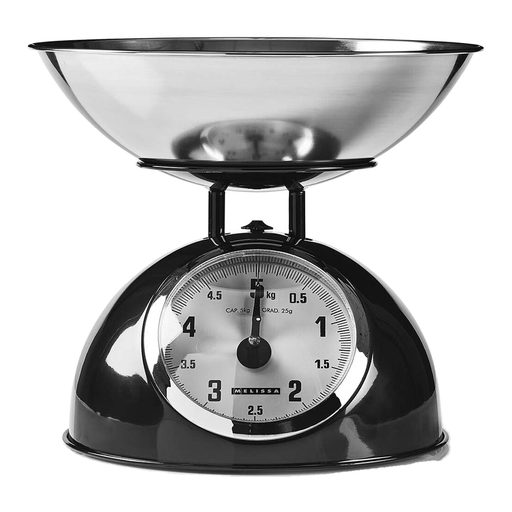
The included removable bowl may suit you if you want to weigh ingredients in the bowl, but the increments are larger than those of the digital options.
The product specifications list a maximum capacity of 5 kg, a tare function and 25 g increments. The product is intended for household use, not commercial weighing; the bowl can be removed for cleaning.
No. On the Beurer KS 36, 0.1 g is the stated increment shown on the display, not a measure of the actual margin of error. The Consumers’ Association tests accuracy and repeatability separately using weights, so don’t infer measured performance from the increments alone.
Place the scale on a flat, stable surface, put the bowl on it and use the tare function before adding chocolate. Keep the combined weight of the bowl and its contents below the stated maximum capacity, and check that the display remains visible.
Brabantia says that the glass surface of the Tasty+ can be wiped clean; this doesn’t mean the appliance can go under water or in the dishwasher. Follow the instructions for your chosen model. Beurer specifically states that the separate bowl supplied with the KS 25 is dishwasher-safe.
For a standard online purchase by a consumer, you’ll generally have a statutory 14-day cooling-off period from delivery; any exceptions still apply. Separately, the seller must offer an appropriate solution if a product is faulty. ACM ConsuWijzer explains that a manufacturer’s guarantee doesn’t replace your statutory rights.
For the private use described here, the Dutch Digital Infrastructure Inspectorate doesn’t specify a requirement to use a scale approved for trade. If you later use a scale to set the price when selling products, check the measurement rules that apply to that use separately.