What should you look for when choosing?
Precision scale with one platform
A good fit if: you mainly weigh small quantities of spices and want fine increments.
Keep in mind: Beurer specifies a maximum load of 2 kg and a weighing surface measuring 11.5 × 8.0 cm for the KS 36; check that your bowl will fit. The 0.1 g display is not an independent accuracy test.
Scale with two platforms
A good fit if: you want to weigh both small portions of spices and heavier bowls.
Keep in mind: Salter specifies a capacity of 200 g with 0.1 g increments for the small platform, and a maximum of 10 kg with 1 g increments for the large platform. Be aware of each platform’s own limit and increments.
Scale for both small and larger quantities
A good fit if: you want to weigh spices and other recipe ingredients on one platform.
Keep in mind: Tanita specifies a capacity of 3 kg and a claim of up to 0.1 g for the KD-321. Check which increments apply at the weight you’ll be using; the claim does not mean the entire range is displayed in 0.1 g increments.
Standard digital kitchen scale
A good fit if: you mainly weigh larger ingredients and don’t need to read fractions of a gram individually.
Keep in mind: Brabantia specifies 1 g increments and a range of up to 5 kg for the Profile. With 1 g increments, you can’t read fractions of a gram individually.
For curry, the increments for a small portion of spices are one consideration; space for a bowl and larger ingredients is another. The Consumentenbond tests kitchen scales with weights from 1 g to 1 kg inclusive and repeats measurements. Product specifications alone therefore don’t tell you how a model performs across repeated measurements.
| What to consider |
What should you check? |
Who is this important for? |
| Reading small quantities |
Compare the increments at the weight you’ll actually be using. Beurer specifies a 0.1 g display for the KS 36; Salter lists 0.1 g increments up to 200 g for the small platform. |
When I weigh small portions of spices, I want to know how much detail the scale shows at that low weight. Around 36% of consumers prioritise fine increments. |
| Room for the bowl and ingredients |
Include the weight of the empty bowl and check the capacity of the platform you’re using. Salter specifies platforms with maximum capacities of 200 g and 10 kg; Brabantia lists a range of up to 5 kg. |
When I weigh a bowl of larger quantities for guests, I don’t want to reach the maximum load. Around 29% of consumers prioritise sufficient capacity. |
| Weighing ingredients one after another |
Check whether the scale has a tare function and whether you can still read the display with a bowl on it. The Consumentenbond also highlights button placement and automatic switch-off as things to consider. |
When I add several ingredients one after another, I want to keep weighing without having to start again each time. Around 21% of consumers prioritise weighing ingredients in succession with ease. |
| Cleaning and storage |
Check the dimensions, whether the platform is removable and which cleaning instructions apply. Tanita specifies a removable platform; Beurer lists dimensions of 9.60 × 19.00 × 2.00 cm for the KS 36. |
When I want to tidy away and clean up after weighing, I look for a size and surface that suit my kitchen. Around 14% of consumers prioritise easy, compact maintenance. |
Brands to compare
These brands offer examples of different weighing ranges and platform layouts. The features mentioned apply to the models described and don’t represent an overall ranking of the brands.
Beurer
Beurer describes the KS 36 as a precision kitchen scale for herbs, spices and powders.
- The KS 36 features tare and a calibration function, a 0.1 g display and a maximum load of 2 kg.
- The weighing surface measures 11.5 × 8.0 cm. The display specification is not independent proof of accuracy.
Tanita
Tanita describes the KD-321 as a single-platform scale for ingredients and liquids.
- Tanita specifies a maximum capacity of 3 kg, tare and a removable stainless steel platform.
- The manufacturer claims accuracy of up to 0.1 g, but doesn’t specify that the increments remain the same across the entire range.
Salter
Salter’s Heston Blumenthal Precision Dual Platform Scale has separate platforms for small and larger quantities.
- Salter specifies 0.1 g increments up to 200 g on the small platform, and 1 g increments up to 10 kg on the large platform.
- The capacity and increments differ between platforms, so check which one suits your bowl and its contents.
Brabantia
The Profile with timer is a digital kitchen scale for larger quantities, which you can read in whole grams.
- Brabantia specifies 1 g increments, a range of up to 5 kg, zeroing, a backlit display and a timer.
- With 1 g increments, you can’t read fractions of a gram individually.
Kitchen scales at Joybuy
This selection includes kitchen scales and a coffee scale for weighing spices and other ingredients. For each model, check whether the increments and capacity suit your portions and the weight of your bowl.
 No image available
5five Digital Kitchen Scale, Stainless Steel, 17 × 13 × 2 cm
An option to consider if you’re looking for a digital kitchen scale for weighing ingredients.
The product name specifies stainless steel and dimensions of 17 × 13 × 2 cm.
Joybuy
 No image available
TIMEMORE Black Mirror Basic 2 Pour-Over Coffee Scale, 0.1 g, 2000 g
Worth considering if you’d also like to use a coffee scale for other kitchen tasks.
The product name specifies 0.1 g, a capacity of 2000 g and an automatic timer. The displayed increment is not independent proof of measurement accuracy.
Joybuy
 No image available
Unique Bluetooth Kitchen Scale, 10 kg, 1 g
This scale is better suited to larger ingredients and readings in whole grams than to fractions of a gram.
The product name specifies a capacity of 10 kg, 1 g increments, Bluetooth, a glass surface and app integration.
Joybuy
 No image available
Unique Smart Nutrition Food Scale, 5 kg
An option if you’re looking for a food scale; check which features are useful for the way you cook.
The product name specifies a capacity of 5 kg, nutritional information display and app synchronisation.
Joybuy
 No image available
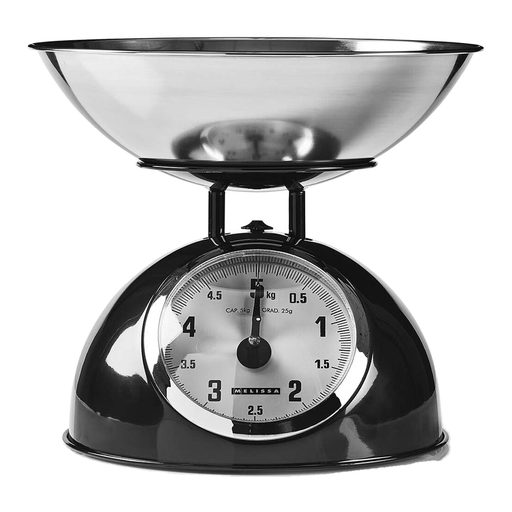
MELISSA Retro Analog Kitchen Scale, 5 kg, 25 g increments
This is an analogue kitchen scale, not a digital one; its coarse increments make it less suitable if you want to weigh small portions of spices with precision.
The product name specifies a capacity of 5 kg and 25 g increments.
Joybuy
Frequently asked questions
Does a 0.1 g display mean every measurement is accurate to 0.1 g?
No. The increments describe how finely the weight is displayed; accuracy and repeatability need to be assessed through measurement results. The Consumentenbond assesses these qualities using weights and repeated measurements.
How do you use tare when weighing different spices?
Place a suitable dish on the platform and set the display to zero before adding the spice. When you add another ingredient, check whether you can reset the scale to zero again, and keep the combined weight of the dish and its contents within the maximum load. Beurer, Tanita and Salter specify a tare or zeroing function.
What should you do if the scale stops working too soon under normal use?
Contact the seller. According to ACM ConsuWijzer, in addition to any manufacturer’s warranty, you have a legal guarantee if the product doesn’t perform as you could reasonably expect under normal use. The appropriate solution depends on the circumstances; in the Netherlands, there is no fixed statutory guarantee period that applies to every product.
Does a kitchen scale need to be trade-approved for a private dinner party?
The Dutch government describes the requirement to use approved measuring instruments in the context of businesses and fair trade. This information doesn’t mean you need to use a trade-approved scale when making curry at home for guests. A calibration function on a consumer model is not the same as trade approval.
What should you look for if spices come into direct contact with the weighing surface?
Check whether the surface is intended for direct contact with food, and follow the cleaning instructions. The Netherlands Food and Consumer Product Safety Authority describes rules for products intended to come into contact with food. Weighing ingredients in a suitable dish using tare prevents direct contact with the weighing surface; product specifications don’t automatically confirm that every model is suitable.


