What should you look for in kitchen scales?
First measure the available storage space, then compare the display position and tare function with the bowl you use. This helps you assess not only whether the scale will fit, but also whether it will be comfortable to use.
| What to consider |
What should you check? |
Who is this important for? |
| Storage when cupboard space is limited |
Measure the available length, width and height. Inventum lists the WS305B as measuring 1,6 × 13,5 × 20 cm; Beurer lists the KS 19 Black as 14,5 × 20 × 1,65 cm. Brabantia lists a hanging loop for the battery-powered Tasty+. |
If every centimetre of cupboard or drawer space counts, first check whether the whole scale will fit. Around 36% of this group prioritise storage space. |
| Weighing dry portions |
Check whether the model displays grams and has a tare function, and whether the combined weight of the container and its contents is within the maximum capacity. |
If you weigh dry grains for each lunch, you won’t want the container included in the portion weight. Around 29% of this group say portion size is their main consideration. |
| Reading the display with a bowl on the scale |
Check whether the bowl blocks the display or controls, and whether backlighting would be useful where you work. Beurer lists the KS 19 Black as having no backlighting; Brabantia lists a backlit LCD for the battery-powered Tasty+. |
If you often check the display while filling the bowl, you’ll want the figures to be easy to read and the tare function easy to reach. Around 21% of this group prioritise ease of use and readability. |
| Batteries and aftercare |
Check which battery type is included and read the instructions and warranty terms for the exact model. Inventum lists a CR2032 for the WS305B; Brabantia lists 3 AAA batteries for the battery-powered Tasty+. |
If batteries, maintenance and aftercare are also part of your decision, compare the details for the exact model. Around 14% of this group consider these their main priorities. |
Scales at Joybuy
Scales to compare for weighing grains for lunch when cupboard space is limited. Along with the dimensions, consider the display increment, capacity and space taken up by your bowl.
 No image available
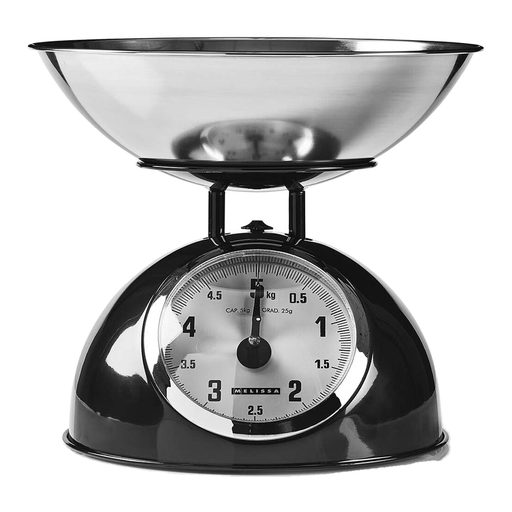
MELISSA Retro analogue kitchen scales, black
The product name mentions a removable bowl; check that an analogue display suits the way you want to weigh portions.
Metal housing; maximum capacity 5 kg; 25 g increments; dimensions 220 × 180 × 30 mm.
View at Joybuy
 No image available
MELISSA digital kitchen scales in white tempered glass
The listed tare function is useful if you use your own container; check that the 17 mm profile will fit in your storage space.
Maximum capacity 5 kg; 1 g increments; LCD; tare function; displays grams, ounces, pounds and millilitres.
View at Joybuy
 No image available
Digital kitchen scales with LED display and timer
Compare the stated dimensions with your available storage space. When using the scale, remember to account for the weight of both the bowl and its contents.
Dimensions 14,8 × 12,8 × 2 cm; tare function; 0,1 g increments; maximum capacity 3 kg.
View at Joybuy
 No image available
Digital coffee scales with timer and tare function
The product name mentions a tare function and a rechargeable design. Check that the size and capacity suit your bowl and portions.
0,1 g increments; maximum capacity 3 kg; timer; heat-resistant platform.
View at Joybuy
 No image available
5five digital stainless steel kitchen scales
Compare the stated dimensions with the cupboard or drawer space you have available. The tare function lets you weigh ingredients in your own container.
Dimensions 17 × 13 × 2 cm; LCD; tare function; maximum capacity 5 kg; displays grams.
View at Joybuy
Frequently asked questions
Should I weigh rice and couscous before or after cooking?
It depends on the amount you want to plan for. If you want to work out how much dry grain to cook, weigh it uncooked and compare it with guidance for uncooked quantities. The Netherlands Nutrition Centre says that rice weighs about 2,6 times as much after cooking, so don’t treat cooked and uncooked grams as if they mean the same thing.
How do I use the tare function with a lunch container?
Place the empty container on the scales and use the tare function to reset the display to zero before adding the dry grains. Inventum describes this method for the WS305B; for another model, check the instructions and keep the total weight within the stated capacity.
Does a 1 g scale increment mean the measurement can be out by no more than 1 g?
No. A 1 g increment describes the displayed step size; it doesn’t automatically indicate the measurement error. The Consumers’ Association (Consumentenbond) treats accuracy and repeatability as separate test criteria, so don’t infer a measured error from the product specification alone.
What should I check about batteries, the warranty and buying online?
Check the battery and warranty terms for the exact model. Inventum lists a CR2032 and a 5-year manufacturer’s warranty for the WS305B; Brabantia lists 3 AAA batteries and a 5-year warranty for the battery-powered Tasty+. According to the Dutch Government, purchases made at a distance usually come with a 14-day cooling-off period; check which information applies to your purchase.
What should I do with a worn-out scale or a flat battery in the Netherlands?
According to the Dutch Government, you can dispose of an unwanted electrical household appliance at a collection point or, as a private consumer buying a similar new appliance, through the take-back scheme. Flat batteries should not go in the bin and can be returned to shops that sell batteries, among other places.


