
For weighing small quantities of seeds
Check the scale increments at low weights, not just the maximum capacity. Beurer lists different increments for different weight ranges for the KS 36.


If you mainly weigh small quantities of each type of seed, check the scale increments around the weights you use. For a large batch, the combined weight of the bowl and ingredients, and the space on the weighing platform, are important. A tare function helps when adding ingredients, but a fine display increment alone doesn’t prove that a scale measures accurately.
Check the scale increments at low weights, not just the maximum capacity. Beurer lists different increments for different weight ranges for the KS 36.
If you want to put the bowl of ingredients on the scale, check the total weight, the size of the weighing platform and how easy the display is to read.
Look for a tare function that lets you zero the bowl and weigh additional ingredients in the same bowl.
Start with the smallest quantity of seeds you want to weigh. Then check that the bowl and all its contents will stay within the scale’s maximum capacity.
| What to consider | What to look for | Who should pay particular attention? |
|---|---|---|
| Small quantities of seeds | Compare the listed increments at the weight of your smallest portion. Also check whether independent test results are available. | I weigh small quantities of different types of seeds and want to read the measurements clearly; around 36% of consumers say small portions are their main consideration. |
| Bowl and large batch | Add the weight of the bowl and ingredients together, then compare the total with the maximum capacity. Also check that the bowl fits on the platform. | When I make a large batch of cracker dough, I want to be able to leave the bowl on the scale; around 29% of consumers focus mainly on the combined weight of the bowl and its contents. |
| Adding ingredients one at a time | Check that the model you choose has a tare function and that the display remains easy to see with your bowl in place. | I add several ingredients to the same bowl and want to reset the scale between additions; around 21% of consumers consider this their main priority. |
| Reading, cleaning and storage | Check the position and backlighting of the display, the cleaning instructions and the storage options for the exact model. | I want to read the weight easily while using the scale, then clean and store it without hassle; around 14% of consumers prioritise this above all else. |
The scale increments and the actual measurement error are two different things. Beurer lists different increments for the KS 36 depending on the weight; the Consumentenbond treats measurement error and repeatability as separate test criteria.
Check the increments for the weight range you’ll be using, and look for independent test results too. Don’t choose a scale based only on the number of decimal places.
Even when the tare function resets the display to zero, the bowl’s weight still counts towards the maximum load. Also check that the bowl fits on the platform.
Weigh or estimate the weight of the empty bowl, then add the weight of the ingredients you expect to use. If the total exceeds the maximum capacity, you may need a different bowl or scale.
If the bowl doesn’t fit or is too heavy, you may have to weigh the ingredients in smaller batches.
The Beurer DS61 listed on Joybuy is not the Beurer KS 36. Models from the same brand can differ in their features and specifications.
Before you buy, check the full model name and compare the features that matter for the way you’ll use the scale.
The models reviewed cater to different weighing needs: the KS 36 has finer increments at low weights, while the KS 34 XL Black has a higher stated maximum capacity.
The Optiss BC50U0 is designed for weighing ingredients in a bowl and adding them one at a time.
The digital kitchen scale reviewed is a straightforward option for recipes where whole-gram increments are suitable.
The battery-powered Tasty+ model reviewed has display and storage features that could come in handy in the kitchen.
Joybuy products for weighing small quantities of seeds and ingredients in a bowl.
 Image unavailable
Increments matter when weighing small portions; the product name mentions a dual LED display, a four-point sensor and a timer.
 Image unavailable
The listed tare function and maximum capacity of 3 kg make this model worth considering if you want to weigh ingredients one at a time in a bowl.
The product name lists 0,1 g; a fine scale increment alone doesn’t prove measuring accuracy. A timer and heat-resistant platform are also mentioned.
 Image unavailable
The stated dimensions of 17 × 13 × 2 cm can help you decide whether the scale will fit with your bowl and in your storage space.
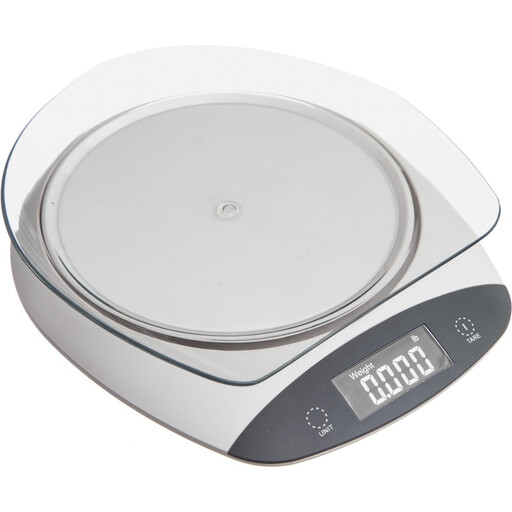 Image unavailable
The removable bowl is useful if you prefer to weigh ingredients in the bowl supplied; check that its size suits the quantity you’re making.
The product name lists dimensions of 20,5 × 18 × 4,5 cm.
 Image unavailable
The stated maximum capacity of 10 kg could be useful for a heavy bowl of ingredients; for small quantities of seeds, the scale increment is an important limitation to bear in mind.
The product information lists increments of 1 g and a minimum weighing weight of 3 g. The product name mentions Bluetooth and app integration.
No. Beurer lists different increments for the KS 36 depending on the weight range. The Consumentenbond treats measurement error and repeatability as separate test criteria, so don’t assume a guaranteed measurement error based only on the displayed increment.
Put the empty bowl on the scale and use the tare function before adding the first ingredient. If necessary, reset the scale to zero before adding the next ingredient, and check that the bowl and its contents stay within your model’s maximum capacity.
Check the battery type for the exact model: the HEMA scale reviewed uses a CR2032, while the battery-powered Brabantia Tasty+ takes three AAA batteries. If you’re buying in the Netherlands, ACM ConsuWijzer explains that statutory guarantees don’t have a fixed general term of two years.
That depends on how the crackers are offered. The NVWA outlines rules for preparing, selling and storing food safely when it’s sold at a market or event, including by a private seller. For unpackaged products offered for sale, the NVWA explains the requirements for allergen information; first check whether those circumstances apply to your event.