What should you look for when buying?
Start with the bowl you actually use: check that the bowl and rice together stay within the maximum capacity and that the bowl sits securely on the platform. Then consider portion sizes, how easy the display is to see and how much space the scales take up.
| What to consider |
What to look for |
Who should consider this most? |
| Capacity and space for a large bowl |
Add the weight of the bowl and rice together, then compare the total with the maximum capacity. Also check that the base of the bowl fits on the platform. |
If you weigh rice for several guests in one large bowl, you’ll want it to sit securely and the total weight to stay within the limit. Around 36% of consumers put capacity and space for the bowl first. |
| Getting the right amount of rice |
Look for a tare function and a display that shows grams. Zero the empty bowl, then weigh the rice uncooked. |
If you’re planning portions for guests, you’ll want to measure the amount of uncooked rice each time. Around 29% of consumers give portion planning top priority. |
| Being able to read the display |
Check whether your bowl obscures the display. A hold function can be useful if the model you choose has one. |
If a wide bowl blocks the screen, you’ll want to be able to read the weight clearly. Around 21% of consumers put readability first. |
| Cleaning and storage |
Compare the dimensions with your storage space and check the cleaning instructions. Also check which parts can be removed. |
If you have limited cupboard space or want to tidy up quickly after cooking, a suitable size and clear cleaning instructions are important. Around 14% of consumers give cleaning and storage top priority. |
The manufacturers listed give different capacities and platform dimensions. For example, according to the manufacturer, the Soehnle Page Compact 300 has a capacity of 5 kg and a platform measuring 20 × 15 cm; the Page Profi 300 is listed as having a capacity of 20 kg and a platform measuring 27 × 20 cm. These are product specifications, not independent measurements of accuracy.
Joybuy products for weighing rice
These digital kitchen scales are designed for weighing portions of rice. The selection includes compact models and one with a higher stated capacity. When choosing, check that the capacity is suitable for the bowl and its contents together.
 No image available
MELISSA digital kitchen scales, white
The tare function is handy when weighing rice in your own bowl.
Maximum capacity: 5 kg. Tare function and 1 g increments. The product also lists an LCD display and readings in grams, ounces, pounds and millilitres.
View at Joybuy
 No image available
5five digital kitchen scales, stainless steel
The compact size could suit a home with limited storage space.
Dimensions: 17 × 13 × 2 cm. The product information lists an LCD screen with large numbers, a tare function and a maximum capacity of 5 kg.
View at Joybuy
 No image available
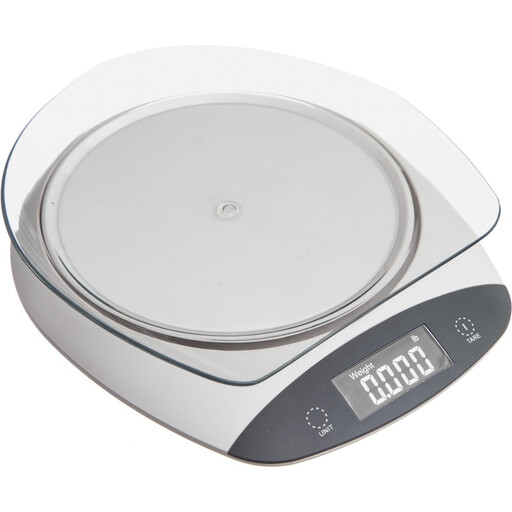
5five digital kitchen scales with removable bowl, white
The removable bowl supplied with the scales is a handy option if you’d rather not weigh rice in your own bowl.
The product information lists a maximum capacity of 5 kg, a tare function, 1 g increments and dimensions of 20.5 × 18 × 4.5 cm.
View at Joybuy
 No image available
Unique Bluetooth kitchen scales, 10 kg
The stated capacity may leave room for a larger bowl, as long as the bowl and its contents stay within the limit.
The product information lists a capacity of 10 kg, 1 g graduations, an LED display and Bluetooth. Dimensions: 200 × 140 × 19.5 mm.
View at Joybuy
 No image available
Unique Smart Nutrition Food Scale, 5 kg
The larger display may be useful if you want to see the reading clearly while weighing.
The product information lists a capacity of 5 kg, 1 g graduations and a 4.54-inch colour screen. The product name also mentions nutritional information and app synchronisation; check that these features suit the way you plan to use it.
View at Joybuy
Frequently asked questions
Should I weigh rice for my guests dry or cooked?
Weigh uncooked rice if you’re working out how much to cook in advance. The Netherlands Nutrition Centre gives 75 g of uncooked rice as an example of an amount that makes about 200 g of cooked rice; the portion you need depends on your meal and your guests. First, use the tare function to zero the empty bowl.
Can I put the bowl from my kitchen scales in the dishwasher?
It depends on the model and the part in question. Beurer only says that the removable bowl of the KS 25 is dishwasher-safe; don’t assume this applies to the electronic base or other models. Follow the cleaning instructions for the model you choose.
What should I do if my scales develop a fault during normal use?
According to the Government of the Netherlands, the seller is your point of contact if a product is faulty, and there is no fixed statutory warranty period in the Netherlands. A manufacturer’s guarantee is in addition to your statutory rights.
Do kitchen scales for home use need to be legally verified?
The requirements set out by the Dutch Authority for Digital Infrastructure apply to certain uses, such as weighing goods to determine a selling price. That’s different from weighing rice at home. A display that measures in 1 g increments is therefore not the same as legal verification for trade use. According to the European Commission, CE marking is only mandatory when applicable harmonised EU rules require it; CE marking on its own is not proof of independently measured accuracy.
How should I store leftover cooked rice?
The Netherlands Nutrition Centre advises cooling cooked rice quickly, storing it in a sealed container and not leaving it out of the fridge for more than two hours. It says cooked rice keeps in the fridge for two days.


