
Cook with a large serving bowl
You want to tare the bowl and weigh a larger quantity without exceeding the maximum capacity or losing sight of the display.


For dry polenta, a digital kitchen scale with a tare function and a grams setting is practical. Make sure the bowl and its contents together stay within the maximum capacity. A compact model may be fine with an ordinary bowl, while a heavy or wide serving bowl calls for extra attention to capacity and how clearly you can see the display. A rechargeable battery is mainly worth considering if you’d also find it convenient for other uses; a 1 g increment alone is no proof of weighing accuracy.
You want to tare the bowl and weigh a larger quantity without exceeding the maximum capacity or losing sight of the display.
You want to weigh dry polenta in grams according to a recipe, without extra features you don’t need for the task.
As well as weighing, you consider cleaning and storage, and whether to choose replaceable batteries or a rechargeable model.
A good fit if: you weigh dry polenta in an ordinary bowl and want to keep storage space to a minimum. Beurer lists a tare function and a maximum capacity of 5 kg for the KS 19 Black.
Bear in mind: the weighing platform measures 20,0 × 14,5 cm and, according to Beurer, the display is not backlit. Check that your bowl won’t cover the screen.
A good fit if: you use a heavy bowl or want to weigh several ingredients one after another. Beurer lists a maximum capacity of 15 kg and a platform measuring 26,3 × 20,0 cm for the KS 34 XL Black.
Bear in mind: a higher maximum capacity doesn’t mean small quantities will be weighed more accurately. Choose dimensions that suit your bowl and workspace.
A good fit if: you use the scale regularly and would rather recharge a built-in battery. ZWILLING lists an integrated Li-ion battery, rechargeable via USB, for the Enfinigy 53011-051-0.
Bear in mind: you’ll need to remember to charge it before use. A built-in battery isn’t essential if you’re only weighing polenta.
| What to consider | What should you check? | Who is this important to? |
|---|---|---|
| Bowl and quantity | Include the weight of the bowl and ingredients; also check the platform and make sure the bowl doesn’t block the screen. | If I use a heavy serving bowl, I want to know that the bowl and its contents together stay within the limit and that the figures remain visible. This combination is a priority for around 38% of consumers. |
| Weighing in grams | Check for a grams setting and a tare function. A 1 g increment isn’t the same as independently verified weighing accuracy; the Consumentenbond assesses deviation and consistency separately. | For a recipe that gives the amount of polenta in grams, I want to be able to zero the bowl and read the ingredients directly. Around 37% of consumers give straightforward weighing in grams the highest priority. |
| Readability and cleaning | Check the screen position, whether it’s backlit and the cleaning instructions for the exact model. | While cooking, I want to be able to see the figures even with a large bowl on the scale, then clean the platform easily afterwards. Readability and maintenance matter most to around 13% of consumers. |
| Power and regular use | Check whether the model uses standard batteries or a rechargeable battery, and whether any batteries are included. | If I use the scale often, I want to know whether I’ll need to replace the batteries or recharge it. For around 12% of consumers, this is their main buying concern. |
The bowl also counts towards the total load. A wide bowl may cover the display, too.
Compare the weight of your empty bowl plus the ingredients with the stated maximum capacity. Check that the bowl fits on the platform without hiding the figures.
A manufacturer’s specification in 1 g increments doesn’t, by itself, tell you how much a measurement may deviate or how consistent it is. The Consumentenbond explains that deviation and consistency are assessed separately using test weights.
Consider the gram increment and independent information about weighing accuracy as two separate points when choosing.
If a recipe gives the amount of dry polenta in grams, the relevant requirement is a suitable grams setting with a tare function. A liquid function is intended for a different way of measuring.
Choose extra liquid functions only if you’ll also use them for other recipes.
The KS 19 Black and KS 34 XL Black are two models to compare if you’re looking for a more compact scale or, instead, higher capacity and a larger platform.
The Tasty+ Dark Grey is a battery-powered model with a backlit display and a platform that, according to Brabantia, can be removed.
The Enfinigy 53011-051-0 is a model with a built-in battery that can be recharged via USB.
The Aquatronic range is worth considering if you want to measure liquids as well as dry ingredients, or weigh several ingredients one after another.
These Joybuy products are suited to weighing ingredients, from compact models for use with a bowl to scales with extra features or higher capacity.
 Image unavailable
A compact model for weighing ingredients in a bowl; the product information lists a tare function.
Maximum capacity: 5 kg. Readings in 1 g increments. Units: grams, ounces, pounds and millilitres.
According to the product information, the glass scale is not dishwasher-safe and must not be submerged.
 Image unavailable
According to its product name, this model is designed for espresso and pour-over coffee. Choose it for polenta only if you also want to use its advertised coffee features.
The product name lists a timer, water flow and coffee-to-water ratio functions, and switching between ounces and kg.
 Image unavailable
A model with a tare function for weighing ingredients in a bowl.
Maximum capacity: 5 kg. Dimensions: 17 × 13 × 2 cm. The product information lists a reading in grams.
Batteries are not included.
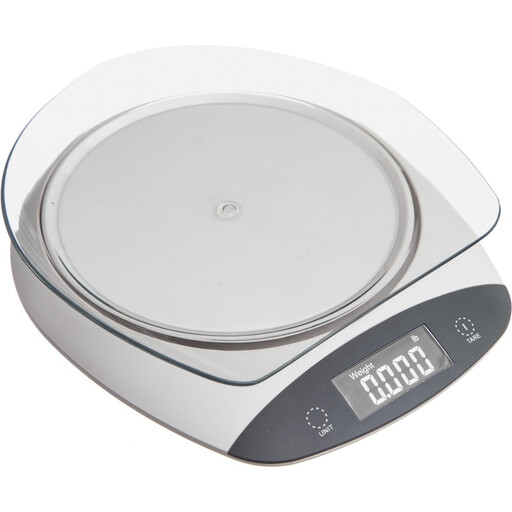 Image unavailable
The removable bowl may be handy if you prefer to weigh ingredients directly in the bowl supplied.
Maximum capacity: 5000 g. Dimensions: 20,5 × 18 × 4,5 cm. The product information lists a tare function.
The required 2 AAA batteries are not included.
 Image unavailable
The stated capacity may be useful if you want to weigh a heavier bowl as well as ingredients; check that the platform is large enough for your bowl.
Maximum capacity: 10 kg. The product name lists 1 g increments, multiple units, Bluetooth and app integration.
According to the product information, clean the glass surface with a soft, damp cloth; do not submerge the scale.
Place an empty bowl on the scale, use the tare function and add polenta until you reach the amount in the recipe. As an example, a recipe from Voedingscentrum uses 120 g of polenta for two people; if you double that exact recipe, use 240 g for four people. Keep the other recipe proportions the same, too.
Don’t assume that it can. For the Tasty+ discussed here, Brabantia recommends wiping the glass surface. Check the cleaning instructions for the exact model before getting it wet.
Check who the seller was when you bought it and who handles returns. According to the Rijksoverheid, online shops and platforms must provide consumers with this information. A manufacturer’s guarantee, such as the five years Brabantia offers for the Tasty+ discussed here, is a separate product promise.
No. It wouldn’t be appropriate to make a general claim about every model: according to the Rijksoverheid, CE marking is compulsory only for product groups covered by the relevant rules. The manufacturer or importer must establish whether this applies to the specific product. CE marking alone says nothing about weighing accuracy.
Milieu Centraal recommends putting used removable batteries in a battery recycling bin separately, and taking small unwanted electrical appliances to an electrical recycling point. According to Milieu Centraal, when you buy a new, similar appliance, you can also hand in an old one free of charge.