
Cooking with your own bowl
You want to weigh dry polenta without including the weight of the bowl. Look for a tare function and a display that stays easy to read with your bowl on the platform.


If you want to weigh polenta in your own bowl, scales with a tare function, a stable platform and an easy-to-read display are a practical choice. Then compare how each model is cleaned and stored, and decide whether you prefer batteries or a hand-operated dynamo. A 1 g increment on its own does not prove that scales will weigh with the same accuracy or consistency; the Consumers' Association has reported differences between models.
You want to weigh dry polenta without including the weight of the bowl. Look for a tare function and a display that stays easy to read with your bowl on the platform.
You want to be able to clean and store the scales easily after use. Check which parts are removable or dishwasher-safe.
You’re looking for a flat model that fits in a drawer or can be hung up. Also check that your usual bowl sits steadily on the platform.
| What to consider | What should you check? | Who is this important for? |
|---|---|---|
| Weighing in a bowl | Check whether the scales have a tare function, whether your bowl sits steadily and whether the display remains visible. | If I’m weighing polenta in my own bowl, I want to exclude the bowl’s weight and see the reading. Around 36% of consumers give weighing with a bowl and using tare their highest priority. |
| Cleaning | Check the cleaning instructions for the exact model, and distinguish between a removable bowl and the electronic base. | After other people have used the scales, I want to be able to clean the contact surface easily. Cleaning is the top buying priority for around 29% of consumers. |
| Storage and readability | Compare the platform dimensions and any hanging option with your bowl and the space available. | With limited worktop space, I want to be able to put the scales away without my bowl obscuring the display. Around 21% of consumers put storage and readability first. |
| Power | Check the battery type and whether batteries are included. For a dynamo model, consider whether you’re happy with how it works. | If I don’t want to keep track of spare batteries, I weigh up that convenience against the extra step of turning a dynamo. Power is the top buying priority for around 14% of consumers. |
A display showing 1 g increments doesn’t, on its own, tell you how accurately or consistently a model weighs. The Consumers' Association has reported differences between kitchen scales.
Use the stated increments as one factor when choosing, but don’t take them as a guaranteed margin of error.
These are different versions with different power sources. Brabantia gives the dynamo model a minimum weighing limit of 5 g.
Check which version you’re buying and decide whether you’d rather replace batteries or turn a knob before weighing.
Beurer describes the removable bowl of the KS 25 as dishwasher-safe; this does not automatically apply to the electronic base.
Follow the cleaning instructions for both the bowl and the appliance.
The Page Compact 300 is worth comparing if you use your own bowl and have limited storage space.
The Tasty+ is available as a battery-powered model and a hand-dynamo model; compare the versions separately.
The KS 25 is worth considering if a supplied, removable bowl would be useful in a shared kitchen.
HEMA’s digital kitchen scales are an option to compare if you want to weigh ingredients in grams.
This Joybuy selection includes digital scales with a tare function for use with your own bowl, as well as an analogue model with a separate bowl. Compare the controls, readability and cleaning requirements of each model. An analogue scale is only suitable if a digital display isn’t essential for you.
 No image available
The tare function makes these scales suitable for weighing ingredients in your own bowl.
Glass platform and LCD display; maximum capacity 5 kg; 1 g increments; units: g, oz, lb and ml.
 No image available
The tare function makes these scales suitable for weighing polenta in your own bowl.
Glass platform and LCD display; maximum capacity 5 kg; 1 g increments; units: g, oz, lb and ml. Not dishwasher-safe; the instructions recommend cleaning with a soft, damp cloth.
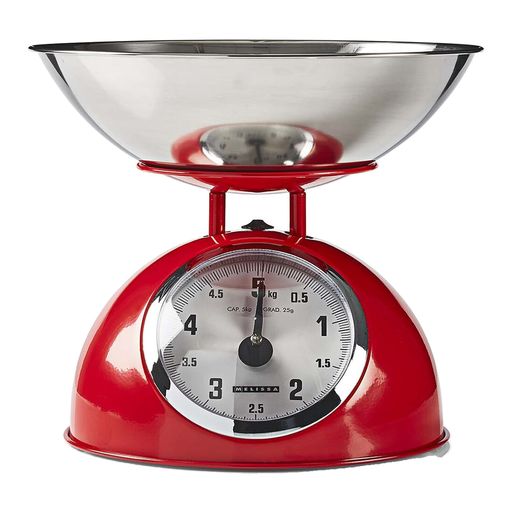 No image available
The removable bowl may be handy if you want to be able to wash it separately; choose this model only if an analogue display suits you.
Metal housing; removable bowl; maximum capacity 5 kg; 25 g increments.
 No image available
The tare function may be useful when weighing polenta in a bowl; check that the capacity is suitable for the bowl and contents combined.
Maximum capacity 3 kg; dual LED display and timer.
 No image available
The tare function and rechargeable design may appeal if you’re looking for scales that don’t need disposable batteries.
Maximum capacity 3 kg; timer and heat-resistant platform. The product name specifies 0.1 g increments.
Place the empty bowl steadily on the scales and use the tare function to reset the reading to zero. Then add the dry polenta. Check that the bowl doesn’t obscure the display and that the bowl and its contents together stay within the maximum capacity.
Don’t assume that the electronic appliance can go in the dishwasher. Beurer says the removable bowl of the KS 25 is dishwasher-safe; Brabantia describes the glass surface of the battery-powered Tasty+ as wipe-clean. Follow the instructions for the specific version you have.
According to ACM ConsuWijzer, you have a legal guarantee in addition to any manufacturer’s guarantee. If a product doesn’t meet the standard you could reasonably expect during normal use, the seller is responsible for providing an appropriate solution at no extra cost. What’s appropriate depends on the product and the circumstances.
The Dutch Authority for Digital Infrastructure describes mandatory requirements for certain uses, including commercial transactions and setting a selling price. Weighing polenta for your own dinner isn’t one of the commercial uses described. Check the requirements separately if you later use the scales to sell products by weight.
According to the Dutch Government, used batteries must not go in the bin and can be taken to collection points, among other places. You can take a discarded electrical household appliance to the retailer when buying a similar new one, or take it to your local council’s recycling centre.
If in doubt, use a suitable, clean bowl. The Netherlands Food and Consumer Product Safety Authority sets requirements for items intended to come into contact with food. A wipe-clean surface alone doesn’t prove that a specific model is intended for direct contact with food.