
Home baker weighing extra ingredients
You want to weigh sultanas and other ingredients for one fruit loaf in the same bowl. Look for a tare function, a gram display and a reading that’s easy to follow.


For weighing sultanas and other ingredients one after another in the same bowl, digital scales with a tare function and a gram display are a practical starting point. If you’re using a heavy bowl or scaling up a recipe, compare the combined weight of the bowl and its contents with the maximum capacity. A display that shows 1 g increments doesn’t prove that the scales measure to within 1 g at every weight, as the Consumentenbond’s test information also makes clear.
You want to weigh sultanas and other ingredients for one fruit loaf in the same bowl. Look for a tare function, a gram display and a reading that’s easy to follow.
You’re using a heavy bowl or making more batter for guests. Check the capacity for the bowl and its contents, and make sure you can still see the display clearly with your bowl in place.
You’re working with a full bowl on a busy worktop and want to read the weight easily, clean the surface and put the scales away without any fuss.
| What to consider | What to check before buying | Who is this most important for? |
|---|---|---|
| Weighing ingredients separately | Check that the scales have a tare function and a gram display. For confidence in their accuracy, look for an independent review of the exact model, if available. | If I’m weighing sultanas and other ingredients one after another in the same bowl, I want to be able to tare the bowl and follow the reading easily. Around 36% of consumers prioritise weighing ingredients separately and consistently. |
| Capacity for the bowl and its contents | Estimate the heaviest combined weight of the bowl and ingredients, then compare it with the maximum capacity of the exact model. | When I scale up a recipe, I want to know that the heavy bowl and all the ingredients will stay within the limit. Around 29% of consumers prioritise capacity for a large bowl or batch. |
| Reading the display and cleaning | Consider the display position with your own bowl in mind, and follow the model’s cleaning instructions. | With a wide bowl, I want to be able to read the weight and clean the surface easily after baking. Around 21% of consumers prioritise readability and easy cleaning. |
| Storage and power | Check the dimensions, battery type and whether batteries are included. | If I mainly use the scales when I’m baking, I want them to be easy to store and get ready to use. Around 14% of consumers prioritise storage and power. |
The maximum capacity applies to everything on the weighing platform at the same time. If you scale up a recipe, the bowl’s weight may make all the difference.
Compare the maximum weight of the bowl and all its contents with the stated capacity, not just the weight of the sultanas.
The increment size describes what the display shows. The Consumentenbond also assesses the accuracy of kitchen scales, so the display increment alone doesn’t tell you how accurately a particular model measures.
If accurate measurements matter for your recipe, look for an independent review of the exact model.
A wide bowl can obscure the display, even if it looks easy to read in a product photo.
Compare the display position and dimensions with the bowl you actually use.
The Page Compact 300 and Page Comfort 300 Slim mentioned here are digital scales with a tare function. They differ in features such as capacity and display size.
The battery-powered Tasty+ is an option if you’d like a backlit display, a tare function and a wipe-clean glass surface for baking.
The KS 19 Pure White is a slim glass kitchen scale with a tare function and multiple units of measurement.
This selection of Joybuy products includes digital kitchen scales for weighing extra ingredients, compact storage and measuring larger quantities. One model is specifically designed for espresso and pour-over coffee.
 No image available
The product name specifies a tare function and 1 g increments, making these scales suitable for weighing ingredients in one bowl.
Maximum 5 kg; units: g, oz, lb and ml; glass platform; LCD display; 17 mm profile.
 No image available
The product name suggests this model is designed for espresso and pour-over coffee. Check whether its features suit weighing ingredients for bread.
Listed features: timer, coffee-to-water ratio and water flow measurement; ounce or kg display.
 No image available
If you want to zero the bowl’s weight, the product information lists a tare function and a maximum capacity of 5 kg.
Dimensions: 17 × 13 × 2 cm; LCD display. Batteries are not included.
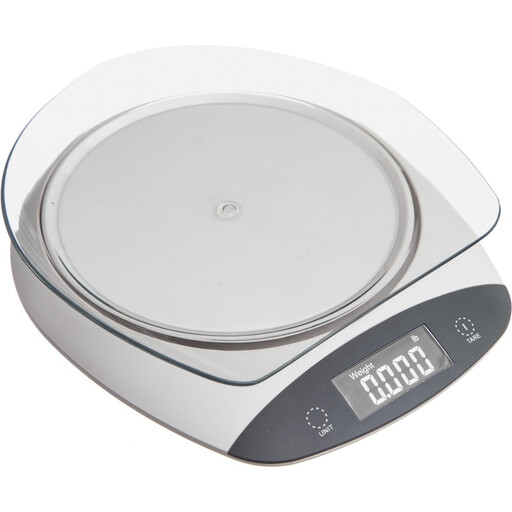 No image available
The removable bowl and tare function are worth considering if you want to weigh ingredients in a bowl.
Maximum 5000 g; LCD display with large digits. Requires 2 AAA batteries, which are not included.
 No image available
If your bowl and ingredients weigh more together, the product information lists a maximum capacity of 10 kg.
Listed increments: 1 g; glass surface, LED display, Bluetooth and app integration. Clean the surface with a damp cloth and don’t immerse the scales.
Place the scales on a stable surface, put the empty bowl on top and use the tare function to reset the display to zero. Add the sultanas. You can tare the scales again for the next ingredient, provided the total weight stays within the stated capacity.
No. The increment size describes what the display shows. The Consumentenbond tests the accuracy of kitchen scales, so don’t judge how accurately they measure by the increment size alone.
Don’t assume you can. For the Tasty+ model reviewed, Brabantia recommends wiping the glass surface. Follow the instructions for your exact model when cleaning the electronics. The Voedingscentrum recommends using clean utensils and materials to keep food safely separate.
You’re entitled to a product that works as it should, but there’s no fixed statutory warranty period in the Netherlands. According to the Rijksoverheid, the seller is your point of contact if a product is faulty and needs to be put right. Any manufacturer’s warranty is an additional guarantee.
Check which rules apply to the specific model. A product category or 1 g increment doesn’t in itself confirm CE status. For the Low Voltage Directive, the NVWA gives nominal AC voltages between 50 V and 1000 V and nominal DC voltages between 75 V and 1500 V; other rules may apply to equipment outside these limits.
Take removable used batteries to a battery collection point, and take small electrical appliances to a collection point for electrical equipment. Milieu Centraal advises against putting batteries in general waste; remove the battery from the appliance if you can.