
Batch baker
You want to weigh oats in a large mixing bowl without having to start a new portion each time. The total weight will determine whether you need a higher capacity.


For weighing oats in portions, a kitchen scale with a 5 kg capacity may be sufficient, as long as the bowl and ingredients stay within that limit. If you’re weighing a heavy bowl or a larger batch all at once, look for a higher capacity and check that the bowl won’t obscure the display. A 1 g increment on the display doesn’t prove that every measurement is accurate to within 1 g.
You want to weigh oats in a large mixing bowl without having to start a new portion each time. The total weight will determine whether you need a higher capacity.
You use one bowl and want to reset the scale to zero between adding oats and other ingredients.
You use a large bowl or work on a busy worktop, and want to make sure the display remains visible and the controls are easy to reach.
Choose this if: you weigh ingredients in portions and the combined weight of the bowl and ingredients stays within the maximum capacity. Inventum and Brabantia list a 5 kg maximum for the models in question.
Keep in mind: a large bowl may obscure the display; the maximum capacity includes both the bowl and its contents.
Choose this if: a heavy bowl or larger batch would otherwise exceed the limit of a 5 kg model. Beurer lists a maximum capacity of 15 kg for the KS 34 XL Black.
Keep in mind: a higher maximum capacity doesn’t, by itself, tell you how accurately the scale measures small quantities.
| What to consider | What to look for | Who is this important for? |
|---|---|---|
| Capacity | Add the weight of the bowl and its contents together, then compare the total with the limit for the exact model. | If I want to weigh a large batch all at once, the scale needs to support the weight of my bowl too. Around 40% of consumers prioritise capacity. |
| Tare and adding ingredients | Check that you can easily reset the scale to zero after placing the bowl on it and between adding ingredients. | I want to add oats and other ingredients to one bowl without having to work out the previous weight myself each time. Around 30% of consumers consider the tare function their top priority. |
| Display and controls | Check whether the display remains visible and the buttons are easy to reach when you use your own bowl. | When I use a large bowl, I want to be able to see the weight and use the controls while weighing. Around 20% of consumers prioritise readability and ease of use. |
| Battery and care | Check the battery type, whether batteries are included and how to clean the weighing surface. | If I’m mainly looking for a simple scale, I want to know which battery it needs and how to care for it. Around 10% of consumers prioritise simplicity and maintenance. |
The bowl and any other ingredients also add to the load on the scale. This can make the total weight higher than you expect.
Compare the maximum capacity of the exact model with the combined weight of the bowl and its contents.
A 1 g increment on the display doesn’t tell you how much a measurement may vary. Consumentenbond assesses measurement error and consistency separately.
If measurement accuracy is essential, check an independent test of the exact model rather than relying only on the gram increments shown on the display.
The bowl may block the display or buttons, making it difficult to read the weight or use the controls while weighing.
Check the position of the display and buttons with a bowl you actually plan to use.
The KS 34 XL Black may suit you if you want to weigh a heavy bowl or a larger quantity all at once.
The WS305B is a compact option for weighing ingredients in portions, with a tare function.
The TASTY+ Light Grey combines a weighing capacity of up to 5 kg with an illuminated display.
The digital kitchen scale with item number 80880037 is a straightforward option, with a maximum capacity of 5 kg and a tare function.
This selection of Joybuy products focuses on digital kitchen scales for weighing ingredients and making flapjacks, with different maximum capacities and features for use with a bowl.
 No image available
The tare function is useful when weighing ingredients in a bowl.
Maximum capacity: 5 kg. LCD display with 1 g increments; readings in grams, ounces, pounds and millilitres. Tempered glass surface.
 No image available
The tare function may come in handy when adding ingredients to a bowl.
Maximum capacity: 3 kg. The description lists weight readings in 0.1 g increments, a dual LED display and a timer.
 No image available
The tare function and maximum capacity are useful when baking with a bowl.
Maximum capacity: 5 kg. LCD screen with large numbers and tare function. Dimensions: 17 × 13 × 2 cm. Battery not included.
 No image available
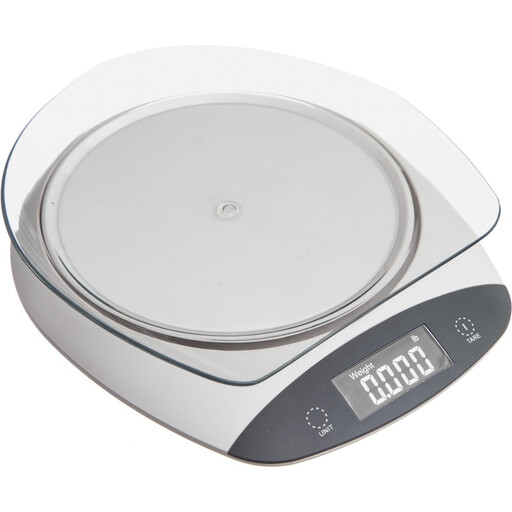
The removable bowl may suit you if you want to weigh ingredients in the bowl supplied.
Maximum capacity: 5000 g. LCD screen with large numbers and tare function. Dimensions: 20.5 × 18 × 4.5 cm. Requires 2 AAA batteries, not included.
 No image available
The higher capacity may be useful if you want to weigh a heavier bowl or a larger batch.
Capacity: 10 kg. The description lists 1 g increments, Bluetooth, app integration and unit conversion, including grams, millilitres, ounces and pounds. Check app compatibility if you plan to rely on this feature.
Yes. The maximum weight is the total load on the scale, so add the bowl and its contents together. The tare function lets you zero the scale with the empty bowl on it, then read the weight of the oats you add.
No. A gram increment describes the display, not the measurement error. Consumentenbond assesses measurement error and consistency separately, so don’t assume a product’s actual margin of error based on the specification alone.
When you buy as a consumer in the Netherlands, you’re entitled to a product that works as it should. According to the Dutch government (Rijksoverheid), there’s no fixed statutory guarantee period; if something is wrong, contact the seller. Online purchases from a business generally also come with a 14-day cooling-off period, subject to applicable exceptions.
Don’t put a used battery in your general waste. Take it to a collection point, such as a shop that sells batteries. You can take an unwanted battery-powered appliance to a suitable collection point or your local council recycling centre. When buying a similar new appliance, consumers can also use the take-back scheme for old appliances.
No. Describing something as a community meal doesn’t mean you’re selling food. If you sell food from home or work as a caterer, the Netherlands Food and Consumer Product Safety Authority (NVWA) sets out additional requirements for that activity. Check what applies to your situation separately from your choice of a household kitchen scale.