
Cooking for one or two
You want to weigh dry couscous for a small salad without confusing its dry weight with its cooked weight. The Netherlands Nutrition Centre recommends kitchen scales as a useful aid and distinguishes between the two weights.


Weigh couscous dry, and for small portions focus on a display that shows grams and a tare function if you’re using a bowl; a higher capacity isn’t necessarily a deciding factor. Then choose based on the space you have and whether you can read the display clearly with your bowl on the scales. A 1 g increment is a product specification, not proof that the scales measure accurately to within 1 g every time.
You want to weigh dry couscous for a small salad without confusing its dry weight with its cooked weight. The Netherlands Nutrition Centre recommends kitchen scales as a useful aid and distinguishes between the two weights.
You want to zero the empty bowl before adding couscous. A tare function is listed for several models tested, including the Beurer KS 19 and Brabantia Tasty+ Dark Grey.
You put the scales away after use, so you’ll want to consider both their dimensions and how easy the display is to read. The Dutch Consumers’ Association assesses features such as readability when testing kitchen scales.
A good fit if: you weigh dry couscous in a bowl and want to put the scales away after use.
Keep in mind: Beurer doesn’t list a backlit display for the KS 19. Also check that your bowl won’t block your view of the screen.
A good fit if: you weigh ingredients in a bowl and a backlit display or hanging loop matters to you; Brabantia lists these features for the battery-powered Tasty+ Dark Grey.
Keep in mind: check the full specification; a backlit display alone says nothing about measuring accuracy.
When weighing ingredients in a bowl, its fit on the scales and your line of sight to the display are practical considerations. The Dutch Consumers’ Association notes that models vary in readability.
| What to consider | What to look for | Who is this important for? |
|---|---|---|
| Dry portion | Check that the weight is displayed in grams and that the scales suit the amounts you want to weigh. | When I make a small salad, I want to weigh dry couscous without confusing that amount with its weight after cooking. Around 36% of consumers say weighing an appropriate dry portion is their main consideration. |
| Bowl weight | Look for a tare function and check with your own bowl that the buttons are accessible and the display stays visible. | I want to leave the bowl in place while adding couscous, without including the bowl’s weight. Around 29% of consumers prioritise being able to zero the scales with the bowl on them. |
| Storage | Compare the dimensions with your drawer or shelf, as well as the base of the bowl you usually use. | If my kitchen has limited storage space, I want to know in advance whether I’ll have somewhere to put the scales after use. Around 21% of consumers prioritise compact storage. |
| Display readability | Check your line of sight and any display lighting with the bowl on the weighing surface. | I want to read the weight without moving the bowl. For around 14% of consumers, being able to read the display with the bowl in place is their main consideration. |
The Netherlands Nutrition Centre says couscous can weigh around three times as much after cooking. So an amount given for cooked couscous isn’t necessarily the same as the dry amount.
Check whether the recipe refers to dry or cooked weight, and weigh it on the same basis.
The stated display increment doesn’t tell you how accurately or consistently the scales measure. The Dutch Consumers’ Association assesses these as separate aspects in its tests.
Use the gram display as a point of comparison, not as a test result. If repeatable measurements matter to you, look for test information on accuracy and consistency.
When you weigh ingredients in a bowl, the position of the buttons and visibility of the display can affect how easy the scales are to use. A high maximum capacity won’t solve those issues.
Check that your bowl fits on the weighing surface and that you can see the display before prioritising extra capacity.
The flat KS 19 is worth considering if a tare function and limited storage space are priorities for you.
The battery-powered Tasty+ Dark Grey is worth a look if a backlit display and a hanging loop for storage are important to you.
These Joybuy products are options for weighing small portions of ingredients. The selection includes basic kitchen scales and a coffee scale.
 No image available
An option if you want to weigh ingredients in a bowl and use a display that shows grams.
Glass surface, LCD, tare function, maximum capacity of 5 kg and 1 g increments.
 No image available
An option if you want to weigh ingredients in a bowl and use a display that shows grams.
Glass surface, LCD, tare function, maximum capacity of 5 kg and 1 g increments.
 No image available
Consider this option if you’d like coffee-making features as well as kitchen weighing functions; the product name mentions a timer and water-flow function.
The stated minimum weighing amount is 3 g. Bear this in mind if you want to weigh very small quantities.
 No image available
A compact option to consider if you’re looking for scales for a small kitchen.
Dimensions: 17 × 13 × 2 cm. Batteries are not included.
 No image available
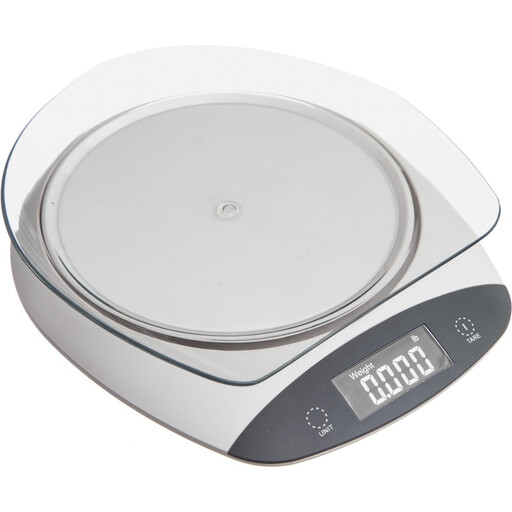
An option if you want to weigh ingredients directly in the removable bowl supplied.
Dimensions: 20,5 × 18 × 4,5 cm. Requires 2 AAA batteries, not included.
Weigh the couscous dry if your recipe gives an uncooked amount. According to the Netherlands Nutrition Centre, its weight increases by around a factor of three during cooking, so follow the weight specified in the recipe.
Place the scales on a stable surface, put the empty bowl on them, use the tare function to zero the weight, then add the dry couscous. First, check that the bowl won’t cover the display or buttons.
No. The display increment and measurement accuracy are two different things. The Dutch Consumers’ Association assesses accuracy and consistency separately using standard weights.
When you buy as a consumer, you’re covered by the statutory guarantee: you’re entitled to a product that meets the terms of the agreement, and the retailer is your point of contact if it doesn’t. A manufacturer’s guarantee is in addition to this. For online purchases from a business, a 14-day cooling-off period applies in many cases; the Dutch Government explains the conditions.
According to the Dutch Government, flat batteries shouldn’t go in the rubbish bin. You can take them to shops that sell batteries, among other places. Old electrical scales should be taken to an electrical appliance collection point. When you buy a similar new appliance, the old-for-new scheme applies to private customers.