
Cooking with a large serving bowl
You want to weigh the bowl and ingredients together for several guests. So, pay particular attention to the model’s maximum capacity; Beurer and Tefal provide this information for the models discussed here.


Choose a kitchen scale based on the combined weight of your bowl and ingredients: the tare function resets the reading to zero with the empty bowl on the scale, but it doesn’t increase the maximum capacity. A model with a 5 kg capacity may be suitable if the bowl and contents stay within that limit; a higher capacity may be more convenient for a heavy serving bowl. A display that measures in 1 g increments doesn’t, by itself, tell you how accurate the measurements are.
You want to weigh the bowl and ingredients together for several guests. So, pay particular attention to the model’s maximum capacity; Beurer and Tefal provide this information for the models discussed here.
You weigh dry couscous, then add other ingredients to the same bowl. In this case, the tare function and an easy-to-read display may matter more than extra capacity you won’t use; HEMA, Tefal and Brabantia describe models with a tare function.
You want to put the scale away easily after use and consider how it’s powered. HEMA lists a battery for the model discussed here; Brabantia says the Tasty+ has a hanging loop and comes with batteries.
| What to consider | What to check before buying | Who is this important for? |
|---|---|---|
| Capacity | Check the maximum capacity of the exact model, counting the bowl and ingredients together. | If you want to weigh a large serving bowl in one go, make sure the bowl and contents don’t exceed the limit. Around 36% of consumers prioritise enough capacity for a large bowl. |
| Tare function and display increments | Check whether the model has a tare function and what increments the display shows for the quantities you’re weighing. | If you weigh couscous and other ingredients one after another in the same bowl, you’ll want to reset the reading to zero between additions. Around 29% of consumers give top priority to the tare function and being able to read the added quantities. |
| Display and controls | Check that you can see the display and reach the buttons with your bowl on the platform; also check the cleaning instructions. | If you’re adding ingredients as you make the salad, you’ll want to read the display clearly and use the controls easily. Around 21% of consumers focus mainly on readability, ease of use and cleaning. |
| Storage and batteries | Check the dimensions, battery type and whether batteries are included. | If you have limited kitchen space, consider where you can store the scale after use and how it’s powered. Around 14% of consumers prioritise compact storage and a practical power supply. |
The tare function resets the display to zero, but it doesn’t make the bowl weightless when it comes to the scale’s maximum capacity.
Before you buy, check whether the bowl and ingredients together will stay within the stated limit. Otherwise, weigh in batches or choose a model with a higher capacity.
The increments describe what the display shows; they don’t prove how small the actual measurement error is. The Consumentenbond assesses accuracy and consistency as separate test criteria.
Compare display increments separately from independent test results, and don’t infer a margin of error for a specific model from 1 g increments.
A bowl may fit on the platform but still cover the display or buttons.
Compare the dimensions with your own bowl and check that the display remains visible and the controls are within reach when the bowl is on the scale.
According to Beurer, the KS 34 XL Black is designed for situations where a higher weighing capacity and a spacious platform may come in handy.
Tefal says the Optiss BC50U0V0 is designed to make it easy to read the display and add ingredients one after another.
According to Brabantia, the battery-powered Tasty+ combines controls for adding ingredients and weighing with a hanging loop.
HEMA’s digital kitchen scale is a straightforward option for weighing dry couscous and other ingredients using the tare function.
This selection includes digital kitchen scales for weighing ingredients in a bowl, with models offering a stated capacity of 5 kg or 10 kg. Count the bowl and contents together when choosing the capacity you need.
 Image unavailable
The tare function is useful for weighing ingredients one after another in the same bowl.
Capacity: up to 5 kg. The product listing mentions a glass surface, 1 g increments and display options in grams, ounces, pounds and millilitres.
The bowl and contents together must stay within 5 kg. Don’t immerse or put in the dishwasher; don’t place hot items directly on the glass surface.
 Image unavailable
The stated 10 kg capacity gives this model a higher weighing range than the 5 kg models in this selection.
The product information lists 1 g increments, a glass surface, several units including grams and millilitres, and Bluetooth.
The bowl and contents together must stay within 10 kg. Don’t immerse the scale; clean the glass surface with a soft, damp cloth.
 Image unavailable
The tare function can come in handy when you weigh ingredients one after another in the same bowl.
Capacity: up to 5 kg. The product information lists dimensions of 17 × 13 × 2 cm and an LCD display.
The bowl and contents together must stay within 5 kg. Batteries aren’t included.
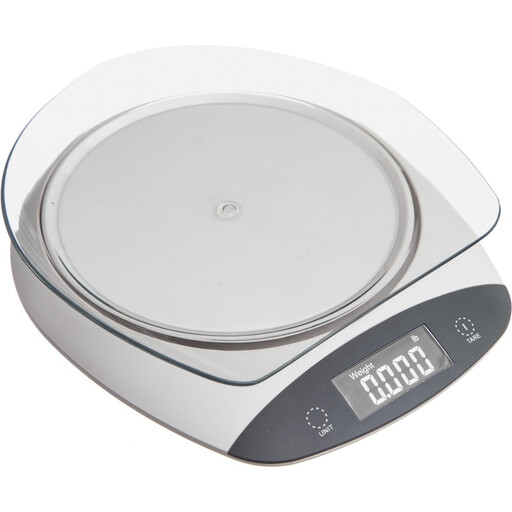 Image unavailable
The removable bowl may suit anyone who prefers to weigh ingredients in the bowl supplied.
Maximum capacity: 5000 g. The product information lists an LCD display and dimensions of 20,5 × 18 × 4,5 cm.
The bowl and ingredients together must stay within 5000 g. Two AAA batteries aren’t included.
 Image unavailable
The product information mentions a large colour display and 1 g increments for reading quantities.
Capacity: 5 kg. The product information lists several weighing units, a nutrition information display and app synchronisation.
The bowl and ingredients together must stay within 5 kg. Four AAA batteries aren’t included; don’t immerse the glass surface and clean it with a soft, slightly damp cloth.
Follow the quantity and preparation stage given in your recipe. A recipe from the Netherlands Nutrition Centre lists 150 g of wholewheat couscous for two people in the ingredients, then soaks it in stock; don’t automatically use that quantity for a meal for a larger group.
Place the empty bowl on the scale and reset the display to zero before adding the couscous. On a model with a tare function, you can reset it to zero again before adding the next ingredient. Remember that the model’s maximum capacity still applies with the bowl on the scale.
Cool leftovers quickly, store them in a sealed container and don’t leave them out of the fridge for more than two hours. The Netherlands Nutrition Centre recommends keeping cooked couscous in the fridge for two days; if you’ve made a mixed salad, also consider the other ingredients.
According to ACM ConsuWijzer, online purchases generally come with a statutory cooling-off period of up to 14 days after delivery; check which exceptions and returns terms apply to your purchase. You’re also entitled to a product that, under normal use, meets the reasonable expectations you were entitled to have. A manufacturer’s warranty is in addition to your statutory rights.
Take used batteries to a separate collection point and don’t put them in your general waste. You can take an unwanted electrical appliance to a municipal collection point, among other places. The Dutch government also describes a take-back scheme when you buy a new, similar appliance.