
Sauce maker with limited cupboard space
Weighs cornflour in whole grams and wants to store the scale flat or hang it up after use.


If you usually weigh cornflour in whole grams, a flat digital scale with a tare function is a good match for those recipes. Choose a precision scale that displays tenths of a gram if your recipes call for such small increments. Soehnle lists a 1 g graduation for the Page Compact 300, while Beurer specifies a 0.1 g display for the KS 36. A finer display increment alone does not prove greater accuracy: also check that your bowl fits on the weighing surface and that the bowl and its contents stay within the maximum capacity.
Weighs cornflour in whole grams and wants to store the scale flat or hang it up after use.
Sometimes follows recipes that use tenths of a gram and needs a weighing surface that suits the bowl being used.
Wants to add ingredients one after another without changing bowls, so looks for a tare function, a clear display and sufficient capacity.
Suitable if: you follow recipes in whole grams and want to store the scale flat.
Trade-off: a display in 1 g increments won’t show tenths of a gram.
Suitable if: your recipes specify small quantities in tenths of a gram.
Trade-off: check that your bowl fits on the weighing surface and stays within the maximum capacity; the displayed increment is not an independent accuracy test.
Suitable if: you have a suitable place to hang it and would rather not give up cupboard space.
Trade-off: you’ll need a suitable spot; also check the battery type for the model you’re considering.
| What to consider | What to look for | Who should pay extra attention? |
|---|---|---|
| Storage | Compare the length, width and height with your cupboard; if you plan to hang it up, check that it has a loop and that you have a suitable place. | If cupboard space is limited, I want to be able to store the scale flat or hang it up. Around 33% of consumers say available storage space is the deciding factor. |
| Small quantities | Check whether your recipe calls for whole grams or tenths of a gram, and compare the increments with the weighing surface. | When my recipe specifies tenths of a gram, I want to be able to read those smaller increments. Around 33% of consumers prioritise the increments their recipes require. |
| Bowl and tare | Check that your bowl sits securely, the display remains visible and the bowl and its contents stay within the maximum capacity. | I want to weigh cornflour in my own bowl and use the tare function to reset the scale to zero. Around 25% of consumers choose primarily on the basis of weighing in a bowl and using tare. |
| Controls and ease of use | Check the display and buttons with your bowl on the scale; look at the battery type, cleaning instructions and warranty terms. | Once the basic functions meet my needs, I focus on readability, controls and maintenance. Around 9% of consumers say ease of use and everyday practicalities are the deciding factors. |
A display showing 0.1 g doesn’t prove that repeated measurements will give the same correct value each time. Consumentenbond assesses deviation and repeatability separately.
Choose an increment that suits your recipes, and consult independent measurement data if accuracy is essential.
Length, width and the space taken up by your bowl also determine whether a scale will fit comfortably.
Measure your storage space and compare the dimensions of your usual bowl with the stated weighing surface.
A manufacturer’s or commercial warranty doesn’t replace your statutory rights. ACM ConsuWijzer explains that the statutory guarantee applies in addition.
Keep your proof of purchase and, if something goes wrong, check both the commercial terms and your statutory rights.
The Page Compact 300 is an example of an extra-flat scale for recipes measured in whole grams.
The KS 36 offers a finer display; the KS 19 is a separate model with 1 g increments.
The battery-powered Tasty+ is an example of a model with a hanging loop.
This selection includes digital kitchen scales for recipes measured in whole grams, as well as compact models with finer displays, including options with a tare function or a removable bowl.
 No image available
An option to compare if you follow recipes in whole grams and want to weigh ingredients using the tare function.
Tempered glass surface; 1 g increments; maximum capacity of 5 kg; tare function; displays grams, ounces, pounds and millilitres.
 No image available
A model to consider if a dual LED display and timer are important to you.
The product name mentions a four-point sensor and timer.
 No image available
An option to compare if your recipes call for increments smaller than whole grams.
The product name mentions a 0,1 g display, capacity up to 3 kg, rechargeable power, a timer, a heat-resistant platform and a tare function.
 No image available
The stated dimensions make this model worth comparing if you have limited storage space.
Stainless steel; dimensions according to the product name: 17 × 13 × 2 cm. Check the product information to see which battery type is required and whether batteries are included.
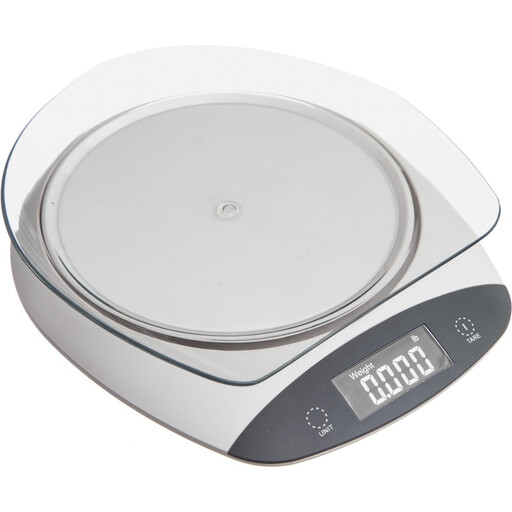 No image available
The removable bowl is a handy option if you want to weigh cornflour in a dedicated bowl.
The product name lists dimensions of 20,5 × 18 × 4,5 cm. Also compare the height with your cupboard space, and check which battery type is required and whether batteries are included.
No. The increment tells you what the display can show, not how small the actual measurement error is. Consumentenbond assesses deviation and repeatability separately; compare test results if measurement reliability is important to you.
If your scale has a tare function, place it on a stable surface, put a suitable bowl on it and reset the display to zero using tare before adding the cornflour. Keep the bowl and its contents within the maximum capacity of your model.
Follow the instructions for the model you choose, as battery types vary. Brabantia specifies three AAA batteries for the battery-powered Tasty+ and says to wipe the glass surface clean; Soehnle lists a CR2430 battery for the Page Compact 300.
No. Any commercial warranty applies alongside your statutory guarantee. According to ACM ConsuWijzer, the seller is responsible if a product doesn’t perform as you could reasonably expect under normal use; the statutory guarantee period isn’t a fixed two years for every kitchen scale.
According to the Dutch government, used household batteries should go to a collection point, not in the bin. When you buy a similar new appliance, the retailer must also take back an old appliance of that type.