
Making small portions of sauce
You want to weigh small amounts of cornflour separately and are mainly looking for a fine weight display. Also check that your bowl is within the scale’s capacity.


For small portions of cornflour, a fine weight increment is useful. If you use a large bowl, pay particular attention to the maximum capacity and the size of the weighing platform. According to Beurer, the KS 36 displays increments of 0.1 g and has a maximum capacity of 2 kg, while the KS 34 XL Black displays increments of 1 g and has a maximum capacity of 15 kg. A small increment on the display does not, in itself, prove how accurately or consistently a scale weighs.
You want to weigh small amounts of cornflour separately and are mainly looking for a fine weight display. Also check that your bowl is within the scale’s capacity.
You’re scaling up recipes for a neighbourhood dinner and want to weigh the bowl and ingredients together without exceeding the maximum capacity.
You weigh ingredients several times during preparation, so tare, an easy-to-read display or a surface that’s simple to clean is important to you.
Choose the increment to suit the portions you want to weigh, and also check the combined weight of the bowl and its contents. The displayed increment is a product specification; Consumentenbond assesses accuracy and consistency separately.
| What to consider | What should you check? | Who is this important for? |
|---|---|---|
| Small portions | Compare the increment with the portions you weigh, and check the capacity, including the bowl. | If you want to weigh small amounts of cornflour for each sauce, a finer display is relevant; around 33% of consumers give small portions the highest priority. |
| Bowl and larger quantities | Check the capacity, the size of the platform and the tare function. | If you’re weighing ingredients for a group in a larger bowl, you’ll want to avoid the bowl and ingredients exceeding the scale’s capacity; around 25% of consumers prioritise space and capacity. |
| Repeated weighing | Check the controls, tare function and how easy the display is to read with the bowl on the platform. | If you’re making several sauces one after another, being able to weigh ingredients again quickly can make preparation easier; around 25% of consumers put this first. |
| Reading the display and cleaning | Check the position of the display and the cleaning instructions for the surface. | If your bowl might obscure the display, or you want a surface that’s easy to clean after cooking, these features matter; around 17% of consumers give readability and cleaning the highest priority. |
The increment describes what the display shows. It’s not the same as an independent assessment of the accuracy or consistency of that specific model.
Choose an increment that suits your portions, and look for a test of the same model if you want an assessment of its accuracy.
The bowl counts towards the maximum load, even when you use the tare function to reset the display to zero.
Compare the scale’s capacity and platform dimensions with the bowl you actually plan to use.
A manufacturer’s guarantee doesn’t automatically define the limits of your statutory rights when you buy as a consumer. ACM ConsuWijzer explains that the law does not set a fixed, general two-year guarantee period.
Keep your proof of purchase and contact the retailer if a fault develops during normal use.
The models mentioned show how the choice between finer increments and greater capacity can vary.
The Tasty+ Dark Grey is a 5-kg model for anyone who values a backlit display and an easy-to-wipe glass surface.
This selection includes digital scales for different uses, including coffee and kitchen scales. Check each model to make sure its listed features and capacity suit weighing cornflour in your bowl.
 No image available
The product name positions this model for espresso and pour-over coffee. Consider it for making sauces only if its features and platform suit the way you’ll use it.
The title lists a timer, a coffee-to-water ratio display, water flow rate and switchable ounce/kg units.
 No image available
According to its product name, this model is designed for espresso and pour-over coffee. Check whether its size and features suit your sauce-making needs.
The title lists a timer, a coffee-to-water ratio display, water flow rate and switchable ounce/kg units.
 No image available
The product name describes a kitchen scale. Compare its listed features with the bowl and quantities you want to weigh for your sauce.
The title lists a dual LED display, a four-point sensor and a timer.
 No image available
The title describes a kitchen scale with fine increments. Check that its platform is suitable for the bowl you use when making sauce.
The product name lists a 0.1 g display, a capacity of up to 3 kg, a timer, a heat-resistant platform, USB charging and a tare function.
 No image available
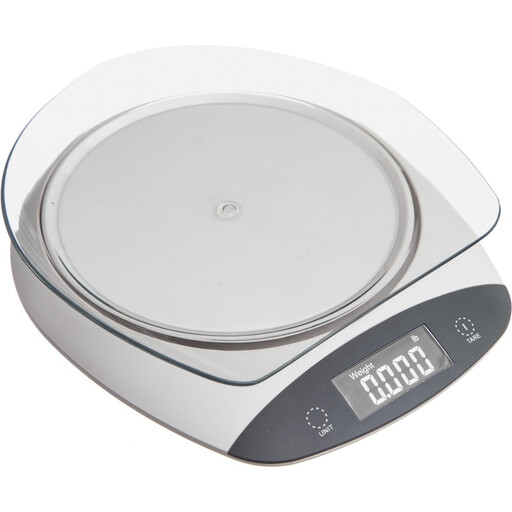
The removable bowl may be useful if you’d rather not place your own bowl on the platform. Check that the capacity suits the ingredients you’re weighing.
The product name lists dimensions of 20,5 × 18 × 4,5 cm.
No, it depends on how small you want to weigh each portion. According to Beurer, the KS 36 displays increments of 0.1 g and has a maximum capacity of 2 kg; according to Brabantia, the Tasty+ Dark Grey displays increments of 1 g. A finer increment does not, in itself, prove greater weighing accuracy.
Place a suitable bowl on the scale and use the tare function before adding the cornflour. Remember, though, that the combined weight of the bowl and its contents must remain within your model’s maximum capacity.
Not according to the Voedingscentrum’s vanilla sauce recipe. It recommends first mixing the cornflour with a little milk to make a paste, then adding it to the pan. Follow the recipe for your sauce; the scale only measures the amount you weigh out.
If the sauce contains ingredients that spoil quickly, the Voedingscentrum advises not leaving it out of the fridge for more than two hours and setting the fridge to 4 °C. A kitchen scale does not check storage temperature.
The NVWA lists food safety rules for selling food and drink at markets and events, including for private individuals. For preparing and selling food repeatedly, the NVWA specifies a mandatory food safety plan; don’t assume these obligations apply simply because you’re organising a neighbourhood dinner.
When you buy as a consumer, your statutory rights may continue after the manufacturer’s guarantee has expired. ACM ConsuWijzer explains that the Netherlands does not have a fixed, general statutory guarantee period of two years; if there’s a fault, contact the retailer.