
For cooks weighing small amounts of cornflour
You want to measure small quantities reliably. Consumentenbond describes separate tests to assess weighing performance; a 1 g increment is not the same as proven accuracy.


When weighing small amounts of cornflour, it’s important to distinguish between the displayed increment and the scale’s actual performance: a 1 g increment alone doesn’t prove how accurately a scale weighs. If you weigh ingredients in a bowl or make a larger quantity of sauce, also check the tare function, whether the display remains easy to read with the bowl in place, and the maximum capacity including the bowl.
You want to measure small quantities reliably. Consumentenbond describes separate tests to assess weighing performance; a 1 g increment is not the same as proven accuracy.
You want to zero the bowl and add ingredients one after another. Beurer and Brabantia list a zero or tare function for the models mentioned.
You want to be able to read the display with the bowl on the scales, while taking the weight of the bowl and its contents into account. Brabantia mentions a backlit display; OXO describes a pull-out display on the version mentioned.
Consumentenbond describes tests using weights from 1 to 1,000 g. For small quantities, don’t just look at the display increment; also check for information about performance at low weights.
| What to consider | What should you look for? | Who is this important for? |
|---|---|---|
| Small quantities | Check the weighing increment and any test results at low weights; a 1 g increment doesn’t prove how large the measurement error is. | If I only need a small amount of cornflour, I want to know how the scales handle low weights. Around 44% of consumers give weighing small quantities top priority. |
| Taring in a bowl | Check whether the model has a tare function and whether you can reach the zero button with your bowl on the platform. | If I want to weigh several ingredients in the same bowl, I want to be able to reset the scales to zero easily between additions. Around 33% of consumers prioritise weighing everything in one bowl. |
| Large bowl and readability | Check where the display is positioned, and add the weight of the bowl to the ingredients before comparing the total with the maximum capacity. | If I’m cooking for a group, I want to be able to see the display with my large bowl on the scales and stay within the weight limit. Around 23% of consumers put bowl clearance and readability first. |
The display increment shows how the weight is displayed, but it doesn’t tell you on its own how accurate or repeatable a low-weight measurement is. Consumentenbond assesses weighing performance using tests at different weights.
Where available, look at test results for low weights and compare them with the specifications for the exact model.
A large bowl can get in the way of the display or controls, even if the bowl and its contents are still within the maximum capacity.
Check the space on the platform and the position of the display and zero button with a bowl like the one you use.
A manufacturer’s guarantee and your statutory rights are not the same. Rijksoverheid states that the Netherlands has no fixed statutory guarantee period.
Keep your proof of purchase and contact the retailer if the product is faulty.
The KS 19 Fresh is a flat digital scale for anyone who wants to tare a bowl. Beurer lists 1 g increments and a maximum capacity of 5 kg for this model.
The battery-powered Tasty+ is an option if you’re looking for a backlit display and a zero or add-and-weigh function. Brabantia lists 1 g increments and a maximum capacity of 5 kg for this version.
According to OXO, the Good Grips 11 lb Stainless Steel Food Scale has a pull-out display, designed to make the screen easier to see when a bowl is in front of it.
According to Salter, the Round Electronic Scale is designed for weighing ingredients one after another in the same bowl.
This selection includes digital scales whose product information describes them as suitable for kitchen, baking or cooking use. Check each model to see whether its listed features suit small quantities of cornflour and the bowl you want to use.
 Image unavailable
The product title mentions espresso and pour-over use as well as kitchen, baking and cooking use; consider whether this broader range suits the way you cook.
The title mentions switching between ounces and kg, a timer function and a water flow function.
 Image unavailable
This digital kitchen scale could suit you if you’re looking for a compact option for weighing ingredients in the kitchen; check that its dimensions work with your worktop and bowl.
The product title lists stainless steel and dimensions of 17 x 13 x 2 cm. Batteries are not included.
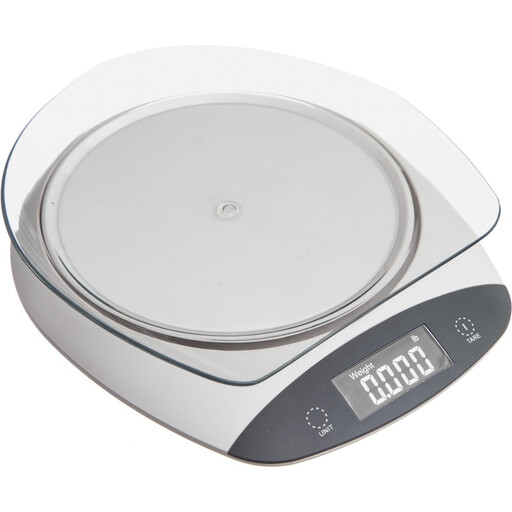 Image unavailable
The removable bowl may be useful if you prefer scales with a bowl of their own; consider whether that suits the way you make sauce.
The product title lists dimensions of 20.5 x 18 x 4.5 cm. This version requires two AAA batteries, which are not included.
No. This describes the display increment and doesn’t, by itself, prove how small the measurement error is or how repeatable the measurement will be. Consumentenbond describes separate tests using weights from 1 g upwards; for a specific model, check any available test results for low weights.
Check that you can still see and reach the display and controls with your bowl on the scales. Add the weight of the bowl to the ingredients before comparing the total with the stated maximum capacity; a backlit or pull-out display may make the reading easier, but it says nothing about weighing accuracy.
No. Brabantia lists a five-year manufacturer’s guarantee for the Tasty+ mentioned here; this is a brand guarantee. Rijksoverheid distinguishes between a manufacturer’s guarantee and statutory rights, and states that the Netherlands has no fixed statutory guarantee period.
Milieu Centraal advises taking small electrical appliances to a collection point. According to Milieu Centraal, you can drop off used loose batteries in collection bins at shops and supermarkets.