
Cake baker weighing small amounts
Wants the weighing increment to suit the smallest quantity in the recipe, without mistaking the stated resolution for tested accuracy.


First, choose scales with a stated weighing increment that suits the smallest quantity in your recipe. Then check that the bowl and ingredients together are within the maximum capacity, and that you can still see the display. The tare function is useful when weighing several ingredients one after another in the same bowl. A finer weighing increment does not, by itself, prove greater measurement accuracy.
Wants the weighing increment to suit the smallest quantity in the recipe, without mistaking the stated resolution for tested accuracy.
Weighs sugar and other ingredients one after another, making the tare function and an easy-to-read display important.
Considers suitable bowls, capacity and cleaning between sessions. A removable bowl or a larger platform may also be important.
Compare the smallest portion in your recipe with the weighing increment at that weight. Also consider the bowl, the total weight and how you’ll clean the scales between sessions.
| What to consider | What to look for | Who is this important for? |
|---|---|---|
| Weighing increment for small amounts | Compare the smallest portion in your recipe with the stated weighing increment at that weight. Consumentenbond assesses measurement accuracy and consistency separately from product specifications. | When weighing small amounts of sugar, you’ll want the increment to suit your recipe rather than assume it proves accuracy; around 36% of consumers make suitable weighing increments their top priority. |
| Weighing ingredients one after another | Check that the tare function is easy to use and that you can see the display with the bowl on the platform. | You may want to add ingredients to the same bowl one after another without including the previous weight; around 29% of consumers prioritise being able to weigh ingredients in quick succession. |
| Bowl and capacity | Add the weight of the bowl and ingredients together. Beurer lists a maximum capacity of 3 kg and a 1.2-litre bowl for the KS 25; the KS 34 Stainless Steel has a maximum capacity of 15 kg and a platform measuring 26.3 × 20.0 cm. | If you use larger bowls or portions, you’ll want to know whether both the size and total weight are suitable; around 21% of consumers make bowl space and capacity their top priority. |
| Cleaning between sessions | Check which parts are removable and what the manufacturer says about cleaning. Beurer states that the bowl of the KS 25 is dishwasher-safe; that doesn’t automatically mean the electronic scales are dishwasher-safe. | When several groups share the same workstation, you’ll want to know in advance how to clean the bowl and scales; around 14% of consumers prioritise tidying up between sessions. |
The displayed increment doesn’t tell you the size of the actual measurement error or how consistent repeated measurements are.
Use the stated increment to see whether the display suits the portions in your recipe. If accuracy is crucial, consult separate measurement tests.
The bowl sits on the scales too, so its weight counts towards the maximum capacity. A large bowl may also obscure the display.
Check the combined weight of the bowl and ingredients, and make sure the bowl fits on the platform without blocking the display.
A statement that a removable bowl is dishwasher-safe doesn’t automatically apply to the electronic scales.
Check the care instructions for each part before using the scales at several workstations.
The Optiss BC50U0 is worth comparing if you weigh smaller portions and add ingredients to one bowl.
The Tasty+ is a flat set of scales to compare if you want a tare function and a backlit display.
The KS 25 and KS 34 Stainless Steel offer different options for bowl use, platform size and capacity.
These product options are digital kitchen scales for weighing ingredients. Check whether each model’s features suit your cake-making workshop.
 No image available
The tare function is useful when adding ingredients to one bowl in succession.
Stated increments of 1 g and a maximum capacity of 5 kg. According to the description, this product is intended for household use, not commercial or industrial use.
 No image available
The product name positions this model for espresso and pour-over coffee; choose it only if that use also suits your workshop.
The product name lists a timer, a water flow rate function, a coffee-to-water ratio and switching between ounces and kg.
 No image available
The tare function is useful for weighing ingredients one after another; the description says the LCD display has large digits.
Dimensions: 17 × 13 × 2 cm; maximum capacity: 5 kg. Batteries are required but not included.
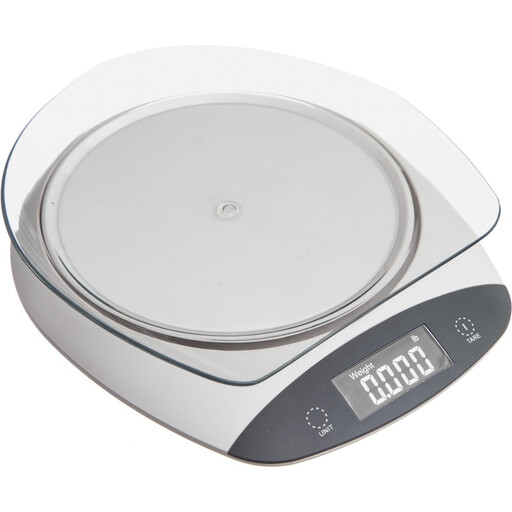 No image available
The removable bowl and tare function suit a way of working where you add ingredients one after another.
Dimensions: 20.5 × 18 × 4.5 cm; maximum capacity: 5000 g. Requires 2 AAA batteries, not included.
 No image available
The stated minimum weight is 3 g, so bear this in mind if your recipe calls for smaller amounts.
The description lists 1 g increments and a glass surface that can be cleaned with a damp cloth. The stated capacity is 10 kg.
No. The stated increment describes how the weight is displayed; Consumentenbond assesses measurement accuracy and consistency separately. Compare the increment with your recipe, and check measurement results if deviations matter.
Place the empty bowl on the platform and use the tare function to reset the display to zero before adding sugar. First, check that you can see the display with the bowl in place, and that the bowl and its contents together are within the maximum capacity.
Don’t assume that you can. Beurer specifically states that the removable bowl of the KS 25 is dishwasher-safe; Brabantia recommends wiping the glass surface of the Tasty+. Follow the care instructions for your chosen model.
Not simply because you’re weighing recipe ingredients. The Dutch Authority for Digital Infrastructure describes specific requirements for scales used, among other things, to determine a product’s selling price in a commercial transaction. If you use the scales for this purpose too, assess that use separately.
That depends on the organisation and the food-related activities. The Netherlands Food and Consumer Product Safety Authority says that businesses involved in the catering or artisanal food preparation activities it describes must follow an HACCP food safety plan or an applicable hygiene code. Your choice of kitchen scales doesn’t determine this.