
Home baker following a precise recipe
You want to weigh butter and other ingredients in grams without adding the weight of your bowl to the ingredients.


For butter and other recipe ingredients, digital kitchen scales with a gram display and tare function are handy: simply place your bowl on the scales, zero the display, then add your ingredients. For larger quantities, check that the weight of the bowl and its contents stays within the maximum capacity. A 1-gram increment is a product specification, not proof of accuracy; the Dutch Consumers' Association assesses accuracy and consistency separately.
You want to weigh butter and other ingredients in grams without adding the weight of your bowl to the ingredients.
You’re baking for a group and want to check that your mixing bowl and its contents are within the scales’ capacity. Extra capacity matters most when the quantities call for it.
You weigh several ingredients in the same bowl, one after another, so the tare function, display readability and button placement matter.
| What to consider | What to look for | Who is this important for? |
|---|---|---|
| Grams and recipes | Check that the scales display grams and look at the weighing increments. A 1-gram increment doesn’t prove that every measurement is exact. | If you want to weigh butter to a recipe, the amount in grams is key. Around 36% of consumers say this is their main concern when buying. |
| Bowl and capacity | Compare the maximum capacity with the weight of your empty bowl plus the largest amount you want to weigh at once. | When baking large quantities, the mixing bowl’s weight counts too. Around 29% of consumers prioritise having enough capacity for both the bowl and ingredients. |
| Tare function and readability | Check that you can reset the display to zero and that the bowl won’t block the display or buttons. | If you weigh ingredients one after another in the same bowl, you’ll want to read the display between additions. Around 21% of consumers say the tare function and readability are their main concerns when buying. |
| Cleaning and power | Read the cleaning instructions for the exact model and check which type of battery it needs. | If maintenance and power are your main considerations after baking, you’ll want to know how to clean the scales and which batteries they use. Around 14% of consumers prioritise this. |
Scales that measure in 1-gram increments don’t automatically tell you how accurate or consistent the measurements are. The Dutch Consumers' Association assesses accuracy and consistency separately.
If reliable measurements are essential, don’t base your choice on the stated increment alone; also check the test results for the exact model.
When you weigh ingredients in a bowl, the bowl sits on the scales too. The HEMA and Brabantia models tested are listed with a maximum capacity of 5 kg; Salter lists a maximum of 10 kg for the High-Capacity Kitchen Scale.
Add the weight of your heaviest empty bowl to the largest quantity you want to weigh at once before choosing a capacity.
A large display or illuminated figures won’t help if your mixing bowl covers the screen or controls. The Dutch Consumers' Association notes differences in features such as button placement and how quickly the scales switch off.
Compare the platform size and the position of the display and buttons with the bowl you use at home. Check the switch-off time in the manual for your chosen model.
HEMA describes item 80880037 as digital kitchen scales for weighing ingredients including butter, sugar and flour.
The battery-powered Brabantia Tasty+ in Dark Grey is an option if you’re looking for an illuminated display and a hanging loop.
The Beurer KS 19 Black is a flat glass set of scales with a tare function, designed for use with your own bowl.
The High-Capacity Kitchen Scale shows the stated capacity a model can offer if you want to weigh a heavy bowl and larger quantities at the same time.
This selection includes kitchen scales with a tare function for weighing ingredients in a bowl, a model also described as suitable for making coffee, and a version with a stated maximum capacity of 10 kg.
 Image unavailable
The stated tare function lets you zero the scales with a bowl on them before adding ingredients.
Maximum capacity: 5 kg; 1-gram increments. The product name lists readings in grams, ounces, pounds and millilitres.
Not dishwasher-safe and must not be immersed; clean with a soft, damp cloth.
 Image unavailable
The product description says it can be used for baking and cooking as well as making coffee.
The description lists weighing in grams and kilograms. The product name mentions a timer and water flow rate display.
 Image unavailable
The product description lists a tare function for weighing ingredients in a container.
Maximum capacity: 5 kg. The title lists dimensions of 17 × 13 × 2 cm; the description mentions an LCD with large figures.
The battery isn’t included.
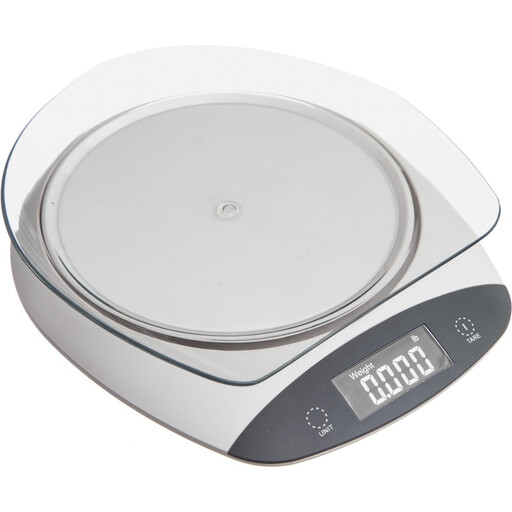 Image unavailable
The removable bowl and tare function give you two ways to weigh ingredients.
Maximum capacity: 5 kg. The product name lists dimensions of 20,5 × 18 × 4,5 cm; the description mentions several selectable units of measurement.
The two required AAA batteries aren’t included.
 Image unavailable
If you need a higher capacity, the product description lists a maximum of 10 kg.
The description lists 1-gram increments and several units of measurement. The product name mentions a glass surface and app integration.
Do not immerse; clean with a soft, damp cloth.
Place the empty bowl on the scales and use the tare function to zero the display before adding the butter. HEMA, Brabantia and Beurer list a tare or zero function for the models reviewed. Remember to account for the combined weight of the bowl and its contents.
Don’t assume they can just because they’re made of glass. Brabantia says to wipe the glass surface of the Tasty+ model reviewed; Salter says the High-Capacity Kitchen Scale reviewed isn’t dishwasher-safe. Follow the cleaning instructions for the exact version.
Take used batteries to a collection point, such as a shop or supermarket that sells batteries. According to the Dutch government, they must not be put in the bin.
No. According to the Dutch government, when you buy as a consumer, you’re entitled to a product that works properly, and you must be able to take a faulty product back to the retailer. There’s no fixed statutory warranty period of two years in the Netherlands; a manufacturer’s warranty is in addition to your statutory rights.