
Making granola quickly
You want to add honey to your granola after an evening class without creating extra washing-up. Using your own mixing bowl with a tare function makes this easier.


Weigh honey in grams straight into your mixing bowl and use the tare function to zero the scale with the bowl on it. Then choose according to what bothers you most: a hard-to-read display, extra washing-up, limited storage space or weighing very small amounts. A finer display increment does not, on its own, mean that a scale measures more accurately.
You want to add honey to your granola after an evening class without creating extra washing-up. Using your own mixing bowl with a tare function makes this easier.
You often weigh ingredients in less-than-ideal kitchen lighting and want to see the weight with a bowl on the scale.
As well as honey, you weigh small amounts of other ingredients and want to balance a finer display increment with bowl size and storage space.
For this evening routine, ease of use with your own bowl, a clear display and the amount of space you have are the most important factors.
| What to consider | What should you check? | Who is this important for? |
|---|---|---|
| Weighing honey with less washing-up | Check whether the model has a tare function and whether your bowl sits securely without covering the display. | If I want to weigh honey straight into my mixing bowl and avoid washing up a measuring jug, tare is useful; around 36% of consumers prioritise working quickly and reducing washing-up. |
| Reading the weight in low light | Compare the display lighting and check whether you can see the figures with the bowl you use. | When the kitchen is dimly lit, I want to be able to keep reading the weight as I add ingredients; around 29% of consumers prioritise readability in the evening. |
| Weighing small amounts | Check the display increment, the maximum load including the bowl, and independent test results if accuracy is a deciding factor. | If I also weigh small amounts of herbs or other ingredients, I look for a finer display increment; around 21% of consumers make weighing small amounts their top priority. |
| Storage and cleaning | Compare the dimensions with your cupboard space and bowl; also check which parts are removable and dishwasher-safe. | When cupboard space is limited, I want to know whether a flat model will work with my own bowl; around 14% of consumers prioritise compact storage. |
A liquid setting does not guarantee that the millilitre reading for honey matches a recipe that gives the amount in grams. Salter’s manual describes liquid measurement for water-based liquids, not a specific conversion for honey.
Follow the unit used in the recipe. If it gives an amount in grams, select the gram setting and use tare with your bowl.
The Beurer KS 36 displays increments of 0,1 g, but has a maximum load of 2 kg and a small weighing surface. A finer display increment does not prove that the scale measures just as accurately.
Choose this type of model if you regularly weigh small amounts. Check the load limit including the bowl, and look at independent test results if discrepancies matter.
For the Beurer KS 25, the manufacturer says only that the removable bowl is dishwasher-safe; this does not automatically apply to the electronic device.
Check the care instructions for each part before cleaning it.
The KS 19 Black, KS 25 and KS 36 illustrate different designs: a flat model, a scale with a bowl and a model for small amounts.
The Tasty+ is a flat model with a backlit display and tare function. It suits anyone using their own bowl who wants to see the reading in less-than-ideal lighting.
The Arc Digital Kitchen Scale with stainless steel platform is a compact model with tare and an add-and-weigh function.
These product picks are intended for weighing ingredients for cooking and baking recipes. They range from flat models with tare to a model with a finer display increment.
 No image available
The product description says it can be used for cooking and baking; the product name also mentions a timer and switching between ounces and kg.
 No image available
A flat model with tare for weighing ingredients in your own bowl; the description mentions large figures on the LCD screen.
Dimensions: 17 x 13 x 2 cm. Batteries are not included.
 No image available
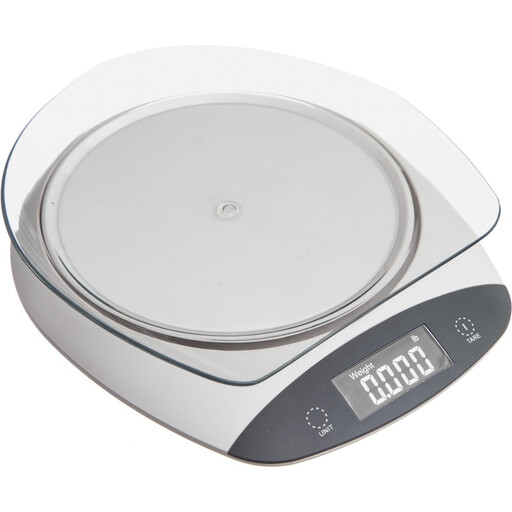
A model with a removable bowl and tare, for anyone who wants to use their own weighing bowl with the appliance; the description mentions large figures on the LCD screen.
Maximum load: 5000 g. The required AAA batteries are not included.
 No image available
The product name mentions app integration; the description says it weighs in grams for kitchen recipes.
Capacity: 10 kg. Display increment: 1 g. Dimensions: 200 x 140 x 19,5 mm. The glass surface can be cleaned with a soft, damp cloth.
 No image available
The product description mentions tare and use for food preparation. The finer display increment is not, on its own, proof of measurement accuracy.
Display increment: 0,1 g. Maximum capacity: 2000 g; the bowl and ingredients must stay within this limit when combined.
Use grams if your recipe gives the amount in grams: zero the scale with the bowl on it, then add honey until you reach the required weight. Don’t assume that an ml setting gives an exact conversion for honey without checking; Salter’s manual describes the liquid setting for water-based liquids.
Not necessarily; for a typical recipe amount, a scale with 1 g increments may be practical. The Voedingscentrum uses 20 g as the weight of a tablespoon of honey. If you also weigh very small amounts, compare a precision scale and check its maximum load including the bowl. A finer display increment does not, on its own, prove greater measurement accuracy.
Follow the cleaning instructions for the specific model. Beurer says that the removable bowl on the KS 25 is dishwasher-safe; this does not automatically apply to the scale itself. Salter’s manual instructs you to clean the appliance with a slightly damp cloth and not to immerse it.
For a consumer purchase in the Netherlands, the seller must offer an appropriate remedy free of charge if the product does not meet what you could reasonably expect under normal use. ACM ConsuWijzer explains that statutory guarantees in the Netherlands do not have a fixed time limit; a manufacturer’s guarantee does not replace your statutory rights.
For a standard online purchase, you generally have a statutory 14-day cooling-off period after delivery; check which exceptions apply. The Dutch government says that when you buy a new, similar electrical appliance, the retailer must take back your old one. You can take used household batteries to a collection point.