
Baker of small loaves
You want to weigh flour into a bowl according to the recipe, rather than relying on a measuring jug.


For flour measured in whole grams, a digital kitchen scale with a gram display and tare function is a practical choice: place the bowl on the scale, zero it and add the flour. If your recipe calls for less than 1 g of yeast, choose a model whose resolution and minimum weighing capacity suit that amount; a display that changes in 1 g increments doesn’t prove it can weigh such small quantities accurately.
You want to weigh flour into a bowl according to the recipe, rather than relying on a measuring jug.
Your recipe calls for less than 1 g of yeast, so the usable lower limit matters more than the maximum capacity alone.
You want to add ingredients one at a time, zeroing the scale between each addition, while keeping in mind how much space the bowl and scale take up.
The right choice depends on what you weigh most often when making small loaves, and how you add your ingredients.
Best for: flour and other ingredients you weigh in whole grams, if you already have a suitable bowl. Beurer and Brabantia list a capacity of up to 5 kg, 1 g increments and a tare function for the models mentioned.
Keep in mind: a tall bowl may obscure the display; the manufacturer’s specifications don’t prove accuracy for fractions of a gram.
Best for: weighing ingredients one at a time in a single bowl supplied with the scale. Salter lists a removable 2-litre bowl and a capacity of 5 kg for the Dual Pour.
Keep in mind: the bowl takes up storage space; check that the display remains visible when the bowl is in place.
Best for: recipes that call for less than 1 g of yeast. Salter describes a Dual Platform Scale with a large platform weighing up to 5 kg and a smaller one weighing up to 500 g.
Keep in mind: check the resolution, minimum weighing capacity and availability in the Netherlands for the exact model.
| Consideration | What to look for | Who it matters to |
|---|---|---|
| Weighing flour | Check that it displays grams and has a tare function, and include the weight of the bowl and ingredients when considering the maximum capacity. | If you want to weigh flour for small loaves according to the recipe, gram measurements come first; around 36% of consumers say weighing flour is their main reason for buying. |
| Weighing small amounts of yeast | Check both the resolution and the minimum weighing capacity of the exact model. | If your recipe requires less than 1 g of yeast, you especially need a usable lower limit; around 29% of consumers prioritise weighing yeast precisely. |
| Working in one bowl | Check that you can zero the scale between additions, that the bowl suits your batch size and that the display remains visible. | If you want to add ingredients one at a time to the same bowl, a tare function and a practical bowl are important; around 21% of consumers prioritise this. |
| Reading and storage | Check the display position with your own bowl, the dimensions and the cleaning instructions. | If you have limited worktop or storage space, readability and compact storage matter; around 14% of consumers put this need first. |
The increment describes the values shown, but on its own it doesn’t tell you how accurately a scale measures small quantities. The Consumentenbond assesses accuracy and repeatability separately using standard weights.
If you want to weigh less than 1 g of yeast, check both the resolution and the minimum weighing capacity of the exact model.
The bowl counts towards the maximum capacity and may also obscure the display.
Check the scale with the bowl you plan to use, and keep the total weight below the limit for the relevant platform.
The KS 19 is a flat digital kitchen scale with a tare function, designed for use with your own bowl.
According to Brabantia, the battery-powered Tasty+ has a flat glass platform, an illuminated display and a hanging loop.
Salter describes both the Dual Pour, supplied with a mixing bowl, and a separate scale with two platforms.
This selection of Joybuy products includes flat kitchen scales, models for finer weighing and a scale with a removable bowl. It also features a coffee scale; check that its functions are suitable for weighing flour and yeast.
 Image unavailable
This flat model may suit small baking sessions where you use your own bowl.
Toughened glass platform; LCD display; maximum capacity of 5 kg; tare function; 1 g increments; displays grams, ounces, pounds and millilitres.
 Image unavailable
This model is designed for espresso and pour-over coffee; check that its functions suit weighing ingredients for your bread recipe.
The product name lists a timer, water flow rate and coffee-to-water ratio functions, with a choice of ounces or kg.
 Image unavailable
If you want to weigh small amounts of yeast, check that the resolution and minimum weighing capacity of the exact version suit your recipe.
The product name lists a dual LED display, a 4-point sensor and a timer.
 Image unavailable
Finer increments may be useful for small amounts; if you’re weighing less than 1 g of yeast, also check the minimum weighing capacity.
The product name lists 0.1 g increments, a capacity of up to 3 kg, rechargeable power, a timer, a heat-resistant platform and a tare function.
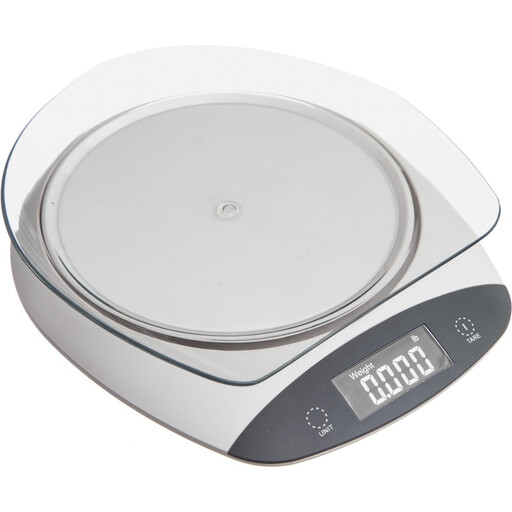 Image unavailable
A removable bowl is handy for weighing ingredients one at a time; before allowing food to come into direct contact with it, check that the supplied bowl is suitable.
Dimensions: 20.5 × 18 × 4.5 cm. Requires 2 AAA batteries; not included.
Place the empty bowl on the scale, use the tare function to reset the display to zero, then add flour until you reach the weight specified in the recipe. Make sure the bowl and its contents stay within the maximum capacity.
No. The increment describes how the value is displayed, not the measurement accuracy in itself. The Consumentenbond tests accuracy and repeatability separately using standard weights.
Don’t assume so. If flour comes into direct contact with the platform, its suitability for food contact matters; if in doubt, use a suitable bowl. The NVWA sets out the applicable rules for food contact materials in the Netherlands.
Not simply because you use it to bake bread at home. The Netherlands Authority for Digital Infrastructure sets out requirements for scales used in commercial transactions or to determine a selling price; if you’re determining weights for products you sell, different rules may apply.
Contact the seller. According to the Dutch Government, products in the Netherlands are legally protected against defects, with no fixed statutory guarantee period; a manufacturer’s guarantee is in addition to this protection. Where your claim is applicable, the seller must provide a solution.