
Home baker weighing raisins for each recipe
You want to weigh small portions of raisins in grams without paying for unnecessary features for occasional use.


If you mainly weigh raisins for recipes, choose a digital kitchen scale that displays grams and lets you tare a bowl. If you also regularly weigh yeast or other small quantities, consider a finer graduation and check the weighing range, space for your bowl and maximum capacity. A smaller display increment alone does not prove greater accuracy or consistency; the Dutch Consumers’ Association assesses these properties separately.
You want to weigh small portions of raisins in grams without paying for unnecessary features for occasional use.
You want to be able to zero a bowl or mixing bowl and then add ingredients, while keeping an eye on the display and maximum capacity.
Alongside raisins, you regularly weigh small quantities such as spices or yeast. A finer graduation may suit you, although the weighing platform could be smaller.
When weighing raisins for small batches of bread rolls, you can assess your options against four practical priorities.
| What to consider | What should you check? | Who is this important for? |
|---|---|---|
| Weighing portions | Check the graduation and weighing range of the exact model. Don’t mistake the displayed increment for independently verified measurement accuracy. | If I mainly want to weigh the raisins for a small batch in grams, I want to be able to read the portion easily. Consumers who prioritise portion weight would make up around 36% of this group. |
| Adding ingredients as you go | Check whether the scale has a tare function and whether you can still reach the buttons with your bowl on the platform. | I want to be able to add ingredients to the same bowl one after another without emptying it in between. Consumers who prioritise adding ingredients as they go would make up around 29% of this group. |
| Reading the display and storage | Check whether you can see the display clearly with your bowl in place, and check the dimensions and storage options of the model. | If I work in a small kitchen, I want to be able to read the display and put the scale away easily after use. Consumers who prioritise ease of use would make up around 21% of this group. |
| Weighing small quantities | Check which part of the weighing range uses the finer graduation. Also compare the platform and maximum capacity with the bowl and its contents. | As well as raisins, I sometimes weigh small quantities of yeast or spices and want to read them more precisely. Consumers who prioritise these small ingredients would make up around 14% of this group. |
The graduation tells you the increments in which the weight is displayed. The Dutch Consumers’ Association assesses accuracy and measurement consistency separately using standard weights.
Choose an increment that suits the ingredients you weigh. Only rely on measurements for the exact model when judging measurement error or repeatability.
Your bowl needs to fit on the platform without covering the display. Some compact precision scales have a smaller platform and a lower maximum capacity.
Compare the dimensions with your bowl, and include the weight of the bowl and ingredients when checking the maximum capacity.
The HEMA digital kitchen scale we researched is designed for everyday weighing with a bowl.
According to Tefal, the Optiss BC50U0V0 combines a tare function and backlit display with finer graduations for weights under 1 kg.
The Tasty+ kitchen scale we researched is battery-powered and, according to Brabantia, designed to weigh in grams.
The KS 36 is a compact precision kitchen scale for anyone who also weighs very small ingredients.
This selection includes digital kitchen scales for baking, as well as a scale with coffee-brewing features. Check whether the features and weighing range of each model suit weighing raisins.
 No image available
Its gram increments and tare function are useful for weighing ingredients in a bowl.
Maximum capacity: 5 kg. Displays in 1 g increments. LCD screen and units for grams, ounces, pounds and millilitres. For household use only; not intended for commercial or industrial weighing.
 No image available
This scale is described as being for espresso and pour-over coffee; check whether its features suit your baking needs.
The product name mentions a timer, a coffee-to-water ratio function and a water flow function. It also mentions switching between ounces and kg.
 No image available
The product description mentions baking and a tare function, so you can weigh ingredients in a bowl.
Stated maximum capacity: 3 kg. The description lists a 0,1 g increment, a minimum weighing amount of 3 g and a dual LED display.
 No image available
The tare function and weight display in grams are handy when weighing ingredients in a bowl.
Stated range: 1–5000 g. The product description mentions an LCD screen with large digits and dimensions of 17 × 13 cm.
 No image available
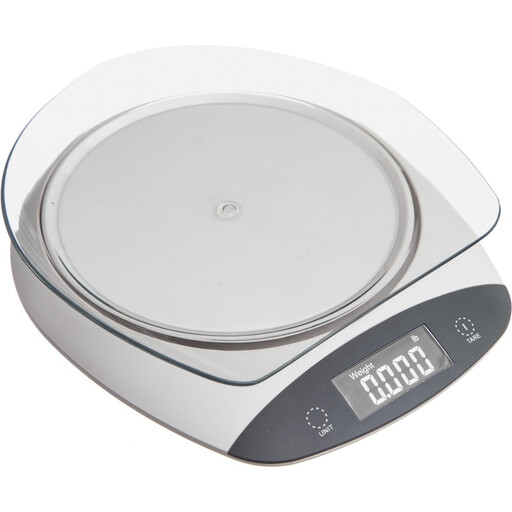
The removable bowl and tare function are useful for weighing ingredients while baking.
Stated maximum capacity: 5000 g. The product name lists dimensions of 20,5 × 18 × 4,5 cm.
Not necessarily: a scale with 1 g increments may be suitable for weighing portions of raisins. A finer increment can be useful if you also weigh smaller quantities, but it doesn’t prove how large the actual measurement error is.
Place the bowl on the scale and use the tare function to set the display to zero before adding the raisins. Keep an eye on the maximum capacity, including the bowl and its contents.
Check the material and battery information for the exact model. Brabantia says the glass surface of the Tasty+ we researched can be wiped clean; for item 80880037, HEMA lists a CR2032 battery and no rechargeable function.
According to ACM ConsuWijzer, for a standard online product purchase you generally have a legal cooling-off period of up to 14 days after delivery. If a product doesn’t meet what you could reasonably expect under normal use, the seller remains responsible under the statutory guarantee.
The rules described do not require you to choose a scale certified for commercial use when weighing raisins at home. The Dutch Authority for Digital Infrastructure sets out requirements and checks for specific uses, including scales used to determine a sale price. If you sell products by weight, check the rules for that use separately.