
Anyone who wants to make soup quickly after class
You want to weigh dried lentils straight into your own bowl. A tare function and a display that stays visible with the bowl on the scale make this easier.


For weighing dried lentils into a bowl after an evening class, the key things to look for are a tare function, an easy-to-read display and enough capacity for the bowl and ingredients together. A flat model is handy if you’re short on storage space; a removable bowl or extra capacity matters most if you’ll use the scale for other cooking tasks too. A 1 g increment doesn’t, by itself, prove that a scale is accurate.
You want to weigh dried lentils straight into your own bowl. A tare function and a display that stays visible with the bowl on the scale make this easier.
You use your own bowl and want to tuck the scale away in a drawer or hang it up afterwards. A flat design or hanging loop may suit the way you prefer to store it.
You sometimes weigh a heavy dish containing several ingredients. So check the combined weight of the bowl and its contents against the scale’s maximum capacity.
| What to consider | What to look for | Who is this important for? |
|---|---|---|
| Quick weighing with a bowl | Check for a tare function and make sure the bowl won’t cover the display or buttons. | If you want to weigh lentils in your own bowl quickly after class, the tare function saves you doing the sums. Speed is the top priority for around 36% of consumers. |
| Compact storage | Compare a flat design or hanging loop with the space you have at home. | If you have limited space on your worktop or in your cupboard, a flat scale or one you can hang up may be easier to store. Around 29% of consumers prioritise compact storage. |
| Reading the display and cleaning | Check the display’s position and lighting, and which parts can be cleaned. | If you want to read the weight clearly and clean the scale easily after cooking, these practical details matter. Around 21% of consumers prioritise readability and ease of cleaning. |
| Capacity | Add the weight of the bowl and ingredients together, then compare it with the maximum capacity. | If you also use heavy dishes or weigh larger quantities, the total weight must stay within the stated maximum. Extra capacity is the top priority for around 14% of consumers. |
The increment tells you how the weight is displayed; it doesn’t, by itself, tell you how small the measurement error is. Consumentenbond treats measurement error and repeatability as separate points in its tests.
If accurate weighing matters to you, compare test results. Don’t choose a scale based only on the number of decimal places or the increments shown on the display.
The bowl and any other ingredients also add to the load on the scale. According to Beurer, the KS 25 has a maximum capacity of 3 kg; the KS 34 is rated for 15 kg. These figures apply to different models.
Compare the expected total weight with the maximum capacity of the model you’re considering. Extra capacity is only useful if you need it for other cooking tasks.
Beurer says the removable bowl of the KS 25 is dishwasher-safe. That doesn’t automatically apply to the scale itself; Brabantia recommends wiping the glass surface of the Tasty+ clean.
Check the cleaning instructions for each part and follow those for the model you choose.
The digital kitchen scale with product number 80880037 is a flat model designed for use with your own bowl.
The Tasty+ is a flat model with a hanging loop. The Profile is a different model with a kitchen timer; their features aren’t interchangeable.
The KS 25 has a removable bowl, the KS 34 has a higher capacity, and the KS 36 is designed for small quantities. Features vary by model.
This selection includes flat digital kitchen scales, models with a removable bowl and a few scales described specifically for espresso or pour-over coffee. For weighing lentils for soup, a tare function and sufficient capacity for the bowl and ingredients are important; for coffee scales, check that the shape and controls suit the way you’ll use the scale for cooking.
 No image available
The product title describes this model as being for espresso and pour-over coffee; check that its controls suit weighing ingredients for soup.
The title mentions a timer and functions for the coffee-to-water ratio and water flow.
 No image available
A flat model to consider if you use your own bowl and want a scale that takes up little storage space.
The product title lists dimensions of 17 × 13 × 2 cm.
 No image available
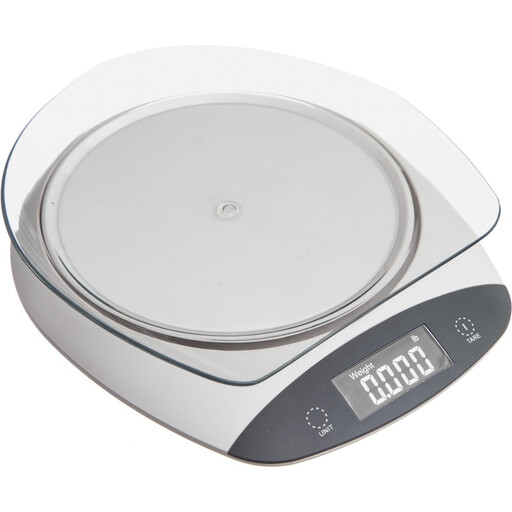
The removable bowl may suit you if you’d rather use the bowl supplied than your own.
The product title lists dimensions of 20.5 × 18 × 4.5 cm.
 No image available
The product title mentions Bluetooth and app integration; check which app and phone compatibility you need.
The title lists a capacity of 10 kg and a glass surface. Follow the product instructions for cleaning.
 No image available
This model is described as a pour-over coffee scale; consider whether its size and controls suit the way you’ll use it for soup ingredients.
The product title mentions a timer and a capacity of 2000 g. If you use a bowl, remember to allow for the total weight.
Follow the recipe’s instructions. The Voedingscentrum lentil soup recipe calls for 150 g of dried lentils for two people, so you weigh that amount before cooking. This is an example from a recipe, not a general serving-size recommendation.
Put the empty bowl on the scale and reset the display to zero before adding the lentils. First check that you can see the display and reach the tare button with your bowl in place.
Don’t assume you can. For the KS 25, Beurer only describes the removable bowl as dishwasher-safe; Brabantia recommends wiping the glass surface of the Tasty+ clean. Follow the cleaning instructions for the model you choose.
Check the battery type, whether batteries are included and what delivery charges apply. ACM ConsuWijzer explains that online purchases come with a statutory 14-day cooling-off period after delivery. The statutory guarantee is separate from the manufacturer’s warranty and depends on what you can reasonably expect from the product.
The requirements set out by the Rijksinspectie Digitale Infrastructuur apply to certain uses, such as commercial transactions and calculating a selling price. Weighing lentils for your own soup is domestic use; don’t use a household scale to set a selling price by weight unless it has been appropriately verified.