
Home baker who weighs everything in one bowl
This home baker wants to add sugar and the next cake ingredients one after another using the tare function, without having to fetch a different bowl each time.


For sugar and other cake ingredients that you weigh one after another in the same bowl, a digital kitchen scale with a tare function is handy, provided the bowl sits securely and the bowl and its contents stay within the maximum capacity. Also consider how easy the display is to read and whether you can reach the zero button; a finer display increment does not in itself prove greater measuring accuracy. The Consumentenbond tests accuracy and consistency separately and has found differences between kitchen scales, but its public summary does not name an overall winning model.
This home baker wants to add sugar and the next cake ingredients one after another using the tare function, without having to fetch a different bowl each time.
This baker wants the bowl and ingredients to fit within the weighing capacity, with the display still visible while adding ingredients.
As well as weighing performance, this baker considers how easy the surface is to wipe clean, how compactly the scale can be stored and what it needs to run.
| What to consider | What to look for | Who should pay particular attention? |
|---|---|---|
| Ingredients in one bowl | Check that you can reach the tare or zero button with your bowl on the weighing platform. | If I want to weigh sugar and then other ingredients in the same bowl, the tare function is my top priority. Around 36% of consumers in this baking scenario prioritise weighing ingredients one after another. |
| Space and capacity | Compare the base of your bowl and the combined weight of the bowl and its contents with the weighing platform and maximum capacity. | With a large mixing bowl, I want to weigh ingredients without the bowl sitting unsteadily or exceeding the total capacity. Around 29% of consumers give the bowl and capacity top priority. |
| Readability | Check the position and backlighting of the display, and whether the buttons remain within reach with your bowl on the scale. | If my bowl could cover the screen, I want to be able to see the figures clearly while adding ingredients. Around 21% of consumers prioritise readability. |
| Cleaning and storage | Check the cleaning instructions, storage options and battery type required; also see whether batteries are included. | After baking, I want to clean the surface easily and store the scale without a fuss. Around 14% of consumers give maintenance and storage top priority. |
The display increment and the actual measurement error are two different things. The Consumentenbond tests accuracy and consistency separately.
Look for independent test results for the exact model, if available; do not treat the stated weighing increments as proof of its measurement error.
The bowl counts towards the maximum capacity. A large bowl may also overhang the weighing platform or cover the display and controls.
Check the maximum capacity, weighing platform and display position using the bowl you actually plan to use.
A stated manufacturer's guarantee does not replace your Dutch statutory rights to a product that meets the required standard. The Dutch government says there is no fixed statutory guarantee period in the Netherlands.
Keep your proof of purchase and contact the seller if there is a fault; a manufacturer's guarantee is in addition to your statutory rights.
The Optiss BC50U0V0 is worth considering if you bake in stages and need room for your bowl.
The Tasty+ is a good fit if you want a backlit display, a hanging loop and an easy-to-wipe glass surface.
The KS 19 Fresh is a slim glass scale for anyone who values a tare function and easy cleaning.
The KN353 was included by KeukenTest.nl in a general ranking for cooking and baking.
This selection includes digital kitchen scales for weighing ingredients in a bowl, with models varying in storage design, materials and stated maximum capacity.
 No image available
The tare function is designed for weighing ingredients one after another in the same bowl.
Toughened glass surface; LCD display; maximum capacity 5 kg; 1 g increments; displays grams, ounces, pounds and millilitres. The bowl and its contents count towards the maximum capacity.
 No image available
The tare function is designed for weighing ingredients one after another in the same bowl.
Toughened glass surface; LCD display; maximum capacity 5 kg; 1 g increments; displays grams, ounces, pounds and millilitres. The bowl and its contents count towards the maximum capacity.
 No image available
Its dimensions may be useful if you are looking for a scale that takes up little space when stored.
Material according to the product name: stainless steel. Dimensions: 17 × 13 × 2 cm.
 No image available
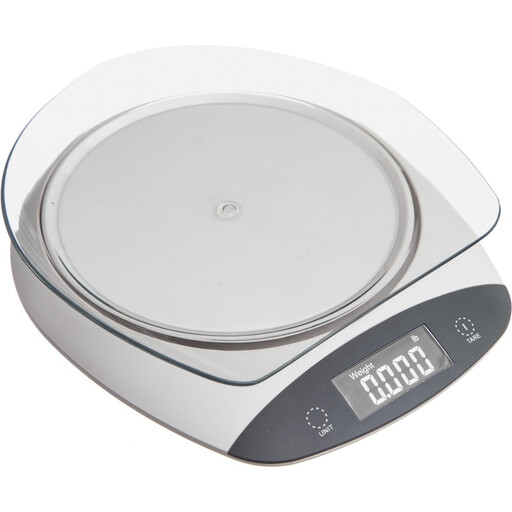
The removable bowl may suit anyone who wants to weigh ingredients in the bowl supplied and handle it separately afterwards.
Dimensions according to the product name: 20,5 × 18 × 4,5 cm.
 No image available
The product name states a capacity of 10 kg; check that your bowl sits securely and remember to allow for the weight of the bowl and its contents.
Toughened glass surface; Bluetooth; app integration; multiple units. The product name also states 1 g precision; this is not an independent test result.
Place the bowl on the scale and reset the display to zero before adding the sugar. Use the tare function again for the next ingredient, and keep the combined weight of the bowl and its contents within the maximum capacity.
No. The stated increment describes how the display is divided; it does not, by itself, tell you the measurement error. The Consumentenbond tests accuracy and consistency separately and has found differences between kitchen scales.
In the Netherlands, you are entitled to a product that meets the required standard, and there is no fixed statutory guarantee period. Contact the seller about a fault; according to the Dutch government, a manufacturer's guarantee is in addition to your statutory rights and does not replace them.
According to the Dutch government, used batteries must not go in household waste. You can take them to shops that sell batteries, among other places. You can take a discarded appliance that uses batteries to a recycling centre, or return it when buying a similar appliance under the old-for-new scheme.