
Bakers who want to follow the recipe precisely
You want to weigh the specified amounts of coconut and sugar and read the result easily. The display and tare function are practical considerations.


For coconut macaroons, a digital scale with a gram display and a tare function is handy if you want to weigh ingredients in your own bowl. Choose a maximum capacity that takes the weight of the bowl and its contents into account. Koopmans’ recipe uses 200 g desiccated coconut and 200 g sugar. A display that changes in 1 g increments does not, by itself, prove that a scale measures to within 1 g in all conditions.
You want to weigh the specified amounts of coconut and sugar and read the result easily. The display and tare function are practical considerations.
You may be using a larger bowl or adding ingredients one at a time. Check the maximum capacity for the bowl and its contents together, as this varies by model.
You may prioritise a clearly visible display and parts that are easy to clean after baking. Check which parts the manufacturer says are dishwasher-safe.
First, decide whether you’d rather use your own bowl on a flat platform or choose a model that comes with a bowl. Then check the total capacity, how easy the display is to read and the cleaning instructions.
| What to consider | What should you check? | Who should give this more weight? |
|---|---|---|
| Easy-to-read weighing | Check that the scale displays grams and that you can see the screen when your own bowl is on the platform. Where available, look at independent test results too. | If I want to follow the quantities in a recipe, I look for a clear display. Around 36% of consumers make reliable, easy-to-read weighing their top purchasing priority. |
| Bowl and capacity | Add the weight of the empty bowl to the ingredients and compare the total with the stated maximum. Also check whether the scale has a tare function. | If you want to weigh several ingredients in a bowl, remember to include the weight of the bowl. Around 29% of consumers give the bowl and capacity top priority. |
| Cleaning and visibility | Check the cleaning instructions for the exact model and which parts, if any, are dishwasher-safe. Also check whether the bowl obscures the display or buttons. | If I want to tidy up quickly after baking and see the reading clearly, I look at how to clean the scale and where the display is positioned. Around 21% of consumers put cleaning and visibility first. |
| Compact and easy to use | Check the dimensions, battery type and controls of the exact model. Don’t base your choice of weighing performance solely on the stated display increments. | If you mainly want a scale that’s easy to put away, look for a compact design and straightforward controls. Around 14% of consumers make compact size and ease of use their top purchasing priority. |
A display that changes in 1 g increments describes the change in weight shown, not necessarily the scale’s measurement error. The Consumentenbond assesses accuracy and consistency separately.
If you want to compare the weighing performance of different models, look for independent test results and check the measurement method used.
The bowl also adds weight. What’s more, the models tested don’t all have the same stated maximum capacity.
Compare the combined weight of the bowl and ingredients with the specification for the exact model.
The dishwasher-safe claim for the Beurer KS 25 applies to its removable bowl, not necessarily to the electronic device.
Follow the cleaning instructions for each part of the model in question.
The Page Compact 300 is a flat model for anyone who uses their own bowl and wants a scale that’s easy to store.
According to Brabantia, the Tasty+ Light Grey has a flat glass platform and an illuminated display.
The KS 19 Fresh has a flat platform, while the KS 25 comes with a removable bowl.
Item 80880037 is a flat model for weighing ingredients in your own bowl.
This selection includes digital scales for kitchen and coffee use. For coconut macaroons, the gram display, tare function and intended use of the model are all worth considering.
 No image available
A flat digital model for weighing ingredients in grams, with a tare function for use with a bowl.
The product name specifies a tempered glass surface, an LCD display, a maximum capacity of 5 kg and 1 g increments.
The product name lists readings in grams, ounces, pounds and millilitres. According to the listing, the model is intended for household kitchen use, not commercial weighing.
 No image available
A flat digital model for weighing recipe ingredients; the listed tare function is designed for use with a bowl.
The product name specifies a tempered glass surface, an LCD display, a maximum capacity of 5 kg and 1 g increments.
The product name lists readings in grams, ounces, pounds and millilitres. According to the listing, the model is intended for household kitchen use, not commercial weighing.
 No image available
This model is described as a coffee scale for espresso and pour-over; check that its intended use and controls suit weighing baking ingredients.
The product name mentions a timer, a coffee-to-water ratio and switching between ounces and kilograms.
 No image available
A flat digital kitchen scale for anyone who wants to weigh ingredients in their own bowl.
The product name specifies stainless steel and dimensions of 17 × 13 × 2 cm.
Batteries are not included.
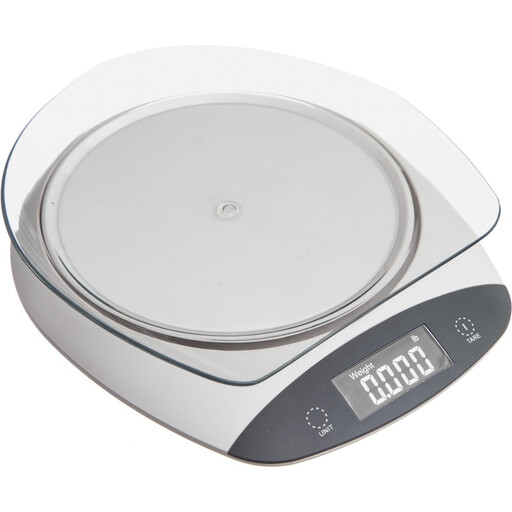 No image available
A model with a removable bowl included, for anyone who would rather not use their own mixing bowl on the platform.
The product name specifies dimensions of 20.5 × 18 × 4.5 cm. The model requires two AAA batteries, which are not included.
Put the empty bowl on the scale and use the tare function before adding the coconut. For Koopmans’ recipe, weigh out 200 g desiccated coconut. Reset the scale to zero before weighing the stated 200 g of sugar.
Don’t assume this from a claim about the bowl. Beurer specifically says that the removable bowl for the KS 25 is dishwasher-safe; follow the relevant cleaning instructions for the electronic unit and other models.
When you buy online from a business, you usually have a 14-day cooling-off period, according to the Rijksoverheid. You also have statutory rights: if a product is faulty, the seller is your point of contact. A manufacturer’s guarantee does not replace these rights.
No. The fact that a scale weighs ingredients does not, by itself, mean that its surface is suitable for food contact. The NVWA sets out separate safety requirements for materials that come into contact with food. Weighing ingredients in a clean, suitable bowl prevents them from coming into direct contact with the platform.
Take a flat, removable battery to a battery collection point separately. Milieu Centraal advises recycling batteries separately if you can remove them from the device.