
Cooking a large batch of sauce
You’re using a heavy bowl or weighing lots of ingredients at once. The combined weight determines whether 5 kg is enough or whether you need to look for a higher capacity.


Weigh the bowl and ingredients together before choosing a kitchen scale. A heavy bowl or large batch may call for a model with a higher capacity, while 5 kg may be enough for smaller portions. The tare function is useful when you’re weighing ingredients one after another in the same bowl. A small weighing increment alone doesn’t tell you how accurately or consistently a scale measures.
You’re using a heavy bowl or weighing lots of ingredients at once. The combined weight determines whether 5 kg is enough or whether you need to look for a higher capacity.
You’re adding cheese and other ingredients one at a time and want to reset the scale to zero between additions without changing bowls.
You’re considering whether the display will remain visible, whether the surface is easy to clean, and how you’ll store or power the scale.
If you’re weighing cheese for sauce in larger batches, the total load, tare function and ease of reading the display are important things to consider.
| What to consider | What to look for | Who will value this? |
|---|---|---|
| Capacity for the bowl and batch | Compare the maximum capacity with the combined weight of your heaviest bowl and its ingredients. | When making a large batch, I want to know that the bowl and its contents stay within the limit; around 28% of consumers therefore give capacity top priority. |
| Repeatable measurements | Check the weighing increment, but don’t treat it as proof of the scale’s accuracy or consistency. | When comparing quantities of cheese across successive batches, I want to be able to rely on consistent measurements; around 22% of consumers prioritise measurement consistency. |
| Tare function for the same bowl | Check that the scale has a tare function and that you can still reach the button with your bowl on it. | When weighing several ingredients in one bowl, I want to reset the scale to zero between additions without moving the bowl; around 22% of consumers say the tare function is their main consideration. |
| Readability and cleaning | Check that you can see the display with your bowl on the scale, and follow the model’s cleaning instructions. | If I want to read the display quickly while cooking and clean up easily after a spill, the display and surface matter; around 17% of consumers say this is their main consideration. |
| Power supply | Check the battery type and whether batteries are included, or find out what’s involved in using a battery-free alternative. | If I’d rather avoid replaceable batteries, or specifically want a battery-powered model, the power supply is the deciding factor; around 11% of consumers put it at the top of their list. |
The bowl also counts towards the maximum load. The models reviewed have stated maximum capacities of 5 kg or 15 kg, depending on the model.
Compare the maximum capacity of the exact version with the heaviest combined weight you expect for the bowl and its contents.
If the total is too heavy, you may need to weigh it in several portions.
A weighing increment describes the steps shown on the display. On its own, it doesn’t tell you how small measurement errors are or how consistently a model measures. Consumentenbond assesses these properties separately using known weights.
Use the stated weighing increment to compare display resolution, and look for independent measurements of the exact model as well.
The battery-powered version is specified from 1 g; the dynamo version’s weighing range starts at 5 g. The dynamo version also requires you to turn a knob to generate power.
Before buying, check the full version name and whether the model runs on batteries or has a dynamo.
The KS 34 XL Black is worth considering if the bowl and batch together could weigh more than they would on a 5 kg model.
The Optiss BC50U0V0 is a 5 kg option with a tare function, for anyone who wants to weigh ingredients one after another in the same bowl.
The Tasty+ models reviewed include a battery-powered version and a separate dynamo version, each with different requirements for use.
HEMA’s digital kitchen scale is a straightforward 5 kg option with an LCD display.
These picks range from kitchen scales with a higher capacity to compact models for weighing ingredients one after another. For a larger batch of sauce, pay particular attention to the combined load of the bowl and its contents; one of the versions shown is analogue rather than digital.
 No image available
Worth considering if the bowl and ingredients together could weigh more than 5 kg.
The product name lists a capacity of 10 kg, 1 g graduations, a glass surface, several units of measurement and app integration. Check whether this version has a tare function if you want to weigh ingredients one after another in the same bowl.
 No image available
A compact option for weighing ingredients one after another in the same bowl, if 5 kg is enough.
The stated capacity is 5 kg; the product information lists a tare function, an LCD display and dimensions of 17 × 13 × 2 cm. Batteries are not included.
 No image available
A compact option for weighing ingredients one after another, as long as the combined load of the bowl and ingredients stays below 3 kg.
The product information lists a tare function, a 0,1 g weighing increment, a dual LED display, a timer and a rechargeable USB-C battery. It measures 14,8 × 12,8 × 2 cm; the maximum load is 3 kg, including the bowl and its contents.
 No image available
This pour-over scale is only suitable if the combined weight of the bowl and its contents stays within the 2.000 g limit.
The product information lists a tare function, a timer, a USB-C rechargeable battery and dimensions of 15 × 13 cm. The maximum load is 2.000 g, including the bowl and its contents.
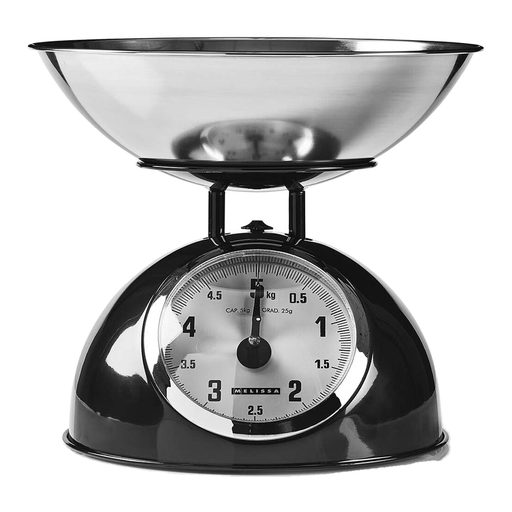 No image available
This version is only suitable if you don’t need a digital scale; the product name specifically says that it’s analogue.
The product information lists a maximum load of 5 kg, 25 g increments, a tare function and a removable stainless steel bowl. Remember to account for the combined weight of the bowl and its contents.
Use a scale with a tare function: put the empty bowl on the scale, reset it to zero and add the first ingredient. Reset the scale to zero again before adding the next ingredient, and stay within the maximum capacity, including the bowl. Tefal describes this use for the Optiss BC50U0V0.
Don’t assume the whole appliance is dishwasher-safe. For the glass surface of the Tasty+ battery-powered version reviewed, Brabantia recommends wiping it clean. Check the manual for your exact model before using water or cleaning products.
In the Netherlands, you’re entitled to a product that matches the contract. According to the Rijksoverheid, there is no fixed statutory warranty period; a manufacturer’s warranty is in addition to your legal rights. If there’s a fault that isn’t your responsibility, the appropriate solution depends on the circumstances.
According to the Rijksoverheid, when you buy online from a business, you’re entitled to a 14-day cooling-off period in many cases. A purchase from a private individual isn’t covered by the same distance-selling rules.
This is food safety advice from the Voedingscentrum and is unrelated to the scale: cool leftovers quickly and don’t leave them out of the fridge for more than 2 hours. Store them in a sealed container in the fridge or freezer; the Voedingscentrum advises keeping covered leftovers in the fridge for no more than 2 days.