
Vandaag of morgen in huis

Kwaliteit gegarandeerd

Welkomstaanbiedingen ontgrendelen: GRATIS bezorging | Tot 80% korting | Gratis 30 dagen JoyPlus-proefperiode
Download de app
A kitchen scale may seem like a simple appliance, but the differences between models can be significant. A home baker has different requirements from someone who makes coffee, prepares portions or wants to keep track of nutritional values. So don’t focus solely on appearance or a long list of features.
Three common pitfalls are:
For everyday cooking, a digital kitchen scale with a capacity of 5 kg is usually sufficient. Also pay attention to the increments:
A precision kitchen scale for coffee or small quantities does not necessarily need a high maximum capacity. Also check the minimum weighing weight. Some models only measure from a few grams upwards.
With a kitchen scale with a tare function, you can set the weight of a bowl or measuring jug to zero. This allows you to add ingredients one after another without weighing everything separately. For baking and cooking, this is often more convenient than using a separate bowl for each ingredient.
Also check which units are available. Grams and kilograms are the most common units in the UK. Ounces and pounds are useful for international recipes. A millilitre setting can be practical, but check whether it is intended for water, milk or a general volume estimate. Weight and volume are not the same for every ingredient.
A kitchen scale with an LCD display should be easy to read when a bowl or pan is placed on it. A flat surface made from stainless steel or tempered glass is generally easy to wipe clean. No electronic model should be immersed in water or placed in the dishwasher.
Also look out for:
An analogue kitchen scale does not need a display or charging function, but its graduations are coarser. This may be sufficient for larger quantities, but less suitable for precise weighing.
The recommendations below are based on the stated product specifications, capacity, increments, controls and accessories. Brand information about features such as nutritional analysis is not presented here as independently verified performance; where relevant, we refer to the product information.

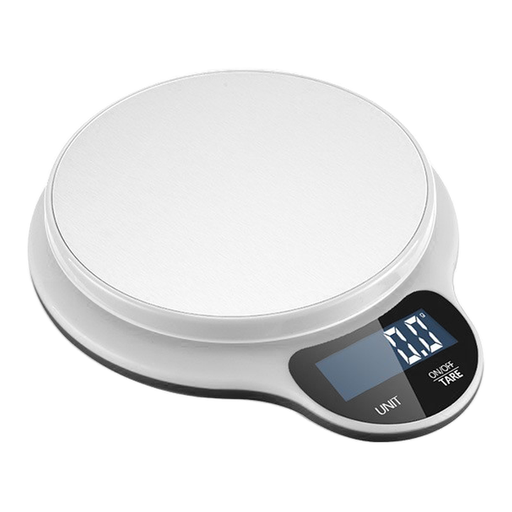
Why it suits this profile: This model is designed for straightforward everyday use: weighing, taring and changing the unit without complicated extra features.
The specifications state a maximum capacity of 5 kg and increments of 1 gram. This clearly defines the capacity rather than presenting it merely as a marketing feature.
Tempered-glass platform, LCD display, tare function, 1-gram increments and an included CR2032 battery.
Why it suits this profile: Home bakers and anyone weighing small quantities benefit from 0.5-gram increments and a stainless-steel platform.
The product information specifies both a 5 kg capacity and 0.5 g precision. Tare, unit conversion, overload warning and automatic switch-off are also listed.
Stainless-steel surface, LCD display, gram/ounce/pound conversion and 2 included AAA batteries.

Why it suits this profile: Suitable for households weighing larger quantities and wanting to use an app connection to record ingredients or portions.
The 10 kg capacity and 1-gram increments are listed separately. The minimum weighing weight is 3 grams, which is relevant when measuring very small quantities.
Bluetooth, multiple units, 3 mm tempered glass and dimensions of 200 × 140 × 19.5 mm.

Why it suits this profile: The product name and description focus on espresso and pour-over coffee, with features for timing, water flow and the coffee-to-water ratio.
Here, you are specifically choosing coffee-related features instead of general nutritional analysis that you may not need. Check the current technical details on the product page before buying.
Timer function, water-flow information and support for ounce and kilogram units according to the product name.
We have put together a complete, up-to-date list of products that fully meet these strict selection criteria and the applicable European safety regulations.
For baking, a digital kitchen scale with 1 gram or 0.5 gram increments and a tare function is practical. A capacity of 5 kg is sufficient for most household recipes. If you often weigh very small quantities of yeast, herbs or coffee, it is better to look for finer increments.
The lifespan depends on use, storage and maintenance. Place the scale on a flat surface, avoid overloading it and clean the platform with a slightly damp cloth. Store an electronic model in a dry place and remove the batteries if you are not going to use it for an extended period.
Most models run on coin-cell or AAA batteries and switch off automatically. As a result, consumption remains limited during normal household use. Check in advance which battery type is required and whether it is included. An analogue kitchen scale does not use an electronic weighing function, but according to the product specifications, certain versions may still require a battery.
