
Baker weighing several portions
If you’re dividing raisins into several portions, the tare function makes it easy to reset the scale to zero between portions.


If you’re weighing raisins for several portions, a kitchen scale with a gram display and a tare function is useful: place the bowl on the scale, zero it and add your ingredients. If you use a heavy bowl or are making a large batch, pay particular attention to the maximum capacity for the bowl and its contents combined. A 1 g increment is a model specification, not proof of weighing accuracy; the Consumentenbond treats accuracy and consistency as separate test criteria.
If you’re dividing raisins into several portions, the tare function makes it easy to reset the scale to zero between portions.
When you’re making a large batch, the bowl’s weight counts towards the total. Check that the maximum capacity can accommodate both the bowl and its contents.
If you want to put the scale away after baking, a clear display and an easy-to-wipe surface may also influence your choice.
Start by choosing a scale that suits the way you work: repeated weighing calls for a tare function, while a heavy bowl makes the total maximum capacity especially important.
| What to consider | What to look for when buying | Who should prioritise this? |
|---|---|---|
| Weighing portions one after another | Check that the model displays grams and has a tare function, and that you can operate it with the bowl on the scale. | If I’m weighing raisins for different portions one after another, I want to be able to weigh again after each addition. Around 36% of consumers say their main priority for this baking task is weighing portions one after another. |
| Weight capacity | Compare the expected combined weight of the bowl and its contents with the maximum capacity. Also check that the bowl sits securely. | When making a large batch, I want the scale to support the weight of both my mixing bowl and the ingredients. Around 29% of consumers say their main priority is having sufficient capacity. |
| Display and cleaning | Check that you can see the display with your bowl on the scale, and follow the cleaning instructions for the surface. | If I want to check the reading quickly while baking and clean the surface easily afterwards, the display position and material matter to me. Around 21% of consumers say their main priorities are readability and ease of cleaning. |
| Storage and batteries | Check the dimensions, battery type and whether batteries are included. | If I want to put the scale away after a neighbourhood meal, I consider how much space the model takes up and how it’s powered. Around 14% of consumers say their main priorities are storage and battery use. |
The tare function resets the displayed reading to zero, but it doesn’t change the scale’s maximum capacity.
To stay within the weight limit, add the weight of the bowl and all its contents together. For a heavy batch, choose a model with a higher stated capacity if needed.
The increment tells you how the scale displays weight; it doesn’t automatically tell you how accurately or consistently it measures.
If consistent measurements are essential, look for an independent test of the exact model.
The Beurer KS 34 XL Black and KS 36 have different maximum capacities. For Tristar, the measuring jug mentioned is supplied with the KW-2453, not the KW-2435.
Before buying, check the full model number, maximum capacity and included accessories.
The 80880037 digital kitchen scale is a straightforward option if you use your own bowl and want a tare function.
The KS 34 XL Black is worth considering if you use a large bowl; the KS 36 is a separate model designed for smaller quantities.
The KW-2435 is a flat model for use with your own bowl, while the KW-2453 comes with a measuring jug.
The battery-powered Tasty+ model we looked at may suit you if you want a backlit display, a glass surface and the option to hang it up.
These product picks are aimed at weighing raisins in your own bowl, where a tare function, readability and easy storage may all be important.
 Image unavailable
Suited to anyone who wants to weigh raisins in their own bowl and use the tare function to zero the bowl’s weight.
Maximum capacity: 5 kg; glass platform; LCD display; readings in grams, ounces, pounds and millilitres; 1 g increments.
 Image unavailable
A possible choice if you value a dual display and a timer when weighing ingredients.
The product name mentions a 4-point sensor and timer.
 Image unavailable
The stated maximum capacity may suit smaller quantities; if you use a bowl, remember to account for the total weight.
The product name mentions 0.1 g, a timer, a rechargeable design, a heat-resistant platform and a tare function.
 Image unavailable
This flat model may suit you if you use your own bowl and want to store the scale compactly.
Dimensions: 17 × 13 × 2 cm.
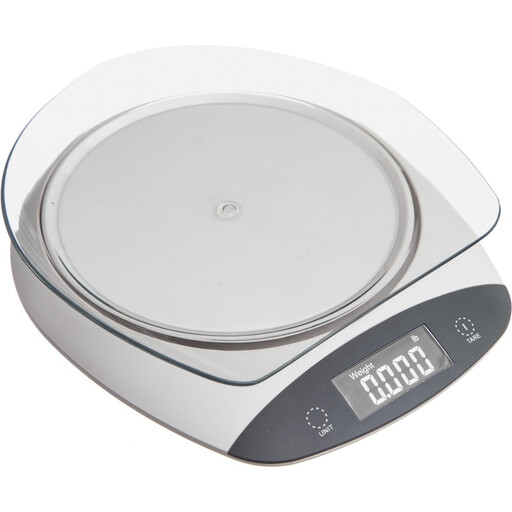 Image unavailable
A possible choice if you’d rather use the bowl supplied than your own mixing bowl.
Dimensions: 20.5 × 18 × 4.5 cm.
Place the empty bowl on the scale and activate the tare function to reset the reading to zero, then add the raisins. Use the tare function again if you want to measure a subsequent addition separately, and keep the total weight of the bowl and its contents below the model’s maximum capacity.
No, the increment is not the same as measurement accuracy. The Consumentenbond treats accuracy and consistency as separate test criteria; check a test of the exact model if these qualities matter to you.
Check the details for the exact version: the HEMA scale mentioned and the Tristar KW-2435 come with a CR2032 battery, while Brabantia lists three AAA batteries for the Tasty+ model we looked at. Brabantia also states that this version comes with a five-year manufacturer’s warranty and service.
The NVWA sets out requirements for safely and hygienically preparing, storing and selling food made at home for sale to consumers. Businesses selling food must also inform consumers about any allergens it contains. This is different from sharing rolls informally and is not affected by your choice of scale.
If you sell products by weight, metrology rules may apply. The Dutch government states that businesses must use approved measuring instruments for fair trade; a household scale displaying grams is not, on its own, proof that it is approved for trade use.