
Bread baker after class
Wants to weigh flour and the next ingredients in one bowl, without too many steps. A tare function and a display that remains easy to read beside the bowl can help you choose.


For flour and standard recipe quantities, a digital scale with a tare function, an easy-to-read display and enough capacity for the bowl and ingredients is a practical place to start. If you also weigh very small amounts of yeast or salt, check the minimum weighing range. For large bowls or batches, the weighing surface and total capacity matter more. A 1 g increment alone does not tell you how accurately a scale weighs.
Wants to weigh flour and the next ingredients in one bowl, without too many steps. A tare function and a display that remains easy to read beside the bowl can help you choose.
Weighs small amounts of yeast or salt as well as flour, so compares the lower end of the weighing range with the size of the bowl and the maximum capacity.
When weighing, needs plenty of space on the platform, sufficient capacity and a clear view of the weight reading.
| Concern | What to look for | Who should consider this most? |
|---|---|---|
| Flour and ingredients in one bowl | Check that the scale has a tare function, displays grams and has enough capacity for the bowl and its contents. | If I want to weigh flour after class, then add other ingredients to the same bowl, I want to be able to reset the scale to zero easily between ingredients. Around 36% of consumers say weighing flour in one bowl is their main concern. |
| Small amounts of yeast or salt | Compare both the display increment and the minimum weighing limit; a smaller increment alone does not prove greater accuracy. | If you also want to weigh small amounts directly, pay particular attention to the lower weighing range and whether your bowl is suitable. Around 29% of consumers put this at the top of their list when buying. |
| Reading the display and storage | Check the position of the display and tare button with the bowl on the platform; also check how long the scale stays on. | If I want to read the display at a glance and put the scale away after use, screen visibility and ease of use matter. Around 21% of consumers prioritise this. |
| Large bowl or batch | Add the weight of the bowl and its contents, then compare the total with the maximum capacity; also check that the bowl fits on the weighing surface. | If you use a large bowl or make a bigger batch of dough, you’ll want to know that the total stays within the weighing range and that the reading remains visible. Around 14% of consumers prioritise bowl size and capacity. |
The display increment is a product specification. The Consumentenbond assesses accuracy and repeatability separately, and reports differences between models.
If you need to weigh precisely, also compare independent test information; don’t base your choice solely on the smallest displayed increment.
The Beurer KS 36 has a stated display increment of 0.1 g, a maximum capacity of 2 kg and a weighing surface measuring 11.5 × 8.0 cm. The bowl and its contents must stay within the maximum, and the bowl must fit on the platform.
Check your bowl’s weight and dimensions in advance. For larger quantities, choose a scale with a surface and maximum capacity suited to the task.
Brabantia states that the Tasty+ dynamo version has a weighing range starting at 5 g. This is a different version from the battery-powered model.
Check the full model name and minimum weighing limit if you want to weigh small amounts directly.
The Tasty+ versions mentioned offer different options for operation and power.
The KS 36 and KS 34 XL Black are designed for different weighing tasks; compare their stated ranges and platforms with your own bowl.
Salter describes a dual-platform scale with a separate platform for larger and smaller quantities.
The products below are digital kitchen scales described in their product name or description as suitable for kitchen or baking use. Compare each model’s stated range, bowl and controls with your own recipe.
 No image available
The removable bowl and tare function are useful for weighing ingredients one after another.
It has 1 g increments and a maximum capacity of 5 kg. It requires 2 AAA batteries, which are not included. The bowl and ingredients together must stay within the maximum capacity.
 No image available
The product name mentions kitchen, baking and cooking use; check whether its features suit the way you weigh flour.
The name lists a timer, a water-flow-rate function and conversion between ounces and kg. No maximum capacity is stated here, so check that it is suitable for your bowl and ingredients.
 No image available
The stated tare function may be useful for weighing ingredients one after another in a bowl.
The product description gives a range of 1 to 5,000 g and an LCD with large digits. Dimensions: 17 × 13 × 2 cm. Batteries are required but not included; keep the bowl and its contents together under 5 kg.
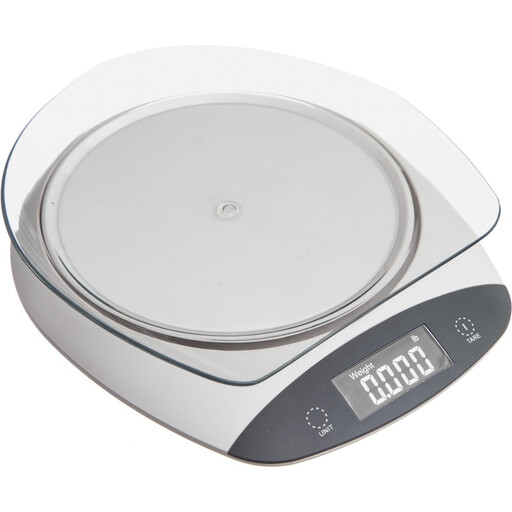 No image available
The removable bowl and tare function are handy if you want to weigh ingredients one after another.
The product description specifies 1 g increments and a maximum capacity of 5 kg. The scale uses a replaceable CR2032 battery. The bowl and its contents together must stay within the maximum; according to the description, this model is not intended for commercial weighing.
 No image available
The stated maximum capacity of 10 kg may be useful if your bowl and ingredients together weigh more than they would on a scale with a lower maximum capacity.
The product name specifies 1 g increments, Bluetooth and app integration. The description mentions an LED display and dimensions of 200 × 140 × 19,5 mm. Do not exceed 10 kg; keep the scale away from water and do not immerse it.
Place the scale on a flat surface, put the bowl on it and use the tare function before adding the flour. Reset the display to zero if you want to read the weight of each following ingredient separately, and make sure the bowl and its contents together stay below the maximum weight.
Don’t assume that it can. Brabantia recommends wiping the glass surface of the Tasty+ model mentioned here; check your own model’s instructions before cleaning it.
According to ACM ConsuWijzer, you have statutory rights in addition to any manufacturer’s warranty. If the product does not meet what you could reasonably expect, the seller is responsible for providing a solution; the statutory guarantee does not automatically last two years for every purchase.
The Netherlands Authority for Digital Infrastructure outlines specific legal requirements for certain uses, including commercial transactions and setting a selling price. These requirements for trade scales do not automatically apply to weighing for private use at home; check the rules separately if you sell products by weight.
Take a discarded electrical appliance to a suitable collection point, or use the take-back scheme when buying a similar appliance. Dispose of loose, dead batteries separately; they should not go in the bin.