
Home baker following a recipe
You want to weigh raisins in grams and get a clear reading while baking. The Voedingscentrum’s advice on weighing ingredients in grams is relevant to this.


For weighing raisins from a recipe, a scale with a clear gram display is a practical starting point. If you also want to weigh other ingredients in the same bowl, check whether the model has a tare function and whether the bowl and its contents will stay within the maximum capacity. With a large mixing bowl, it’s also important to be able to read the display. A 1 g increment is a product specification, not proof that every measurement is exact.
You want to weigh raisins in grams and get a clear reading while baking. The Voedingscentrum’s advice on weighing ingredients in grams is relevant to this.
You want to weigh several ingredients for a family gathering, and need to make sure the bowl and its contents stay within the maximum capacity and that the display remains visible.
You want to add ingredients one after another using the tare function, then easily clean the weighing surface or bowl afterwards.
Choose this if: you use your own bowl and want to weigh ingredients one after another.
Keep in mind: a wide bowl may obscure the display. Also check the combined weight of the bowl and ingredients.
Choose this if: you don’t want to use your own weighing bowl and the supplied bowl is large enough for your portion.
Keep in mind: according to Beurer, the Beurer KS 25 has a 1.2-litre bowl and a maximum capacity of 3 kg, including the bowl.
Choose this if: you want to weigh small amounts, such as spices, separately as well as raisins.
Keep in mind: finer increments don’t necessarily offer a practical benefit when weighing a typical recipe quantity of raisins.
| What to consider | What should you check? | Who is this important for? |
|---|---|---|
| Gram display | Check whether the weight is shown in grams and what increments the model specifies. A 1 g increment doesn’t prove that measurements are accurate; Consumentenbond assesses deviation and consistency. | If I want to weigh the raisins directly according to the recipe, I look for a clear gram display and repeatable measurements. Around 36% of consumers give weighing reliability their top priority. |
| Capacity and bowl | Check the maximum capacity and include the weight of the bowl. Also make sure the bowl fits on the weighing platform. | With a large mixing bowl, I want to avoid the bowl and ingredients exceeding the limit when weighed together. Around 29% of consumers prioritise capacity for the bowl and batch. |
| Tare function and display | Check whether you can easily reset the display to zero and whether you can see it with your bowl in place. | If I add ingredients one after another to the same bowl, I want to be able to reset the display to zero between additions and keep the figures in view. Around 21% of consumers particularly value this convenience during food preparation. |
| Cleaning and batteries | Check which parts are removable or dishwasher-safe, and what type of battery the model uses. | After baking, I want to know which parts I can wipe clean or wash separately, and how to store batteries safely. Around 14% of consumers prioritise maintenance and battery use. |
The display increment alone doesn’t tell you how large the measurement deviation is or how consistently a scale measures. Consumentenbond assesses these aspects separately.
If measurement performance is an important factor in your choice, compare independent test results for the exact model.
When you weigh ingredients in a bowl, the bowl’s weight also rests on the scale. For example, according to Beurer, the Beurer KS 25 has a maximum capacity of 3 kg.
Before using or buying a scale, check the combined weight of the bowl and the largest quantity you want to place on it.
VeiligheidNL warns that kitchen scales can be a source of button-cell batteries and that swallowing one can cause serious injury.
If a model uses a button-cell battery, check the battery compartment and keep spare batteries out of children’s reach.
According to Brabantia, the Tasty+ is a flat digital kitchen scale with 1 g increments, a maximum capacity of 5 kg, an illuminated display and a wipe-clean glass surface.
According to Beurer, the KS 19 has a flat glass platform, a tare function and a maximum capacity of 5 kg. The KS 25 comes with a bowl and has an illuminated display.
The Aquatronic Glass Electronic Kitchen Scale is described on a UK product page as a flat scale with a function for adding ingredients one after another and a maximum capacity of 5 kg.
The Stainless Steel Scale with Pull Out Display is designed for those who want to pull the display out from beneath a large bowl.
This selection at Joybuy ranges from an analogue scale with a bowl to digital models with a tare function. When weighing raisins, pay particular attention to the scale increments and the space your bowl needs.
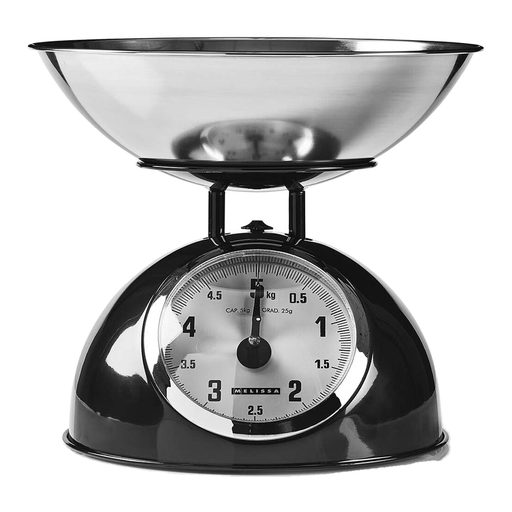 No image available
The supplied bowl may suit you if you want to weigh ingredients in a separate bowl.
The scale has 25 g increments and a maximum capacity of 5 kg.
 No image available
The digital gram display and tare function are useful if you want to weigh raisins and other ingredients in the same bowl.
The stated maximum capacity is 5 kg and the increment is 1 g. This isn’t an independent measurement of accuracy.
The scale also displays measurements in ounces, pounds and millilitres.
 No image available
The tare function is useful when you want to weigh ingredients in a container or bowl.
The description states that it weighs in grams from 1 to 5000 g and measures 17 × 13 × 2 cm.
Batteries aren’t included, according to the product description.
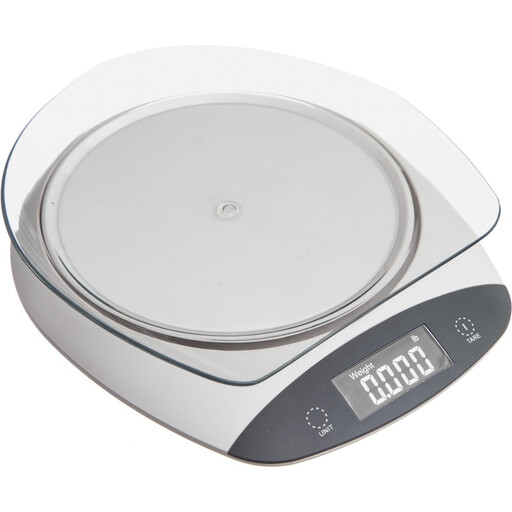 No image available
The supplied bowl and tare function are useful if you want to weigh ingredients without using your own bowl or add them one after another.
The stated capacity is 5000 g; the dimensions are 20.5 × 18 × 4.5 cm.
According to the product description, it requires 2 AAA batteries, which aren’t included.
 No image available
The gram display and tare function are suitable for weighing ingredients in a bowl; check that the display remains easy to see with your bowl in place.
The description lists a glass weighing surface, a maximum capacity of 5 kg and 1 g increments. The increment isn’t an independent measurement of accuracy.
According to the product description, it requires 4 AAA batteries, which aren’t included.
Place the bowl on the scale and use the tare function to reset the display to zero. Add the raisins until you reach the recipe weight in grams, keeping the combined weight of the bowl and its contents within the maximum capacity.
Don’t assume that the whole scale is dishwasher-safe. Beurer specifically states that the KS 25’s removable bowl is dishwasher-safe; Brabantia describes the Tasty+’s glass surface as wipe-clean.
As well as any manufacturer’s guarantee, you’re covered by statutory consumer rights: with normal use, the product must meet what you could reasonably expect, and the retailer is your point of contact if it doesn’t. According to the Autoriteit Consument & Markt, online consumer purchases generally come with a cooling-off period of up to 14 days after delivery, subject to legal exceptions.
For weighing ingredients at home, the checks that apply to weighing equipment used by shops and businesses aren’t a relevant buying criterion. If you later use a scale to sell goods by weight, assess that commercial use separately under the applicable measuring instrument regulations.
According to the Rijksoverheid, you can take an old electrical household appliance to a recycling centre, among other options, or hand it in under the take-back scheme when buying a similar new appliance. Used household batteries can be returned to shops and supermarkets that sell batteries, among other places.