
Vandaag of morgen in huis

Kwaliteit gegarandeerd

Welkomstaanbiedingen ontgrendelen: GRATIS bezorging | Tot 80% korting | Gratis 30 dagen JoyPlus-proefperiode
Download de app
A kitchen recycling bin can make sorting your rubbish much easier. Yet many households buy a model that turns out to be awkward to use after a few weeks. A small opening, inner bins that are difficult to remove or a lid that slams shut can make everyday use unnecessarily frustrating.
So don’t just focus on colour and shape. Pay particular attention to the layout, dimensions, opening mechanism and how easy the bin is to clean. Below, we cover the main pitfalls and suggest a few models to suit different households.
A 60-litre kitchen bin sounds spacious, but if it has three compartments, for example, that capacity is divided into 3 x 20 litres. That may be enough for general waste, while a compartment for plastic or paper might take longer to fill. A 2-compartment bin with 2 x 15 litres offers a different layout.
So think about which type of rubbish your household produces most. For a small kitchen or household, a 30-litre kitchen bin may be more practical than a large model that takes up a lot of floor space.
Always check the exact external dimensions. A rectangular pedal bin may fit neatly against a wall, but it also needs enough room for the lid to open. Check how high the lid reaches when open, especially if the bin will sit beneath wall cabinets.
A model may look compact on paper, but its width or depth could still block a walkway. Measure the available space before you order, and leave room for the pedal.
A bin with a soft-close lid shuts more quietly, but the mechanism needs to be kept clear of rubbish bags and other items. A sensor bin opens without you touching it, but it runs on batteries and needs extra care when cleaning. With a pedal bin, it’s important that the pedal is sturdy and that the inner bins are easy to remove.
According to the product information provided by the brands concerned, some pedals can withstand a large number of uses. Treat these figures as manufacturer specifications, not as a guarantee that every component will last just as long in all conditions.
Choose a compartment pedal bin to suit your rubbish-sorting routine:
Also check whether each compartment has its own lid and inner bin. Separate compartments mean you won’t have to move the whole bin when it’s time to empty it.
A stainless steel bin or steel bin is easy to wipe clean with a damp cloth. Check the difference between a rust-resistant finish and a guarantee that the material will remain rust-free in all conditions. Avoid abrasive cleaners and steel wool if the manufacturer advises against using them.
A removable plastic inner bin makes emptying and cleaning easier. Check whether it has a handle and whether standard rubbish bags will fit. Some models come with bags, but always check how many are included and what size they are.
A pedal bin lets you open it hands-free, which is handy when you’re using both hands to cook. A sensor bin opens automatically when your hand comes near it. Avoid placing one right where people are constantly walking past, to reduce the chance of it opening accidentally.
A soft-close feature is particularly useful in open-plan kitchens or homes where noise carries easily. Use the lid as instructed: several models specify that you shouldn’t force it shut by hand.
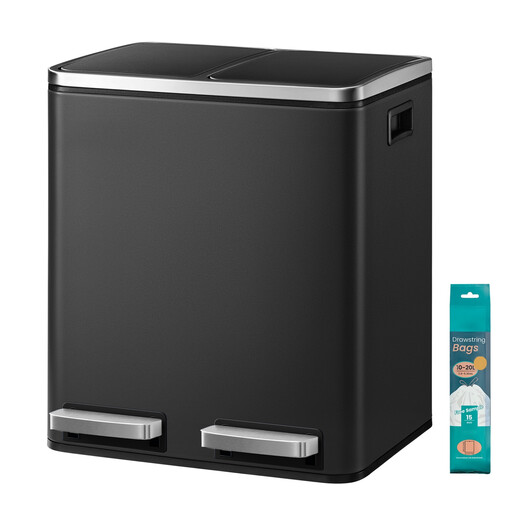
Why it suits this type of buyer: Two 15-litre compartments offer a straightforward introduction to sorting your rubbish, without taking up too much space in a small kitchen.
The total capacity is clearly divided between two separate inner bins, so you know in advance how much space is available for each type of rubbish.
Steel housing, two pedals, removable inner bins and soft-close lids, according to the product description.
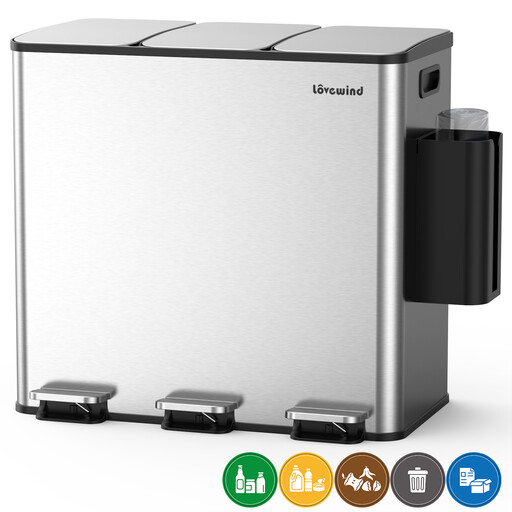
Why it suits this type of buyer: This model is a good fit for households that want to sort three types of rubbish and have enough room for a wider bin.
The capacity is specified as 3 x 20 litres. Each compartment also has its own lid and inner bin.
Stainless steel housing, soft-close function, 90° open position, magnetic labels and a separate storage compartment for rubbish bags.
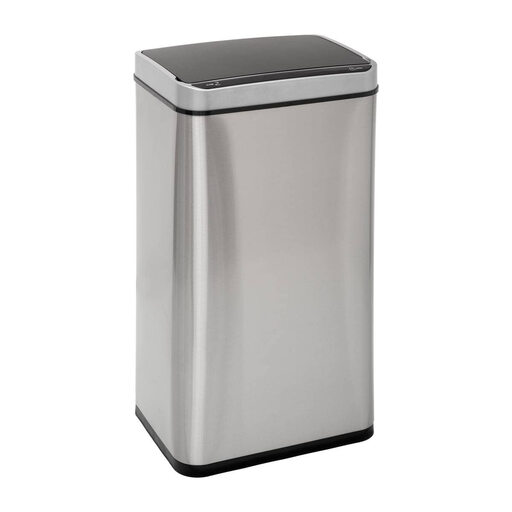
Why it suits this type of buyer: A practical choice if you’re looking for a spacious, hands-free bin and are happy to sort your rubbish into separate bins if needed.
The capacity and external dimensions are clearly stated: 40 litres, 33 x 24 x 66 cm. This lets you check the available space before you buy.
Motion sensor, soft-close mechanism, removable inner bin with handle, and a rust- and stain-resistant finish, according to the product information.
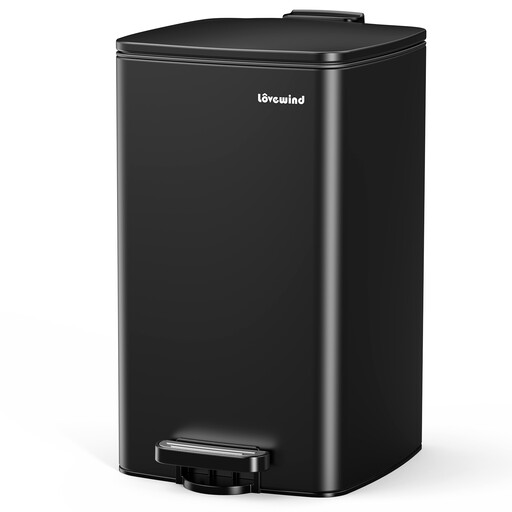
Why it suits this type of buyer: Its square shape and 30-litre capacity make it suitable for a small kitchen, home office or household with one main type of rubbish.
The capacity is easy to understand, and its compact shape helps you make efficient use of the space available. The inner bin can be removed for cleaning.
Stainless steel housing, pedal operation, soft-close lid and removable inner bin.
We’ve put together a complete, up-to-date list of products that meet these strict selection criteria and the applicable European safety regulations.
It depends on which types of rubbish you actually sort at home. Two compartments are often enough for general waste and recycling. Three are useful if you also want to keep food waste separate. Just make sure each compartment is large enough for the amount of rubbish you produce each day.
Empty the inner bins regularly and wipe the outside with a soft, damp cloth. Rinse plastic inner bins with lukewarm water if the product information says this is suitable. Don’t use abrasive cleaners on steel or stainless steel. For soft-close models, keep the hinge and edge of the lid free of rubbish.
Sensor bins usually run on batteries. How much power they use depends on how often they open and the type of batteries used. If you’d rather not replace batteries, you could choose a pedal bin. It doesn’t need power and still lets you open it hands-free.
