
Vandaag of morgen in huis

Kwaliteit gegarandeerd

Welkomstaanbiedingen ontgrendelen: GRATIS bezorging | Tot 80% korting | Gratis 30 dagen JoyPlus-proefperiode
Download de app
A kitchen mixer can make baking and cooking easier, but not every model is suitable for the same tasks. A hand mixer is compact and practical for cake batter, while a stand mixer with a bowl is better suited to regularly kneading bread or pizza dough. A stick blender, meanwhile, is mainly useful for soups, sauces and smoothies.
The product name does not always tell you everything. Pay attention to the specifications, included accessories and usage limitations. This will help you avoid buying a powerful food mixer that is too large for your kitchen, or a compact electric mixer that struggles with heavy dough.
A higher wattage does not automatically mean that a mixer is better suited to your recipes. Manufacturers may use different measurement methods, such as peak power or rated power. For example, the Monsga SM100 lists 1000 W peak power and 600 W rated power. The Honinst mixer specifies a motor power, but also sets clear usage limitations for heavy dough.
Also check:
A 6-litre mixing bowl may seem spacious, but you cannot always fill it completely. The Monsga SM100 lists a maximum capacity of 6 litres, with a recommended usable capacity of 5 litres. With bread dough, the consistency is also more important than volume alone. An overfilled bowl can cause splashing, uneven mixing or additional strain on the motor.
Always check the recommended quantities in the manual, especially if you often make bread, brioche or pizza dough.
A mixer with a whisk, beater and dough hook may seem versatile, but check that the accessories are suitable for your recipes. A mixer with a dough hook, for example, needs to provide enough space around the hook and remain stable during use. Also check which parts are dishwasher-safe. The motor housing should never be immersed in water.
A splash guard, removable bowl and easy-release system can make a significant difference in everyday use.
For cake batter, whipped cream and sauces, a model with multiple speed settings is useful. A multi-speed mixer gives you greater control: start slowly to reduce splashing, then increase the speed as the mixture becomes thicker.
For bread dough, wattage is not the only relevant factor. A sturdy drive system, a securely locking head and a stable base are just as important. When mixing heavy dough, use a low to medium setting and follow the rest times stated in the manual. For example, the AUCMA 5L specifies a maximum operating time of six minutes without a break. For heavy yeasted dough, the Honinst mixer recommends working for no more than ten minutes at a time, followed by a cooling period.
A stainless-steel mixing bowl is generally practical for everyday use, as stainless steel is durable and does not retain food odours. Also check:
A larger bowl is useful for family-sized batches, but it also takes up more space. Measure the area on your worktop and check that there is enough room for the tilt-head mechanism and accessories.
A kitchen mixer will always make some noise, but the product information can provide an indication. AUCMA lists 68–72 dB at one metre for its 6L model, while Monsga states a noise level of less than 75 dB. These are stated product specifications, not a guarantee that every use will sound equally loud.
Non-slip feet or suction cups help keep the appliance in place. Also check whether it has protection against overheating and overloading. Always unplug the appliance before changing accessories or cleaning it.

Why it suits this profile: According to the product information, this model offers a 5-litre bowl, ten speeds and three basic accessories for cakes, bread, pizza and pastries. It is a practical combination for anyone keen to try a range of recipes.
The specifications cover not only the power, but also the bowl capacity, speeds, pulse function and overheating protection. For heavy dough, however, make sure you follow the specified operating time.
400W copper AC motor according to the product description, 5L stainless-steel bowl, tilt-head, whisk, beater and dough hook.
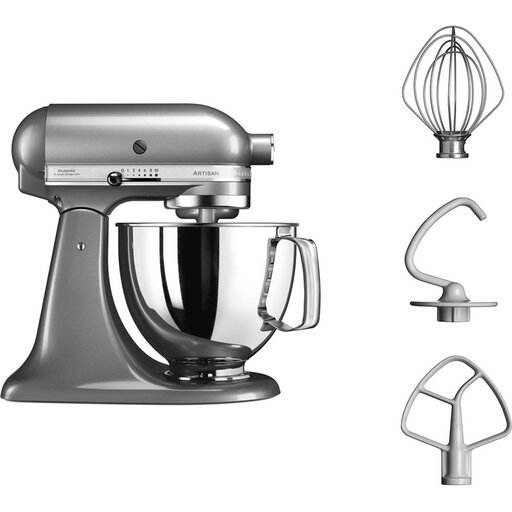
Why it suits this profile: This model has a metal housing, a 4.8-litre bowl and ten speeds. The included beater, dough hook and whisk are well suited to regular baking.
The product information clearly states that the 300W model is not intended for heavy dough. This helps prevent unrealistic expectations when buying.
Metal housing, direct drive, ten speeds and a wide range of optional accessories according to the product description.
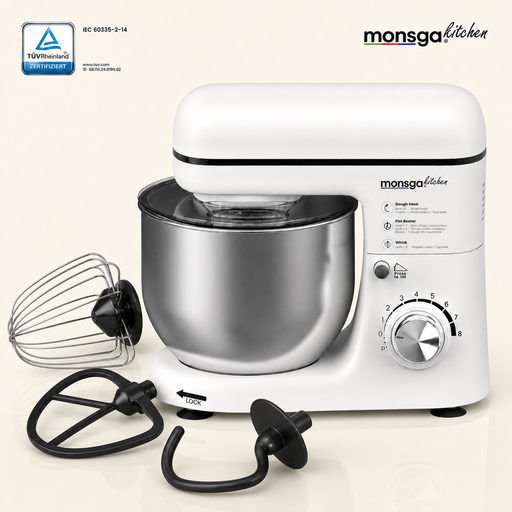
Why it suits this profile: According to the product information, this model has eight speeds, a 6L bowl with a recommended usable capacity of up to 5L, and accessories for kneading, mixing and whisking.
The recommended bowl capacity is listed separately from the maximum capacity. Low to medium speeds for dough and overload protection are also specified.
1000W peak power and 600W rated power according to the product information, a stainless-steel bowl, tilt-head and dishwasher-safe accessories.
We have compiled a complete, up-to-date list of products that fully meet these strict selection criteria and the applicable European safety regulations.
Choose a hand mixer if you mainly make cake batter, whipped cream and light doughs, and have limited storage space. For example, the Philips 5000 Series offers 450 W, six speeds, an automatically rotating 3-litre bowl and both beaters and dough hooks.
A stick blender is better suited to smoothies, soups, sauces and small portions. According to the product information, the Braun MQ55254M has a 1000 W motor, 25 speeds, a turbo setting and a chopper. However, a stick blender is not the right choice for bread dough.
A stand mixer or kitchen machine is suitable for users who regularly prepare large quantities of batter or dough. Pay particular attention to stability, rest times and the amount of space available on your worktop.
It depends on the quantity and type of dough. Do not look at wattage alone; also consider the recommended dough capacity, drive system and operating time. Start at a low speed and allow the appliance to cool down whenever the manual instructs you to do so.
A mixer with a bowl leaves your hands free and is practical for longer mixing tasks. A hand mixer is lighter, easier to store and convenient for smaller quantities. For everyday baking in family-sized batches, a stand mixer can make things easier.
Power consumption depends on the wattage and operating time. A 450 W appliance running for ten minutes theoretically uses approximately 0.075 kWh. In practice, actual consumption is affected by the load on the motor. Accessories and parts that are easy to clean also affect everyday convenience.
