
Vandaag of morgen in huis

Kwaliteit gegarandeerd

Welkomstaanbiedingen ontgrendelen: GRATIS bezorging | Tot 80% korting | Gratis 30 dagen JoyPlus-proefperiode
Download de app
A kitchen mixer can take a lot of the work out of baking and cooking. Even so, many people buy an appliance that does not really suit the recipes they make. A hand mixer is useful for cake batter, but less suitable for large quantities of bread dough. A stick blender works well for soups and sauces, but it cannot replace a food processor or stand mixer with a bowl.
If you are planning to buy a kitchen mixer, it therefore pays to look beyond the wattage or the number of accessories. Below, you will discover which features really make a difference, which common pitfalls to avoid and which type of mixer suits different households.
Higher wattage does not automatically mean that a mixer will perform every task better. The motor design, overload protection, drive system and type of accessory also matter. For example, a 450 W hand mixer may be suitable for batter and light dough, while a stand mixer with a bowl offers greater stability during prolonged kneading.
Also pay attention to the difference between rated power and maximum or peak power. Some products mainly highlight their highest power output. Always check the full product description and instruction manual.
A mixer with a whisk is suitable for whipping cream, whisking egg whites and making light batters. Dough hooks are designed for heavier mixtures, but not every hand mixer is suitable for large quantities or prolonged kneading. A blender with accessories can chop, purée and whisk, but it generally does not have a large mixing bowl for bread dough.
So do not just check how many parts are included. Also find out:
A 6-litre mixing bowl may sound spacious, but you cannot always fill it completely. Dough and liquid batter need room to prevent splashing and overflowing. Check the recommended quantity in the manual instead. A large bowl is particularly useful for families and home bakers who regularly make several batches.
The right choice depends on what you are preparing:
If you mainly make bread, pizza or brioche, you will generally get more use from a mixer for dough and batter with a stable bowl than from a basic hand mixer.
Multiple speed settings make it easier to start slowly and reduce splashing. A gradual increase in speed is useful when whipping cream or egg whites. A turbo setting can be handy for chopping and puréeing. A model with variable speed control gives you more control, while fixed settings are simpler to operate.
Also consider the position of the controls, the weight and the shape of the handle. A powerful mixer that is heavy or awkward to hold may be less comfortable during longer preparations.
A stainless-steel bowl is generally sturdy and easy to clean. With accessories, it is important to check which parts can go in the dishwasher. The motor housing must not be immersed in water; clean it with a slightly damp cloth.
Always use the correct accessory and unplug the appliance before changing any parts. Blades on stick blenders and choppers are sharp. Also follow the maximum operating time and allow the appliance to cool down whenever the manual instructs you to do so.

Why it suits this profile: This hand mixer has a 3-litre automatically rotating bowl, 6 speeds, beaters and dough hooks. It offers a straightforward starting point for cake batter and small quantities of dough.
The bowl rotates, so you do not have to keep stirring by hand. The specifications also state a power output of 450 W and clearly list the included accessories.
3L bowl, 6 speeds, 2 dough hooks and 2 beaters. The product information states a 2-year manufacturer’s warranty.

Why it suits this profile: A fixed stand mixer with a stainless-steel housing, 1200 W power output, automatic speed control and integrated scales is ideal for enthusiastic home bakers.
The product specifications state a 7-litre capacity, a fixed setup and functions for kneading and mixing. For heavy recipes, however, check the recommended quantities in the manual.
1200 W, stainless steel, automatic speed control and integrated scales. The stated warranty period is 2 years.

Why it suits this profile: If you mainly prepare soups, sauces, smoothies and chopped ingredients, this stick blender offers a compact solution with 25 speeds, a turbo setting and a chopper.
Its functions are not limited to a single speed or blade. The product description lists an adjustable chopper with three texture levels.
1000 W, 25 speeds, turbo function and dishwasher-safe parts according to the product information.
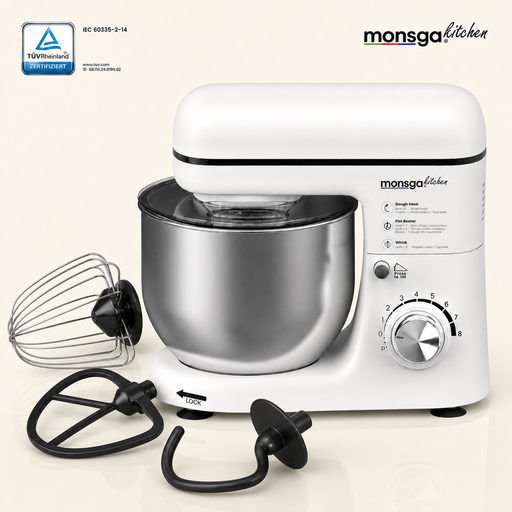
Why it suits this profile: The 6-litre mixing bowl, 8 speeds and accessories for kneading, mixing and whisking are practical for families that regularly prepare larger quantities.
The recommended usable capacity is stated as 5 litres, so the bowl’s full capacity does not need to be interpreted as its working volume.
1000 W peak power, 8 speeds, stainless-steel bowl and overload protection according to the product description.
We have put together a complete, up-to-date list of products that fully meet these strict selection criteria and the applicable European safety regulations.
A stand mixer or food processor with a dough hook is generally more practical for bread dough than a lightweight hand mixer. Always check the maximum quantity of flour or dough stated in the manual. When kneading, use a low to medium speed and observe the recommended operating time.
That depends on how you intend to use it. A hand mixer with a few hundred watts may be sufficient for cake batter and whipped cream. For heavier dough, wattage is not the only important factor; stability, the drive system, bowl capacity and overload protection also matter. Compare several specifications at the same time.
First unplug the appliance and remove the accessories. Only wash parts that the manual confirms are dishwasher-safe. The motor unit must be kept dry and cleaned with a cloth. Do not touch sharp blades directly, and store loose parts safely, especially in households with children.
