
Vandaag of morgen in huis

Kwaliteit gegarandeerd

Welkomstaanbiedingen ontgrendelen: GRATIS bezorging | Tot 80% korting | Gratis 30 dagen JoyPlus-proefperiode
Download de app
A kitchen machine for dough can make kneading bread dough, pizza dough and cake batter significantly easier. However, a large bowl or high wattage isn't automatically enough. A machine may look powerful on paper, but in practice it can be awkward due to a small maximum dough capacity, poor stability, or a motor that needs frequent cooling breaks.
Joybuy Product Recommendation Officer helps you cut through marketing claims and focus on verifiable facts. This way, you can choose a stand mixer that suits your recipes, kitchen space and how often you bake.
A higher wattage sounds appealing, but it doesn't tell you everything about performance during kneading. Manufacturers sometimes quote peak power, while the nominal or continuous power is lower. For example, the Monsga SM100 is listed with 1000 watts peak power, alongside 600 watts nominal power.
So, pay attention to:
A 5 or 6-litre bowl may look spacious, but that doesn't mean you can fill it completely with dough. Dough expands and needs room to be kneaded properly. Always check the maximum dough capacity, not just the mixing bowl volume.
The Bear Intelligent Dough Maker states a bowl capacity of 5 litres and a maximum dough capacity of 2.5 kilograms. The Monsga lists a 6-litre bowl, with a recommended usable capacity of 5 litres.
A stand mixer often sits on your worktop running for several minutes. An unstable machine can shift during kneading, especially with firm bread dough. The noise level also deserves attention. A stated value, such as 68–72 dB, is only useful if it's clear at what distance and under what conditions it was measured.
Look for:
A kitchen mixer with a dough hook is usually suitable for multiple tasks: kneading, mixing and whisking. A stand mixer typically has a fixed base and a mixing bowl, so you don't have to hold it while it's running. A dedicated dough kneader can be handy if you mainly make bread or pizza, but it sometimes offers fewer accessories.
For families and home bakers, a kitchen machine with a mixing bowl and three basic accessories is often the most practical choice:
Multiple speeds give you control over different recipes. A low setting is usually best for gently combining ingredients. For whisking or light batter, you'll need a higher speed. A pulse function can be useful for short, powerful bursts.
Touch controls or an automatic timer can be practical, but check that you can also set things manually. Automatic programmes don't replace the instructions in your recipe.
A stainless steel bowl is easy to clean and suitable for daily use. Check whether the accessories are dishwasher-safe; this varies by model and part. The motor housing must never be submerged in water.
Always use an electric dough mixer on a stable, dry surface. Keep hands, clothing and utensils away from moving parts. Follow the maximum running time stated in the manual. For example, the AUCMA product description notes that the mixer should not run for longer than 6 minutes continuously under heavy use. The Honinst manual advises a maximum of 10 minutes for heavy yeast dough, followed by a cooling period.

Why this fits the profile: This stand mixer combines a spacious bowl with three basic accessories for baking, mixing and kneading. That makes it suitable for anyone wanting to try different recipes without committing to a specialist appliance straight away.
The product description lists not only the power but also 6 speeds, a pulse function and a noise level of 68–72 dB at 1 metre. Do check the recommended dough quantity in the manual before buying.
6-litre stainless steel bowl, dough hook, whisk, beater and tilt-head design.
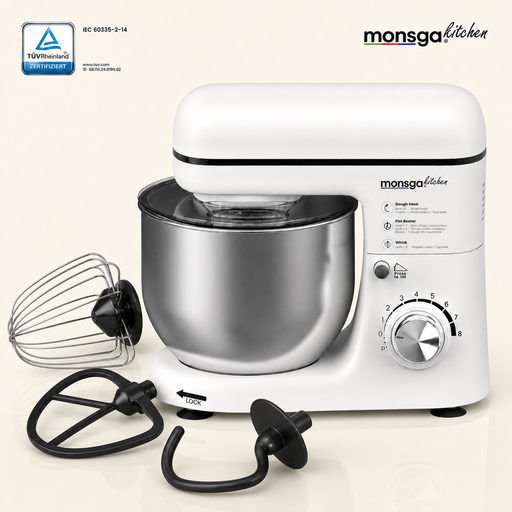
Why this fits the profile: For home bakers who regularly switch between bread, cake, biscuits and whipped cream, 8 speeds and multiple accessories are practical. The bowl has a handle and the head can be tilted.
The specifications clearly distinguish between 1000 watts peak power and 600 watts nominal power. A noise level of 75 dB is also stated, so you can factor this into your kitchen layout.
Stainless steel bowl, 8 speeds, non-stick dough hook and splash guard.

Why this fits the profile: If you mainly make bread dough or pizza dough and have less need for whisking, automatic kneading and resting programmes can be a real help. The stated capacity is aimed at households of 3 to 5 people.
The specification states a maximum dough capacity of 2.5 kilograms. This makes it much clearer how much dough you can process at once, compared to only listing the bowl capacity.
5-litre family size, automatic kneading function and resting function according to the product description.
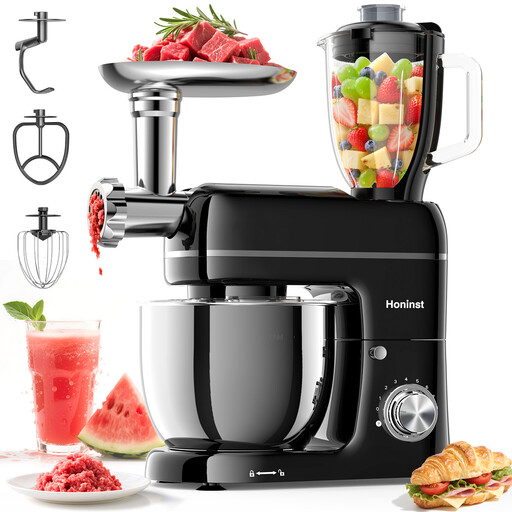
Why this fits the profile: This model is designed for households that want to mix, blend or grind as well as knead. Check beforehand whether you'll actually use the extra accessories and whether you have enough storage space.
The product information mentions a safety lock and overheat protection. According to the manual, a cooling period is needed for heavy yeast dough, so don't plan for unlimited continuous use.
6.5-quart bowl, 8 speeds and accessories for kneading, whisking, mixing and grinding.
We've put together a full, up-to-date list of products that fully meet these strict selection criteria and comply with current European safety regulations.
There is no universal wattage that suits every recipe. Alongside the power, look at the nominal value, maximum dough capacity, speed settings and running time. For heavy yeast dough, low speeds and sufficient rest for the motor are more important than just a high peak power.
Yes, provided the machine has a suitable dough hook and the amount of dough stays within the stated limit. Generally, use a low to medium speed and follow the resting times from both the recipe and the manual. A kitchen machine for pizza dough must also stay firmly in place during kneading.
The lifespan depends on usage, maintenance and load. A machine that is regularly used above its maximum capacity will wear out faster and can overheat. Clean the bowl and accessories after use, keep the motor housing dry and let the appliance cool down as instructed. Also check that replacement accessories and customer service are available before you order.
