
Vandaag of morgen in huis

Kwaliteit gegarandeerd

Welkomstaanbiedingen ontgrendelen: GRATIS bezorging | Tot 80% korting | Gratis 30 dagen JoyPlus-proefperiode
Download de app
A kitchen machine can take a lot of work off your hands, but not every model is right for every kitchen. A stand mixer for bread dough does a different job from a food processor, blender or hand blender. A coffee machine also falls within the broad category of kitchen appliances, but calls for very different specifications.
The most common buying mistakes usually come down to three things:
So start by thinking about what you’ll really use the appliance for: baking, kneading dough, chopping vegetables, making smoothies or preparing coffee.
A kitchen mixer or stand mixer is best suited to cake batter, whipped cream and dough. With a dough hook, whisk and flat beater, you can prepare a range of baking recipes. If you often make bread, pizza or brioche, a sturdy dough mixer will be more useful than a compact blender.
A food processor is more practical for slicing, grating, chopping and puréeing. A blender or smoothie blender is better for liquids, fruit, sauces and ice. A hand blender takes up very little space and is handy for soup and small portions.
If you want to combine several functions, consider a multifunction kitchen machine. Just check that the accessories you need are actually included. Extra choppers or mixing bowls are sometimes available only as optional extras.
Wattage is only one part of the picture. Also check:
Kneading is usually done at a low to medium speed. Higher speeds are mainly useful for whisking or light, airy mixing. A machine with lots of settings gives you more control, but that doesn’t automatically make it suitable for large quantities of heavy dough.
A stainless steel bowl is practical for everyday use and is generally easy to clean. Don’t just look at the total capacity; check the recommended working capacity too. The Monsga SM100 has a bowl with a maximum capacity of 6 litres, according to the product information, while the recommended capacity is listed as 5 litres.
A 5 to 6-litre bowl can be useful if you regularly make large batches. In a small kitchen, however, the bowl and its housing can take up a lot of storage space.
An appliance that moves around on the worktop is awkward to use, especially when kneading. Check whether the model has non-slip feet, suction cups or another feature to keep it stable. The stated noise level is useful for comparing models, but also check the conditions under which it was measured.
Also look for:
The motor unit should generally not be submerged. Unplug the appliance before changing accessories or cleaning it.

Why it suits this profile: This kitchen mixer combines a bowl with a maximum capacity of 6 litres, eight speed settings and three basic accessories for baking and everyday mixing.
The product information lists both 1000W peak power and 600W rated power, so you can assess the motor’s performance more realistically.
304 stainless steel bowl, tilting head, splash guard and eight speed settings. The stated noise level is 75 dB.
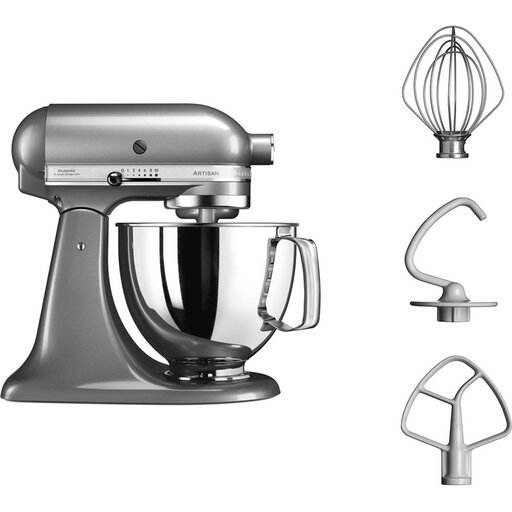
Why it suits this profile: This metal stand mixer is designed for users who value a sturdy build, direct drive and accessories that can be added over time.
The product information clearly states that the power is 300W and that heavy dough is not recommended. This helps you avoid choosing a mixer based on its appearance or brand name alone.
10 speed settings, a 4.8-litre bowl and direct drive. According to the product information, the whisk is not dishwasher-safe.
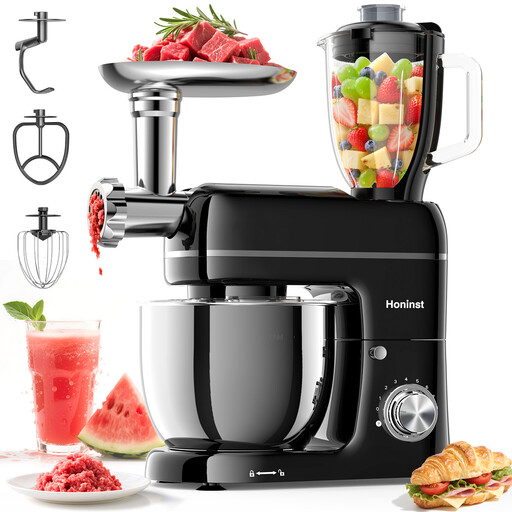
Why it suits this profile: This model is aimed at households that want to use a blender and meat grinder as well as mix and knead.
The product description clearly lists the extra functions and accessories. Before buying, make sure you’ll use them and have enough storage space.
Up to 1300W according to the product information, a 6 QT stainless steel bowl, eight speed settings and a safety switch.

Why it suits this profile: A good choice if you mainly want to blend, crush ice and prepare larger quantities in one jug.
This isn’t a full stand mixer for dough. Its clear positioning as a blender helps you avoid buying it for tasks it isn’t designed to do.
1200W power, a 2.1-litre jug, 14 manual speed settings and four automatic programmes according to the product information.
We’ve put together a complete, up-to-date list of products that meet these strict selection criteria and current European safety requirements.
That depends on the motor power, dough hook, bowl capacity and maximum dough quantity. For heavy dough, always use a low or medium speed and don’t exceed the limit in the manual. A compact kitchen mixer isn’t automatically suitable for large loaves or several batches of dough in a row.
For a household of three to five people, a bowl of around 5 litres is often practical for cake batter and regular-sized batches of dough. Be sure to check the recommended filling capacity. Don’t confuse the bowl’s total volume with the amount of ingredients the motor can process safely.
Energy use depends on the power rating and how long you use the appliance. A higher wattage doesn’t necessarily mean it will use more energy every time you prepare something; the actual cost depends on how long you use it and which setting you choose. For coffee machines, warm-up time, standby consumption, water filters and the type of coffee also affect running costs. Check the energy label and product specifications before comparing models.
