
Vandaag of morgen in huis

Kwaliteit gegarandeerd

Welkomstaanbiedingen ontgrendelen: GRATIS bezorging | Tot 80% korting | Gratis 30 dagen JoyPlus-proefperiode
Download de app
A kitchen machine can take much of the work out of making cake batter, bread dough, pizza, biscuits and whipped cream. However, not every kitchen mixer is suited to the same tasks. A model with a large bowl is not automatically practical in a small kitchen, and a high wattage rating alone says little about how well a machine handles heavy dough.
Anyone who focuses only on price, power or the number of accessories may encounter a few familiar problems after buying.
Manufacturers do not always state power in the same way. The wattage shown may refer to the rated power or a temporary peak power, for example. A 1000-watt kitchen machine is therefore not necessarily more powerful in everyday use than a 700-watt model.
Also consider:
According to the product information, the Monsga SM100 has a peak power of 1000 watts and a stated rated power of 600 watts. This is more relevant than simply looking at the highest figure on the packaging.
A 6-litre stainless-steel mixing bowl may sound appealing, but it should not be filled to the brim. With dough, the recommended quantity is often lower than with light cake batter.
For a household that occasionally makes cake or whipped cream, a 3- to 5-litre bowl may be sufficient. Regular bakers and families may benefit more from 5.5 to 7 litres. Always check the maximum quantity in the manual, particularly when choosing a mixer for bread dough.
A mixer with a dough hook, whisk and flat beater is more versatile than a model with just one type of beater. Also pay attention to the materials and cleaning instructions. Not every component is dishwasher-safe. This information helps prevent damage, discolouration or unnecessary wear.
A splash guard helps prevent flour and batter from flying around, but it does not make the machine completely maintenance-free. The head, drive components and housing will usually need to be cleaned with a damp cloth.
A whisk with several speed settings is useful for whipping cream and egg whites. A flat beater is generally better for cake batter. For bread and pizza dough, you need a sturdy dough mixer with a dough hook.
An electric kitchen mixer with 5 to 10 settings gives you control across different recipes. Always start heavy batter or flour at a low setting to reduce splashing and overloading. A pulse function can be useful for short, powerful mixing movements, but it does not replace a suitable dough setting.
With planetary mixing technology, the accessory rotates around the bowl while also moving around its own axis. According to product descriptions from various brands, this is designed to bring ingredients from the edges towards the centre more evenly. Treat this as a technical feature rather than a guarantee of a particular baking result.
Also check:
A kitchen machine for home use should stand securely on a flat worktop. Non-slip feet or suction cups can help limit movement during kneading. Even so, it remains important to respect the maximum dough quantity and operating time.
Noise levels are not listed for every product and also depend on the surface and speed. Where a brand states a figure, it refers to its own product specification. For example, the AUCMA ASM1559 lists 68 to 72 dB at one metre, while the AUCMA 5L version lists a maximum of 75 dB. Only compare these figures when the measurement conditions are the same.
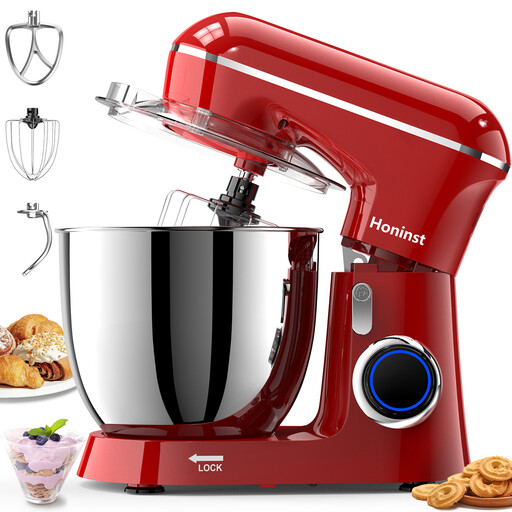
Why it suits this profile: A spacious mixer with a bowl for home bakers who want to make cake, biscuits, pizza and the occasional batch of bread dough with one appliance.
The product information lists 10 speeds, a 6.5QT stainless-steel bowl, splash guard and overheating protection. For heavy yeast dough, there is a maximum operating limit of 10 minutes, followed by a cooling period.
A whisk, flat beater and dough hook are included. The tilting head makes changing accessories convenient.

Why it suits this profile: Ideal for households that regularly make large quantities of batter or dough and value a metal build and additional control functions.
The stated bowl capacity is 7 litres and the power is 1200 W. Before buying, check the available space: according to the specifications, the appliance is 37 cm long, 22.5 cm wide and 40 cm high.
The product details mention automatic speed control and an integrated set of scales. The mixing functions include kneading and mixing.

Why it suits this profile: A practical stand mixer for families and hobby bakers who often make bread, pizza, cake or pastries and need a spacious bowl.
The product information lists a 6L stainless-steel bowl, four suction cups, overload protection and overheating protection. The stated noise level is between 68 and 72 dB at one metre.
The 450W motor, six speeds and pulse function offer a range of settings. A whisk, beater, dough hook and splash guard are included.
A stand mixer operates independently and is useful when you want to weigh or prepare other ingredients while mixing. The bowl and accessories are usually larger, but the appliance takes up more space.
A hand mixer is lighter, easier to store and suitable for cake batter, whipped cream and smaller quantities. For example, the Philips 5000 Series HR3745/00 has 450 W, six speeds, an automatically driven 3-litre bowl, plus both beaters and dough hooks. For heavy bread dough or large batches, a stand mixer is often more practical, provided the manual allows it.
Also consider energy consumption. The wattage indicates the maximum electrical power, not automatically the consumption for each recipe. Brief mixing at a higher setting may use less energy than running for a long time at a low setting. Use the machine according to the specified quantities and allow the motor to cool whenever the manual recommends it.
We have put together a complete, up-to-date list of products that fully meet these strict selection criteria and the applicable European safety regulations.
For regular home use, 4 to 5 litres is often practical. Choose 5.5 litres or more if you make larger batches of bread dough, cake batter or biscuit dough. Always check the recommended working quantity rather than looking only at the total bowl capacity.
No. Check whether a dough hook is included and look up the maximum dough capacity. A hand mixer with dough hooks is mainly suitable for smaller quantities. When working with yeast dough, use a low to medium speed and take the maximum continuous operating time into account.
Its lifespan depends on the load, cleaning, storage and following the instructions in the manual. Overloading, kneading for long periods without a break and using non-approved accessories can accelerate wear. Placing the appliance on a stable surface, using the correct quantities and allowing it to cool down in good time will help you use it with care.
