
Vandaag of morgen in huis

Kwaliteit gegarandeerd

Welkomstaanbiedingen ontgrendelen: GRATIS bezorging | Tot 80% korting | Gratis 30 dagen JoyPlus-proefperiode
Download de app
A good kitchen knife does not have to be expensive. It does, however, need to suit the way you cook, the ingredients you use most often and the space where you plan to store it. If you focus only on terms such as “extra sharp” or “professional”, you could end up buying a knife that feels uncomfortable, becomes blunt quickly or is not suitable for the dishwasher.
The Joybuy Product Recommendation Officer selects products based on verifiable details, such as blade length, material, handle, care requirements and intended use. This allows you to compare kitchen knives without relying solely on marketing claims.
A sharp knife is pleasant to use, but sharpness alone does not indicate how long the cutting edge will remain effective. The hardness of the steel, sharpening angle and maintenance also play a role. Claims such as “20% sharper” are brand claims. According to Wüsthof’s own information, some knives are sharpened using laser-guided techniques and are on average 20% sharper than standard knives. Treat this as the brand’s product specification, not as a universal measurement standard.
A large 20 cm chef’s knife offers plenty of cutting surface, but may be less practical on a small kitchen worktop. A 16 cm knife is often easier to manoeuvre for everyday preparation. For bread, a longer serrated blade is more useful, while a 7 cm paring knife offers greater control for small, precise tasks.
Not all stainless-steel kitchen knives are suitable for the dishwasher. Heat, washing-up liquid and contact with other items can put strain on the handle and cutting edge. Always check the care instructions. A knife block or drawer insert prevents the blade from coming into contact with cutlery or other kitchen utensils. You should also use a wooden or plastic chopping board; glass, stone and metal are damaging to the cutting edge.
The right length depends on your ingredients and available workspace:
Many stainless-steel kitchen knives combine corrosion resistance with easy maintenance. The product specifications for several Wüsthof knives list X50CrMoV15 steel. Some models are stated to have a hardness of 58 HRC. HRC is a scale for material hardness: a higher value can contribute to longer-lasting sharpness, but does not eliminate the need for correct sharpening and careful use.
Also consider the difference between forged and stamped steel. A forged knife is formed from a single piece of steel, while a stamped knife is cut from sheet metal. Neither construction alone determines how well a knife performs. Balance, handle, geometry and maintenance are at least as important.
A handle should feel sturdy without creating pressure points. A full-tang construction, where the steel extends through the handle, can provide a stable feel. Also check whether the handle is suitable for both left- and right-handed use.
Wood feels warm in the hand, but generally requires more care than plastic. Plastic or synthetic handles are often easier to clean. An anti-slip profile can provide additional control, but the fit remains a personal choice. If possible, hold the knife before purchasing several knives.
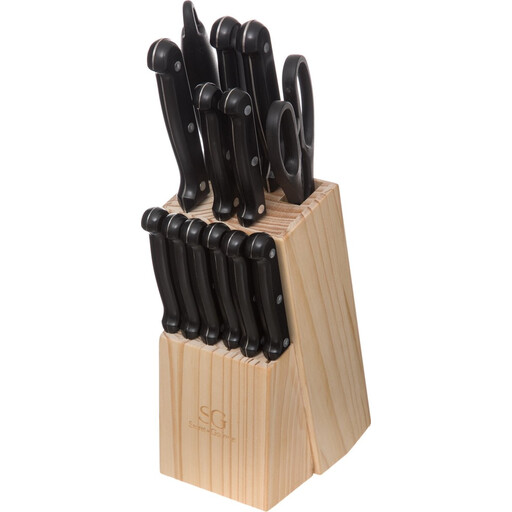
Why it suits this profile: Beginners get several knife shapes, kitchen scissors, a sharpener and a knife block in one purchase. This is practical if you do not yet have a basic set of kitchen tools.
The contents are clearly specified and include a chef’s knife, bread knife, three other knives, six steak knives, scissors and a sharpener. The set is not dishwasher-safe, so hand washing is part of its use.
13-piece set, wooden knife block and sharpener included.
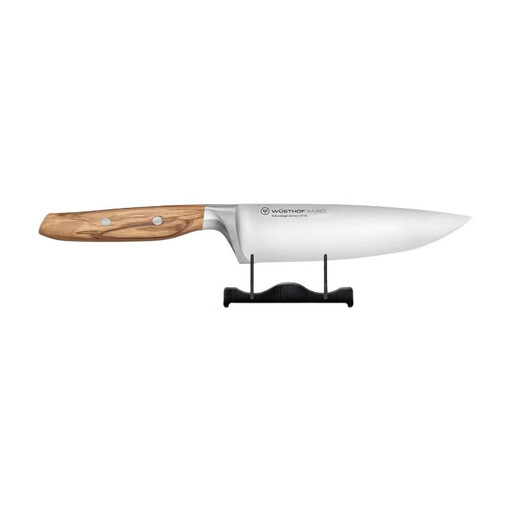
Why it suits this profile: For anyone who regularly prepares vegetables, herbs, meat or cabbage and values a larger, versatile chef’s knife with a wooden handle.
The specifications list X50CrMoV15 stainless steel, a sharpening angle of 14 degrees and a hardness of 58 HRC. According to Wüsthof’s own information, the knife is sharpened using laser guidance.
20 cm blade, broad cutting edge and olive-wood handle with half bolster.
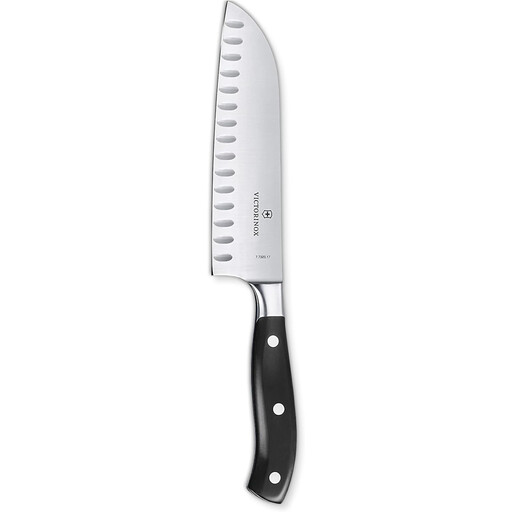
Why it suits this profile: A logical choice for cooks who regularly slice vegetables, fish and meat and prefer the shape of a santoku knife to a classic European chef’s knife.
The blade is 17 cm long and features indentations which, according to the product description, can help prevent sliced ingredients from sticking to the blade.
Santoku shape, ergonomic plastic handle and stainless-steel blade.
We have compiled a complete, up-to-date list of products that fully meet these strict selection criteria and the applicable European safety regulations.
A kitchen knife set is practical if you want to cover several functions at once. However, check that you are not paying for knives you rarely use. A compact set with a chef’s knife, bread knife, paring knife and, optionally, steak knives will be sufficient for many households.
Individual kitchen knives are more convenient when you want to choose exactly what you need. Consider a Wüsthof knife for everyday cutting, a Victorinox santoku knife for vegetables and fish, or a separate bread knife for sourdough and hard crusts. A knife block saves space in the drawer, but does take up room on the worktop.
For a basic set of kitchen tools, a chef’s knife, bread knife and paring knife are usually sufficient. Add a santoku knife if you often prepare vegetables, fish or Asian dishes. Steak knives are mainly intended for use at the table.
This depends on usage, the steel, chopping board and technique. A honing steel can realign the cutting edge between sharpening sessions; genuinely blunt knives need a sharpening stone or professional sharpening. Do not force a cut: a knife that glides through food requires less pressure and is easier to control.
Some models are dishwasher-safe according to the product information, but hand washing is often advisable to preserve the handle and cutting edge. Always check the specific instructions for the knife or knife set you have chosen.
