
Vandaag of morgen in huis

Kwaliteit gegarandeerd

Welkomstaanbiedingen ontgrendelen: GRATIS bezorging | Tot 80% korting | Gratis 30 dagen JoyPlus-proefperiode
Download de app
A blunt knife, a wobbly handle, or a spatula that warps over a hot pan: kitchen knives and utensils may seem like simple purchases, but you often only notice the wrong specifications when you start cooking. A low price, moreover, says little about ease of use and maintenance.
With this buying guide, you can compare kitchen knives, knife sets and cooking utensils on material, size, function and care. This way, you avoid paying for accessories you won't use or for features that matter less in practice.
A knife set with a knife block can look appealing because of the number of pieces. Yet a set sometimes contains several knives with almost the same function. So check the contents: does the kitchen knife set include a chef's knife, bread knife, smaller utility knives, steak knives and possibly a santoku knife? Also look to see whether a knife sharpener, kitchen scissors or knife block is included.
For everyday cooking, a few well-chosen knives are often more practical than a large number of unused models.
Stainless steel is a practical choice, but the material isn't completely maintenance-free. Salt, acids and prolonged moisture can cause stains or surface rust. With stainless steel kitchen utensils, drying them after washing is therefore advisable.
Also check whether a product is dishwasher-safe. The product information for a knife or set may indicate this, but hand washing is sometimes recommended to extend the life of the blade, handle or a wooden component.
Silicone spatulas are handy for non-stick pans because they are less likely to scratch the surface. That doesn't mean every silicone product can be left over an open flame or in a hot pan for a long time. Check the usage warnings and don't leave a spatula in the pan unnecessarily.
With a metal wok spatula or slotted spoon, the handle, length and distance from the heat source are also important.
A chef's knife of around 20 cm is suitable for common cutting tasks, such as chopping vegetables, slicing herbs and portioning meat. A smaller knife gives you more control with fruit and small ingredients. A bread knife typically has a serrated blade, allowing you to saw through bread crusts without squashing the loaf.
A santoku knife has a different shape from a classic chef's knife and can be pleasant for cutting vegetables, fish and meat. Don't just look at terms like "extra sharp", but pay particular attention to blade length, weight, handle and care instructions.
Many kitchen knives in this range use stainless steel. With the Wüsthof Gourmet Chef's Knife, for example, stainless steel is listed as the blade material, with a blade length of 20 cm and a weight of 184 grams. The manufacturer states that hand washing is recommended for a longer lifespan, although according to the product information the knife can go in the dishwasher.
For cooking utensils, 304 stainless steel can be relevant. Several Maxcook and PURECOOK products use this material according to their product descriptions. With metal kitchen utensils, also pay attention to weld seams, a sturdy connection between the handle and the head, and the possibility of hanging the utensil up.
A handle should feel sturdy and suit the way you cook. Long handles keep your hand further from a hot pan, but take up more space in a kitchen drawer. A knife block can store knives neatly, while individual knives need a separate solution for safe storage.
With a set, also check the overall size. According to the specifications, the Alpina set contains 13 knives, a knife block and scissors, making 15 pieces in total. Such a set requires more worktop space than a single chef's knife.
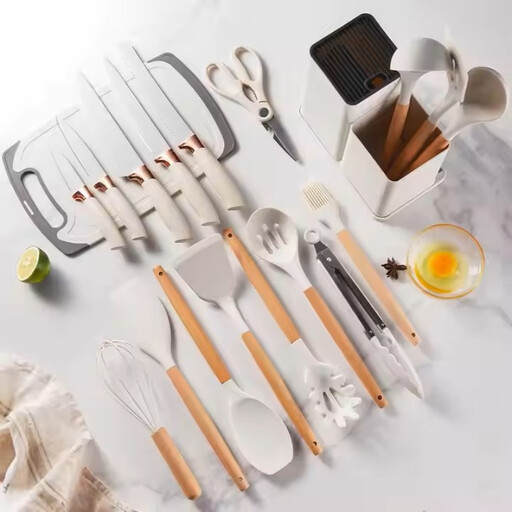
Why this fits the profile: A combination of kitchen knives and silicone kitchen utensils is practical for anyone wanting to stock up on the basics of cooking and baking in one purchase. Do check the exact contents of the set beforehand.
The combination saves you from having to search for several separate basic items, but the product page remains the definitive source for the exact number and type of components.
A combined set for various cooking tasks; silicone utensils are stated as suitable for kitchen use according to the product information.
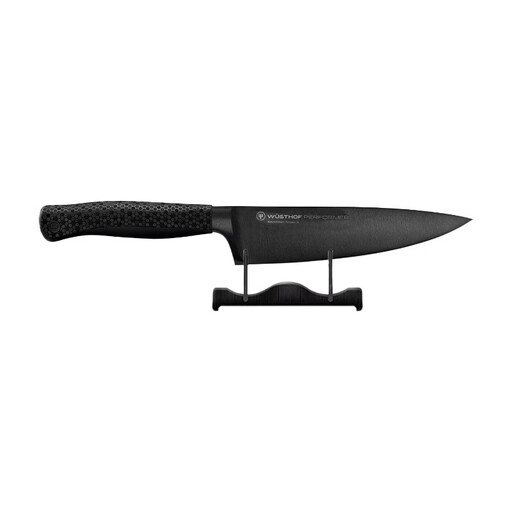
Why this fits the profile: For those who cook regularly and prefer to use one versatile knife, you get a chef's knife with a 20 cm blade and a handle with a honeycomb structure according to the product description.
You don't buy a bulky set when a versatile knife is sufficient. The product information mentions X50CrMoV15 stainless steel and a DLC coating; check the current details on the product page.
20 cm blade; 11.9 cm handle; suitable according to the description for vegetables, herbs, fruit and meat.
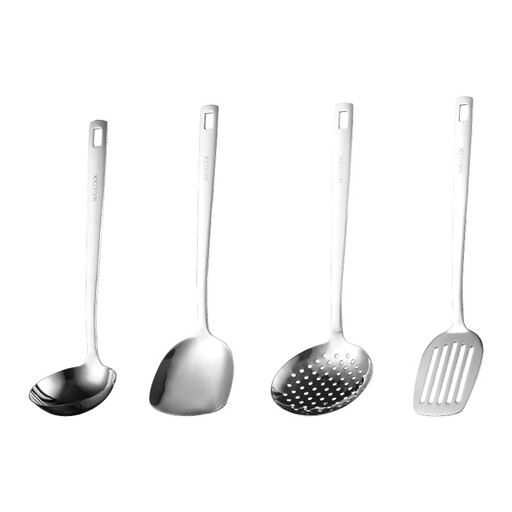
Why this fits the profile: For stir-frying, deep-frying and everyday cooking, a set with a wok spatula, slotted spoon, soup ladle and perforated spatula is more straightforward than individual accessories.
The set uses stainless steel and has long handles according to the description. However, the utensils can get hot; therefore use caution and dry them after cleaning.
Four pieces; one-piece stainless steel construction according to the product information; suitable for stirring, serving and straining.
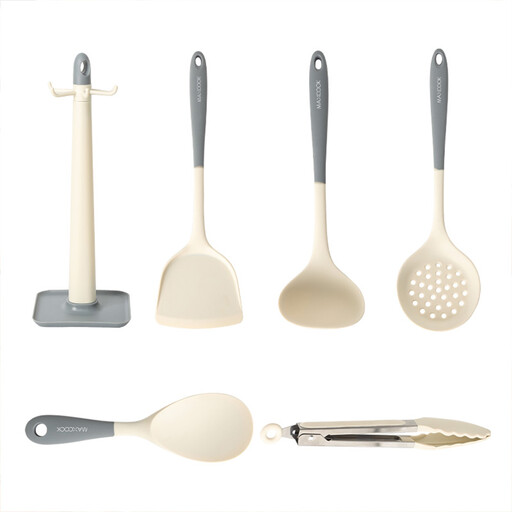
Why this fits the profile: A kitchen utensil set with silicone components is handy for baking, mixing and working with pans where you want to minimise scratches.
You deliberately choose multiple cooking accessories instead of a knife set with components you don't need. Check the full composition before purchase.
Set of six pieces according to the product information; designed for everyday cooking and baking.
We've put together a full, up-to-date list of products that fully meet these strict selection criteria and comply with current European safety regulations.
A practical starting point is a chef's knife, a smaller knife for fruit and vegetables, and a bread knife. If you often serve meat, you can add steak knives. A santoku knife is an alternative or addition to a chef's knife, depending on your cutting habits.
That depends on the contents and your usage. A set can be good value when you need multiple functions and want a knife block. Individual knives make more sense if you're only looking for a chef's knife or bread knife. Always compare the actual components, materials and care requirements.
The lifespan of the sharpness depends on use, chopping board, cutting technique and maintenance. Don't use the knife for bones or hard frozen products when it isn't intended for that. Regular sharpening or honing helps, but replace a knife if the blade or handle is damaged.
