
Vandaag of morgen in huis

Kwaliteit gegarandeerd

Welkomstaanbiedingen ontgrendelen: GRATIS bezorging | Tot 80% korting | Gratis 30 dagen JoyPlus-proefperiode
Download de app
A well-equipped kitchen doesn't necessarily need dozens of knives. However, it's important that each knife and pair of scissors is right for the jobs you do every day. When choosing kitchen knives and scissors, many shoppers focus on a low price, a shiny blade, or the term “extra-sharp”. This can be misleading if important details are missing.
The following pitfalls are common:
Most kitchen knives are made from stainless steel. This material is practical for everyday use and relatively easy to clean. However, the exact type of steel and its hardness are not always specified in the product details. Therefore, don't draw conclusions about edge retention when only “stainless steel” is mentioned.
Pay attention to these points:
A knife block keeps your knives organised and limits contact with other kitchen accessories. With a wooden block, like those included with some 5five sets, keeping it dry is especially important.
A chef's knife is suitable for general cutting tasks, such as chopping vegetables, herbs, and meat. A bread knife has a serrated blade that can slice through crusts without completely squashing soft bread. A santoku knife typically has a wider, relatively straight blade and is useful for slicing vegetables and other ingredients.
Always check the total length and the blade length. A 32 or 34 cm knife requires more space on your cutting board and in the kitchen drawer than a compact model. For steak knives, the set size is the main thing to consider: six identical knives are practical when you regularly cook for several people.
A pair of multifunctional kitchen scissors can combine various tasks, such as snipping herbs, opening packaging, or cracking nuts. For poultry, a sturdier pair of poultry shears with a good grip and a robust joint makes more sense.
Note:
It's best not to use scissors intended for food on cardboard or other materials. This prevents unnecessary wear and contact with non-food-safe surfaces.
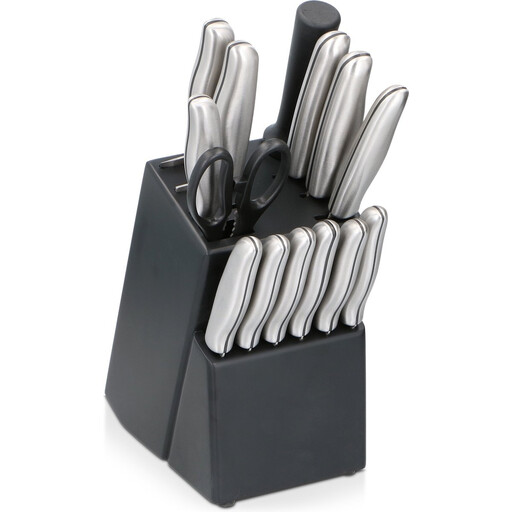
Why it's a good match: This set provides a variety of knives for everyday cooking, including a chef's knife, bread knife, steak knives, and a santoku knife, plus a pair of scissors and a knife block.
The contents are clearly specified: 13 knives, a knife block, and a pair of scissors. This makes it clear what you're getting.
15-piece set, stainless steel knives, and organised storage in a black knife block.
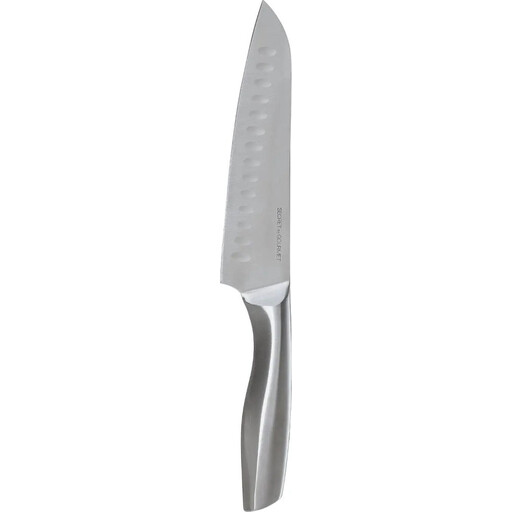
Why it's a good match: A single santoku knife is ideal for those who prefer to choose one specific knife rather than buying a large set.
The product information specifies a stainless steel blade, a total length of 32 cm, and a blade length of 18 cm. This allows you to gauge its size beforehand.
Fully forged according to the product details, with a weight of 180 grams and a sturdy handle.
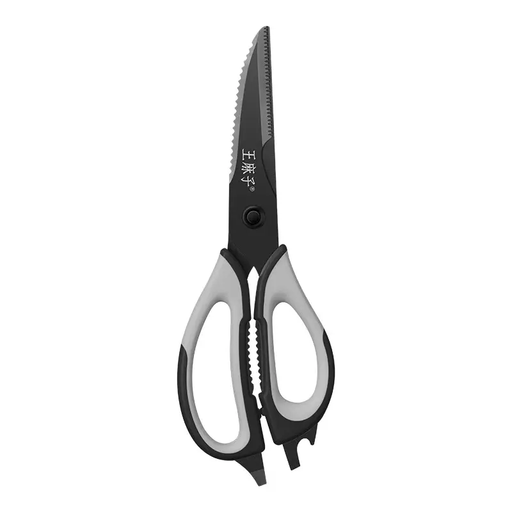
Why it's a good match: This model is designed for food preparation and tougher household tasks, such as cutting poultry as mentioned in the product description.
The product details mention a take-apart design. This makes inspection and cleaning easier than with a fixed model.
Multifunctional design, rust-resistant titanium according to the product name, and suitable for food preparation.
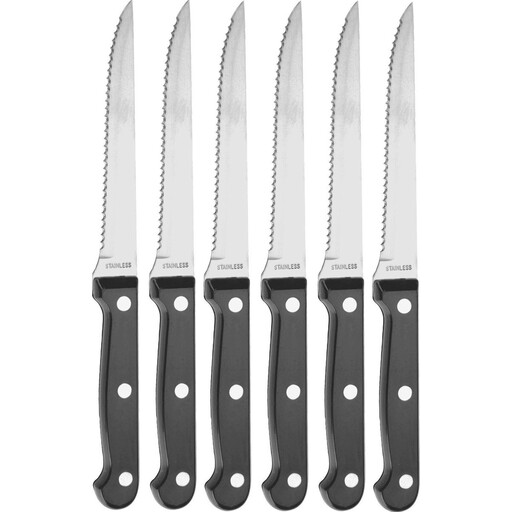
Why it's a good match: A set of six steak knives is perfect for households that regularly dine with several people.
The set contains six identical knives with a blade length of 11 cm. This means there's no ambiguity about the quantity or purpose.
Six stainless steel steak knives, plastic handles, and product details that state they are dishwasher-safe.
We've put together a complete, up-to-date list of products that fully meet these strict selection criteria and comply with current European safety regulations.
Even sharp kitchen knives need regular maintenance. Rinse off food residue after use, dry the blade immediately, and store knives so they don't bang against each other. It's best to use a sharpening steel or sharpening solution that is suitable for the type of knife. You don't sharpen a serrated bread knife in the same way as a smooth chef's knife.
With kitchen scissors, the joint is the main point of focus. Remove any food residue from around the joint and allow a take-apart model to dry completely before reassembling it. Always follow the manufacturer's care instructions. A product advertised as dishwasher-safe may still stay in better condition for longer with hand-washing and immediate drying.
Keep knives and scissors out of the reach of young children. Before each use, check that the blade, joint, and handle show no visible damage.
For most households, a chef's knife, bread knife, paring knife, and a pair of kitchen scissors are sufficient. Add steak knives if you often eat with several people. A santoku knife is an alternative or an addition for those who chop a lot of vegetables and herbs.
That depends on what's included. A set can be practical if you need several knives at once. However, you should compare the individual functions, maintenance, and storage. Don't buy a large set if you'll only end up using two or three of the knives.
The frequency depends on use, your cutting board, and maintenance. When a knife doesn't glide through ingredients as smoothly, it may need sharpening. Do not use a glass or stone surface as a cutting board, as this can dull the blade more quickly. Don’t force a dull knife; replace or sharpen safely.
