
Vandaag of morgen in huis

Kwaliteit gegarandeerd

Welkomstaanbiedingen ontgrendelen: GRATIS bezorging | Tot 80% korting | Gratis 30 dagen JoyPlus-proefperiode
Download de app
A sharp kitchen knife makes daily cooking much easier, but an attractive product page doesn’t always tell the full story. A knife might be described as “professional” without any clear details about the steel type, sharpening angle or care requirements. Similarly, a large knife set can seem like great value, yet in practice you’ll mainly use a chef’s knife, bread knife and paring knife.
As Joybuy’s Product Recommendation Officer, I filter the most important information based on verifiable specifications. This way, you can buy kitchen knives based on use, material and maintenance rather than just marketing language.
A 13-piece knife set sounds comprehensive, but always check what it actually contains. According to the product description, the 5five set includes a chef’s knife, bread knife, three other kitchen knives, six steak knives, a kitchen scissors and a knife sharpener. That’s practical for a household that often entertains guests, but possibly unnecessary if you mainly chop vegetables and meat on a daily basis.
Also pay attention to storage. A knife block takes up worktop space and needs regular cleaning. Loose kitchen knives are a better fit for a compact kitchen or when you want to choose your own combination.
Terms like “extra sharp” or “stays sharp for longer” aren’t automatically comparable. According to Wüsthof’s own information, some models are laser-controlled sharpened and then hand-finished. That’s a product feature, but the lifespan of an edge also depends on your chopping board, cutting technique and maintenance.
A kitchen knife should never be used on glass, stone or metal. A wooden or plastic chopping board puts less strain on the edge. Only use a honing steel or whetstone if it matches the knife’s sharpening angle.
Stainless steel kitchen knives are generally resistant to moisture, but that doesn’t mean every knife is dishwasher-safe. According to the product information, the Wüsthof Classic 16 cm should be washed by hand; the Wüsthof Gourmet is described as dishwasher-safe, although hand washing is still recommended for a longer lifespan there too.
Always check the care instructions for the specific model. Dry a knife immediately after washing and don’t leave it soaking in water for long periods.
Choose your knife based on the tasks you perform:
Many models in this range are made from stainless steel. That’s practical for everyday use, but “stainless” doesn’t mean the knife can be stored without any care. Water, acids and food residue can cause staining.
According to the product description, the Wüsthof Classic Chef’s Knife 16 cm uses X50CrMoV15 steel. The Wüsthof Amici 20 cm also mentions this steel, with a hardness of 58 HRC and a sharpening angle of 14 degrees per side. Such details are more useful for comparison than a general claim about sharpness.
A full-tang construction, where the steel runs through the handle, can contribute to balance and sturdiness. Also check whether the handle fits well and whether the grip is suitable for left- or right-handed use.
A heavier knife can be pleasant for heavy cutting work, but a lighter knife often offers more manoeuvrability. The Wüsthof Classic Ikon Santoku, for example, is listed with a weight of around 170 grams. The Wüsthof Performer has a 20 cm blade and a handle with a hexagonal grip profile.
Consider:
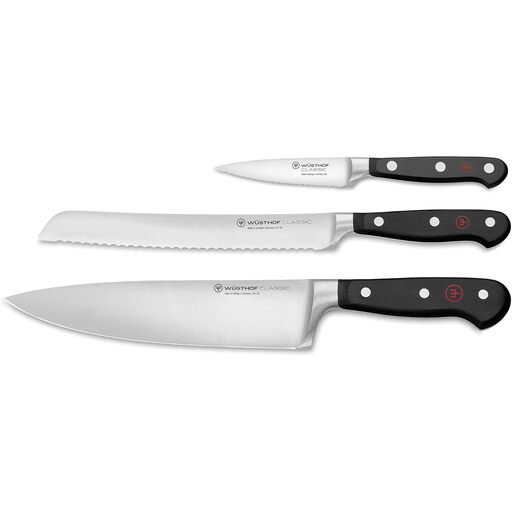
Why this fits: A compact starting point for anyone who needs one chef’s knife, bread knife and paring knife for daily preparation.
The set limits itself to three clearly defined functions rather than lots of unused knives.
Stainless steel blades, plastic handles and three commonly used knife shapes.
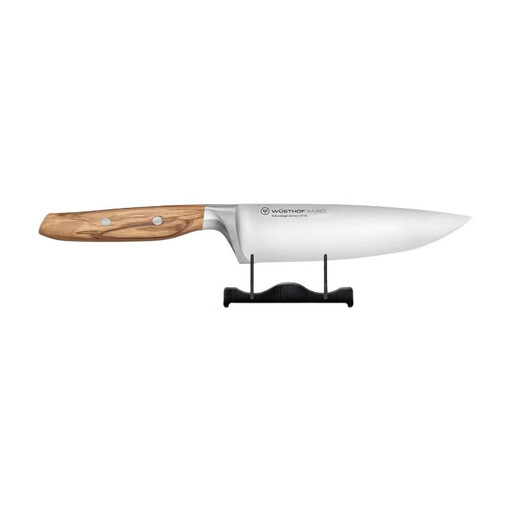
Why this fits: For home cooks and chefs who use a long, wide chef’s knife for vegetables, meat and herbs.
The product information lists X50CrMoV15 steel, 58 HRC and a sharpening angle of 14 degrees per side.
20 cm blade, wide shape for moving ingredients and an olive wood handle.
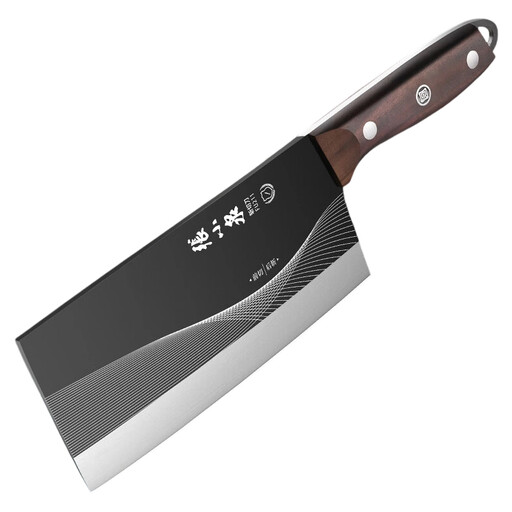
Why this fits: For users who regularly tackle heavy meat preparation and need a thicker cleaver or bone knife for the job.
The 313 mm length and description as a thick bone knife make its purpose clear; it’s not a universal fruit or chef’s knife.
Stainless steel construction and a long blade for larger cuts of meat.
Browse a current selection of stainless steel kitchen knives and compare blade shape, dimensions and care information.
For most households, a chef’s knife, bread knife and paring or utility knife are sufficient. Add a Santoku knife if you prepare lots of vegetables, herbs or fish. A steak knife or cleaver is mainly worthwhile when you perform those specific tasks often.
That depends on your usage. A set can be attractive when you need several knife shapes and a storage system. However, buying loose kitchen knives means you don’t pay for knives that remain unused. So compare the contents, materials and care requirements rather than just the number of pieces.
There’s no fixed schedule. The frequency of use, chopping board and cutting technique all determine how quickly a knife feels blunt. A honing steel can touch up the edge in between; for truly blunt knives, you’ll need a suitable whetstone or professional sharpening service. Always use a method that matches the specified sharpening angle.
