
Vandaag of morgen in huis

Kwaliteit gegarandeerd

Welkomstaanbiedingen ontgrendelen: GRATIS bezorging | Tot 80% korting | Gratis 30 dagen JoyPlus-proefperiode
Download de app
A good kitchen knife should suit your cooking style, worktop and maintenance routine. Yet many people buy a knife set based on the number of pieces or a striking marketing claim. This can leave you with knives you rarely use, that quickly feel blunt or are difficult to store.
Look out for these three common pitfalls:
For everyday cooking, you usually don’t need the largest kitchen knife set. Start with knives that suit the tasks you do regularly.
A chef’s knife is suitable for cutting vegetables, herbs, meat and fish. A blade of around 20 cm offers a good balance between cutting surface and control. A wide blade can also come in handy for transferring chopped ingredients to a pan.
The Wüsthof Amici chef’s knife has a 20 cm blade made from X50CrMoV15 stainless steel. According to Wüsthof’s product description, the blade is sharpened to a 14-degree angle and has a hardness of 58 HRC. These details give you a better idea of what you’re buying than the general term “professional kitchen knives”.
A santoku knife usually has a shorter, wider blade and is suitable for vegetables, herbs, meat and fish. According to some product descriptions, the dimples on certain blades can help prevent ingredients from sticking.
A 17 cm blade is a common size for home cooks. Pay attention to the handle, too: an ergonomic shape and a secure grip matter more than a decorative pattern on the steel.
A bread knife has a serrated blade. This lets you cut through hard crusts and soft bread without squashing it unnecessarily. A blade between 23 and 34 cm is practical for different sizes of loaf.
A bread knife is no substitute for a chef’s knife. Don’t use its serrated blade for small, precise cutting tasks, as sharpening and caring for it work differently.
A vegetable knife or paring knife is handy for small ingredients, peeling and precise cutting. A carving knife often has a longer, narrower blade for slicing and portioning. For a student room or small kitchen, a chef’s knife and a smaller paring knife may be enough. If you bake often or prepare large meals, an additional knife set may be more useful.
Stainless steel knives are popular because they’re relatively easy to care for. However, stainless steel doesn’t mean maintenance-free. Always check whether hand washing is recommended, and dry the knife straight away.
Some products are dishwasher-safe, while others aren’t intended for the dishwasher according to their product descriptions. Heat, moisture and contact with other kitchen utensils can put unnecessary strain on the blade and handle.
A longer knife can cut through larger ingredients in one stroke, but it also needs more space and control. For most home cooks, knives with blades of 17 to 20 cm are easy to handle. Also consider the weight and the transition between the blade and handle.
A half bolster, a wide blade or an ergonomically shaped handle can affect how the knife feels to use. This is partly down to personal preference, so consider the size of your hand and the space available on your chopping board.
A knife block keeps knives visible and separate. A knife set with a block is practical if you want to buy several knives at once. Check the dimensions of the block and make sure all the slots fit the knives included.
A roll-up bag is especially useful for students, cookery courses or anyone who wants to take their knives with them. A honing steel can help maintain the edge, but it won’t replace professional sharpening when the blade is genuinely blunt or damaged.
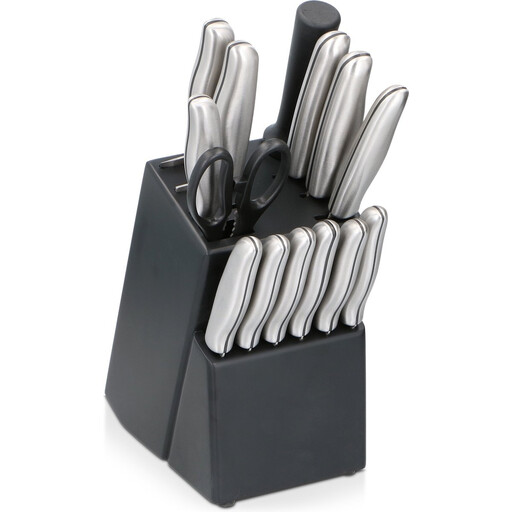
Why it suits this profile: This complete kitchen knife set includes several types of knife and a knife block, making it a good choice if you want to stock up on kitchen essentials in one go.
The contents are clearly listed: 13 knives, a pair of scissors and a knife block. That way, you know exactly what you’re buying.
15 pieces, including a chef’s knife, bread knife, steak knives and santoku knife; includes a black knife block.
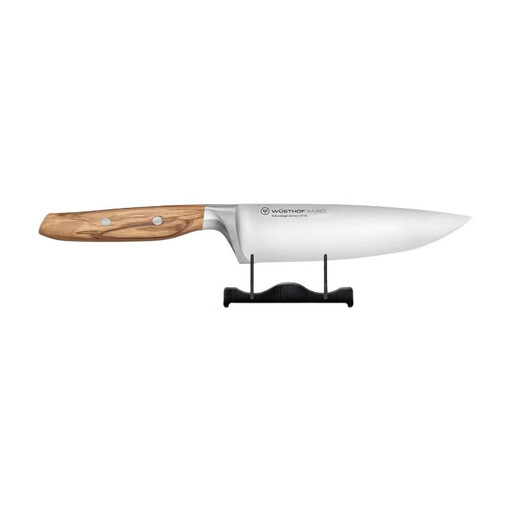
Why it suits this profile: A single chef’s knife is a good choice if you’d rather invest in one knife you’ll use every day than buy a large set.
The product information lists the blade length, steel type, cutting angle and hardness. So you don’t have to rely on a vague sharpness claim alone.
20 cm blade; X50CrMoV15 stainless steel; 14-degree cutting angle and 58 HRC according to the product details.
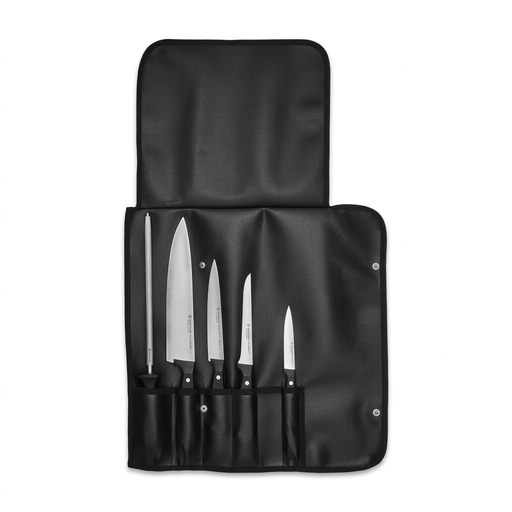
Why it suits this profile: This set is aimed at beginner cooks, students and anyone who handles a range of everyday tasks or wants to take their knives with them.
Each item in the set is listed individually, and it comes with a washable roll-up bag. This makes storage and transport more straightforward.
Five knives and a honing steel; 23 cm chef’s knife; stainless steel; roll-up bag made from soft, washable plastic.
We’ve put together a complete, up-to-date list of products that meet these strict selection criteria and the current European safety regulations.
Wash kitchen knives according to the manufacturer’s instructions. If washing by hand, use lukewarm water, mild washing-up liquid and a soft sponge. Dry the blade straight away, and don’t leave the knife loose among other cutlery.
Use a wooden or plastic chopping board rather than one made from glass or stone. These hard surfaces can blunt the edge more quickly. A honing steel is suitable for regular maintenance; have damaged knives sharpened rather than removing more and more material yourself.
For most households, a 17 to 20 cm chef’s knife, a small vegetable or paring knife and a bread knife are enough. Add a santoku knife or carving knife if you use one regularly.
It depends on the product. Some knives are listed as dishwasher-safe in their product descriptions, while hand washing is recommended for others. Check before you buy, and consider the handle material.
It depends on how often you use the knife, your chopping board and the type of steel. You can use a honing steel regularly, but a full sharpening is only needed when the knife no longer cuts smoothly despite correct use. Always choose a method suited to the knife.
