
Vandaag of morgen in huis

Kwaliteit gegarandeerd

Welkomstaanbiedingen ontgrendelen: GRATIS bezorging | Tot 80% korting | Gratis 30 dagen JoyPlus-proefperiode
Download de app
A good kitchen knife should suit the way you cook. Home cooks often need just one versatile chef’s knife, while keen cooks and professional chefs prefer to use several knives for vegetables, bread, meat and fish. Even so, comparing product information properly can be difficult. Terms such as “extra sharp”, “Damascus steel” and “professional quality” do not always tell you enough about everyday use.
Pay particular attention to the dimensions, steel, handle and care requirements. This will help you avoid paying for features you do not use or buying a knife that does not suit your chopping board, dishwasher or cooking routine.
A sharp kitchen knife is pleasant to use, but sharpness alone does not determine how long the knife will remain useful. The blade shape, sharpening angle and care also have an impact. A thin knife can make precise cuts, but it is not automatically suitable for hard ingredients or bones.
Check whether the manufacturer specifies a sharpening angle, type of steel or care advice. For example, the product information for the Wüsthof Classic Chef’s Knife states that it is sharpened to 14 degrees per side. According to Wüsthof’s own information, the knife is sharpened using laser-controlled technology. This is a brand claim; practical service life also depends on use and care.
A knife set may seem like good value, but it sometimes contains knives you hardly ever use. For everyday cooking, a chef’s knife, bread knife and small paring knife are often a sensible starting point. Steak knives are particularly useful if you regularly serve meat at the table.
Always check:
According to the product specification, the Wüsthof Classic 3-Piece Knife Set contains a chef’s knife, bread knife and paring knife. This covers a range of basic tasks without requiring you to buy a large set straight away.
A stainless steel kitchen knife may be resistant to moisture and corrosion, but that does not mean the dishwasher is always the best choice. High temperatures, harsh detergents and contact with other cutlery can damage the edge. Some models are listed as dishwasher-safe on the product page; for others, hand washing is recommended or the dishwasher is not suitable.
If in doubt, wash knives in warm water with mild washing-up liquid. Dry them immediately and store them in a knife block, protective sheath or drawer insert. Use a wooden or plastic chopping board and avoid glass, stone and metal.
The right length depends on your workspace and cutting technique.
A longer knife is not automatically more convenient. In a compact Dutch kitchen, a shorter blade may give you greater control.
Many kitchen knives are made from X50CrMoV15 stainless steel. This type of steel is used in various Wüsthof models and is designed to combine corrosion resistance, hardness and ease of care. When looking at other brands, check whether the type of steel is clearly stated. A vague description such as “premium steel” makes comparisons difficult.
The sharpening angle indicates how finely the edge has been sharpened. A smaller angle can make finer cuts, but generally requires more careful use. Use a suitable honing steel or whetstone and follow the manufacturer’s instructions.
An ergonomic handle can help with control, but “ergonomic” is not a fixed technical standard. Look instead at the material, shape, length and connection to the blade. A half bolster can reduce the weight and make it easier to sharpen more of the edge.
Also consider:
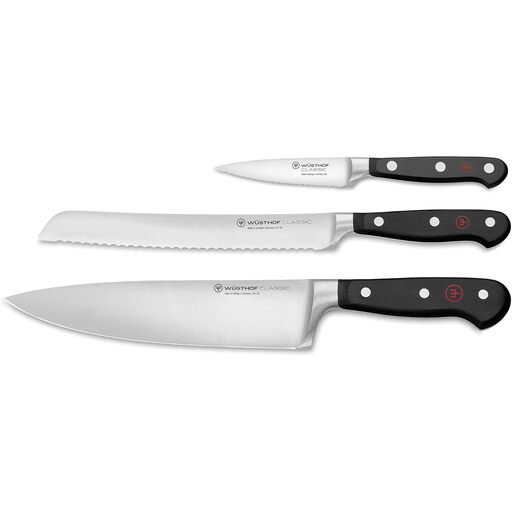
Why it suits this profile: This set provides three different knives for everyday preparation: slicing, cutting bread and small peeling or precision tasks.
The contents are clearly specified, so you do not pay for a large set containing knives you will not use.
Three knives, stainless steel blades and plastic handles. The product information states that they are dishwasher-safe.

Why it suits this profile: This santoku knife is designed for anyone who prepares plenty of vegetables, herbs, fruit, fish and meat and wants a compact, versatile blade shape.
The specifications state the X50CrMoV15 steel, handle material and sharpening angle of 14 degrees per side. The knife requires hand washing.
17 cm blade, synthetic handle and half bolster. According to Wüsthof’s own information, the knife is sharpened using laser-controlled technology.
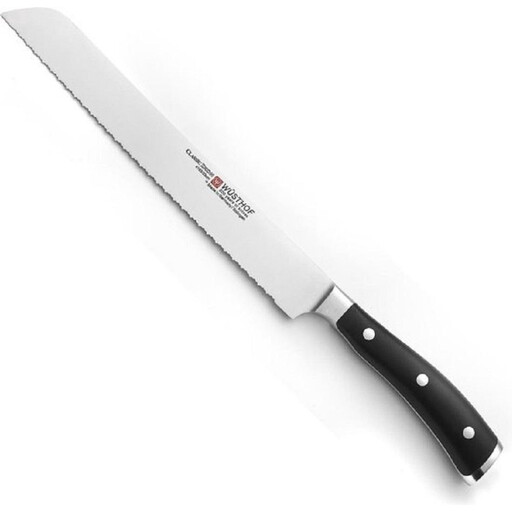
Why it suits this profile: A long bread knife with double serration is practical for everyday bread, hard crusts, cakes and soft foods.
Its intended use is clearly defined: this is not an all-purpose chef’s knife, but is designed to make even cuts through bread and similar products.
23 cm blade, X50CrMoV15 steel and double serration. Hand washing and careful storage are recommended.
The service life of kitchen knives depends largely on how you use them. Do not use a standard chef’s knife to cut through bones, frozen products or tough packaging. For meat on the bone, use a suitable cleaver and check beforehand that the model is designed for this purpose.
Maintain the edge regularly with a honing steel or whetstone. A honing steel primarily realigns the edge; blunt knives need to be sharpened properly. Store each knife so that the blade does not rub against other cutlery. A knife block or drawer insert prevents unnecessary damage.
Always hand-wash a sharp kitchen knife when this is specified by the manufacturer. Dry the knife completely before storing it. Also check the handle and joints regularly. Do not continue using a damaged knife until it has been assessed as safe or replaced.
We have put together a complete, up-to-date list of products that fully meet these strict selection criteria and the applicable European safety regulations.
A chef’s knife measuring 16 to 20 cm is a practical choice for many home cooks. The blade is suitable for slicing, chopping and finely preparing vegetables, herbs, fruit and meat, without the need for several different knives. If you mainly prepare vegetables and fish, you could also consider a santoku knife.
It varies from product to product. Some product pages state that the knives are dishwasher-safe, while others specify hand washing. Hand washing with mild washing-up liquid will generally help keep the edge, surface and handle in good condition for longer.
This depends on how often you use it, the type of steel and your chopping board. A knife used every day may need regular maintenance with a honing steel. Once the knife no longer glides smoothly through ingredients, it needs sharpening. Use a method that is suitable for the specified sharpening angle.
