
Vandaag of morgen in huis

Kwaliteit gegarandeerd

Welkomstaanbiedingen ontgrendelen: GRATIS bezorging | Tot 80% korting | Gratis 30 dagen JoyPlus-proefperiode
Download de app
A good kitchen knife doesn't have to be expensive. What matters most is that it suits the way you cook, feels comfortable in your hand, and is easy to maintain. However, if you only focus on a low price, an eye-catching design, or a claim of "extra sharp", you could quickly make the wrong purchase.
A chef's knife is suitable for vegetables, herbs, meat and fruit, but not for everything. Bread is usually cut more neatly with a serrated bread knife. For steak, steak knives are more practical, and for Asian cutting techniques, a santoku knife may be a better fit.
A large knife set may look appealing, but it sometimes contains knives you rarely use. So first check which tasks you carry out on a daily basis.
"Ultra-sharp" says very little without information about the grind angle, the steel, and the way the knife has been sharpened. With some Wüsthof models, for example, a cutting angle of 14 degrees per side is stated. That is a verifiable specification; a general claim about exceptional sharpness is not always that.
Also pay attention to the difference between a factory-sharpened knife and a knife you need to maintain yourself on a regular basis. Even a sharp kitchen knife loses its cutting edge more quickly on glass, stone or metal than on a suitable wooden or plastic chopping board.
Not every kitchen knife is suitable for the dishwasher. Heat, moisture and contact with other kitchen items can damage the cutting edge and the handle. A steak knife set, for example, may explicitly require hand washing, while other models are advertised as dishwasher-safe. Always check the product information and dry the knife after washing.
For everyday cutting, a blade of 16 to 20 cm is often practical. A 16 cm chef's knife offers more control and is suitable for smaller work surfaces. A 20 cm knife gives more cutting surface for large vegetables, pieces of meat and cabbage.
Stainless steel is practical for everyday use because it is less prone to rust than ordinary carbon steel. A product with X50CrMoV15 steel, such as certain Wüsthof models, gives a more concrete material indication than just "stainless steel".
With forged kitchen knives, the blade is formed from a single piece of steel. A full-tang construction means the steel runs all the way through to the handle. This can contribute to balance and sturdiness, but always check whether this is actually stated in the product specifications.
A lower grind angle can enable precise cutting, but also requires careful use. Do not cut on hard surfaces and do not use twisting motions to force your way through hard products.
A handle should feel stable without you having to grip it tightly. Pay attention to:
For prolonged cooking, for example in a professional kitchen, grip and balance are at least as important as the price. A heavy knife can be pleasant with larger ingredients, but a lighter model gives some users more control.
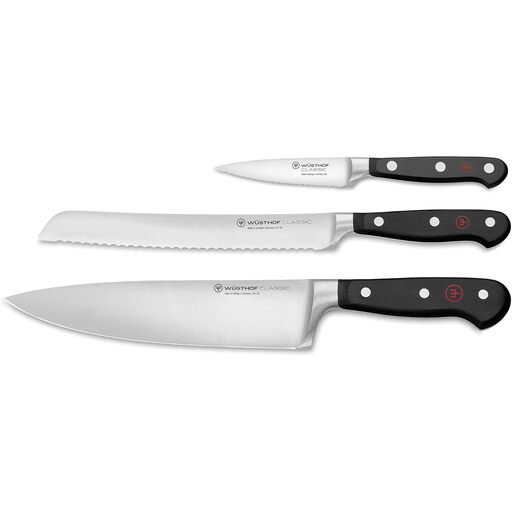
Why this suits the profile: This knife set contains a chef's knife, bread knife and office knife, covering several daily kitchen tasks without buying a large collection.
The three knife shapes make it clear what each knife is intended for. This means you don't have to use one universal knife incorrectly.
3-piece composition, stainless steel blade and ergonomic synthetic handle according to the product information.

Why this suits the profile: This 17 cm santoku knife is designed for finely chopping vegetables, herbs, fish and meat, and suits cooks looking for a controlled, versatile cut.
The product information mentions the X50CrMoV15 steel, a 17 cm blade and a grind angle of 14 degrees per side.
High-carbon stainless steel, synthetic handle and a design suitable for left-handed and right-handed use.
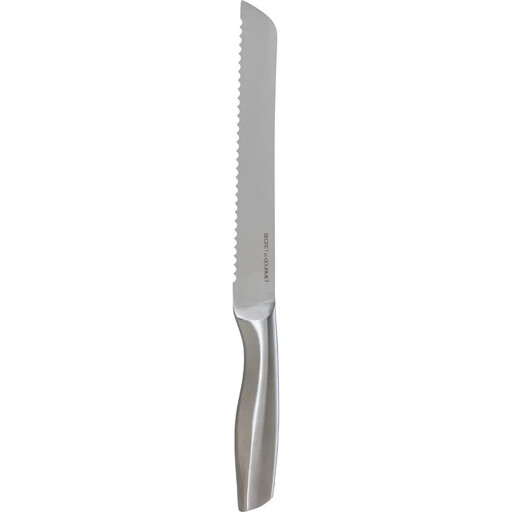
Why this suits the profile: A long bread knife is handy for large loaves, baguettes and cakes. The serrated design requires less pressure on products with a firm exterior.
You use a bread knife for a specific task instead of burdening a chef's knife with hard crusts.
34 cm long stainless steel bread knife, forged construction according to the product information and dishwasher-safe.
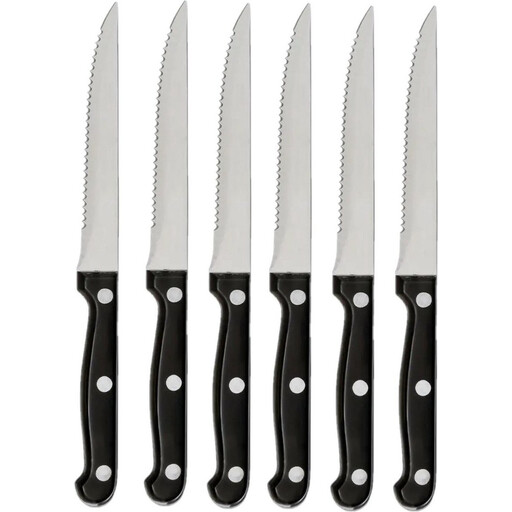
Why this suits the profile: Six steak knives are practical for a family, dinner parties or a table where several guests are eating meat or pizza at the same time.
The serrated blades are intended for serving and cutting at the table, not as a replacement for a chef's knife.
Set of 6, stainless steel blades, synthetic handles and a length of 22 cm per knife.
We have compiled a full, up-to-date list of products that fully meet these strict selection criteria and comply with current European safety regulations.
Wash kitchen knives by hand if the manufacturer advises this. Use warm water, mild washing-up liquid and dry the blade immediately. Store knives in a knife block, protective sheath or drawer insert to limit contact with other cutlery.
Only use a honing steel when it suits the edge. For periodic sharpening, a whetstone or a professional sharpening service is more suitable. Also check the handle and the transition to the blade regularly. A loose handle is a reason to stop using the knife.
A chef's knife of 16 to 20 cm is a logical starting point for vegetables, herbs, fruit and meat. Add a bread knife if you often buy or bake bread. A small knife set can be advantageous when you want to cover several basic tasks straight away.
That depends on use, steel, grind angle, chopping board and maintenance. A knife that is used daily on a soft board and maintained regularly will generally retain a usable edge for longer than a knife used on glass or stone. There is no fixed lifespan that applies to all kitchen knives.
Some models are advertised as dishwasher-safe, but hand washing can help extend the life of the blade and handle. Always check the product specifications. If in doubt, hand washing, immediate drying and safe storage are the cautious choice.
