
Vandaag of morgen in huis

Kwaliteit gegarandeerd

Welkomstaanbiedingen ontgrendelen: GRATIS bezorging | Tot 80% korting | Gratis 30 dagen JoyPlus-proefperiode
Download de app
A kitchen knife may look impressive online, but that says little about how comfortable it is to use every day. A shiny blade, eye-catching pattern or phrases such as “professional” and “ultra-sharp” are no guarantee of a good choice. For home chefs, keen cooks and professional chefs, the most important factors are the type of knife, its dimensions, the steel and how easy it is to maintain.
If you focus only on price or appearance, you will often encounter three problems:
The knife should suit the tasks you regularly carry out in the kitchen:
A knife set may look appealing, but check which knives it actually contains. A set with three well-chosen knives can be more useful than a large set containing several knives you rarely use.
A stainless steel kitchen knife generally requires less care to prevent corrosion than carbon steel. However, stainless steel is not maintenance-free: prolonged soaking, food residue and moisture can cause marks.
With a forged knife, the blade often consists of a single piece of steel according to the product description. A full-tang construction extends into the handle and can contribute to balance and strength. Also look at the connection between the blade and handle. A smooth transition is easier to clean.
A Damascus kitchen knife refers to a specific steel construction or blade finish, but the pattern on the blade does not automatically determine cutting performance. Therefore, also check the type of steel, sharpening angle, blade length and care instructions. According to the product information, the Wüsthof Performer Santoku has a Damascus steel blade and hand washing is recommended.
A long knife cuts through larger ingredients in a single movement, but also requires more space and control. For everyday use, 16 to 18 cm are often practical sizes. A 20 cm knife is better suited to anyone who uses larger vegetables, cuts of meat or generous-sized chopping boards.
The handle should feel stable without requiring you to grip it tightly. Pay attention to:
Where possible, use kitchen knives on a wooden or plastic chopping board. Glass, stone and metal can damage the edge more quickly. Dry the knife immediately after washing and store it in a knife block, protective sheath or drawer insert.
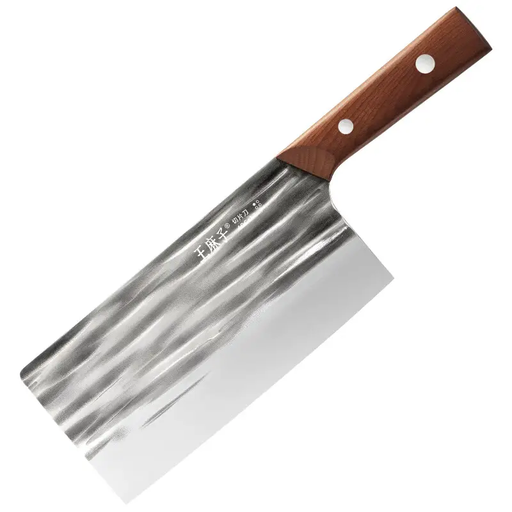
Why it suits this profile: This multifunctional kitchen knife is designed for everyday preparation of meat, vegetables and fruit. The ergonomic handle and stainless steel construction make it well suited to straightforward home use.
The product description mentions specific uses and materials rather than relying only on a style claim. Hand washing and drying it immediately help to prevent prolonged soaking.
Stainless steel; suitable for meat, vegetables and fruit; comfortable handle according to the product description.

Why it suits this profile: This santoku knife combines an X50CrMoV15 high-carbon stainless steel blade with a polyoxymethylene handle. The 17 cm length is well suited to fine chopping and everyday mise en place.
You can assess this choice based on the type of steel, blade length and maintenance requirements, rather than appearance alone. According to Wüsthof’s own product information, the knife has a sharpening angle of 14 degrees; this is a product specification, not a guarantee for every user.
17 cm blade; X50CrMoV15 steel; hand washing recommended; suitable for vegetables, herbs, fish and meat.
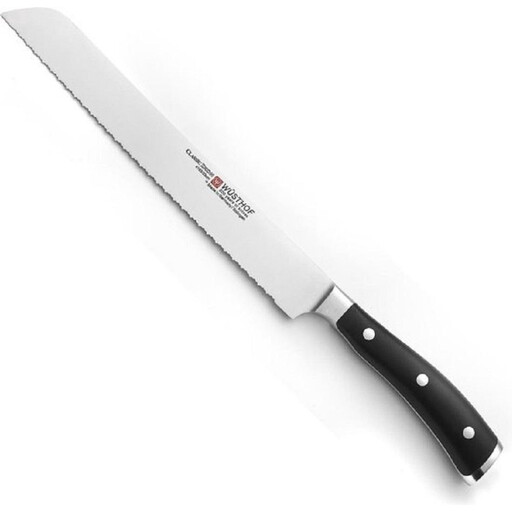
Why it suits this profile: If you often cut bread, cake or cabbage, a specialist bread knife is more useful than another smooth-bladed chef’s knife. The blade is 23 cm long and double-serrated according to the product information.
The design is tailored to cutting bread, so you do not have to use one universal knife for every task. Hand washing, a softer chopping board and safe storage help to limit unnecessary wear.
23 cm blade; double-serrated edge; suitable for left- and right-handed users; hand washing recommended.
We have compiled a complete, up-to-date list of products that fully meet these strict selection criteria and the applicable European safety regulations.
A good knife will only remain enjoyable to use if you look after it properly. Wash the knife immediately after use with lukewarm water and mild washing-up liquid. Dry it completely before putting it away. Check whether the manufacturer allows dishwasher use for each model. Even when this is stated, hand washing can help extend the life of the edge and handle.
To maintain the edge, use a honing steel or whetstone that matches the sharpening angle. A santoku knife and a European chef’s knife may have different sharpening angles. Do not force the knife through bones, frozen food or hard surfaces. Specific knives or tools are required for these tasks.
Start with a chef’s knife of around 16 to 20 cm, then add a bread knife if you regularly buy or bake bread. A small paring knife is useful for peeling and preparing small ingredients. A knife set is particularly practical when it contains exactly these functions.
No. A Damascus kitchen knife also needs to be washed and dried after use. Check the type of steel and care instructions for the specific model. A decorative blade pattern alone says little about durability or edge retention.
This depends on how you use the knife, your chopping board and your technique. Regular light honing can help maintain the edge; a blunt knife may need a whetstone or professional sharpening. Do not wait until the knife slides through ingredients or requires force: this makes cutting less controlled.
