
Vandaag of morgen in huis

Kwaliteit gegarandeerd

Welkomstaanbiedingen ontgrendelen: GRATIS bezorging | Tot 80% korting | Gratis 30 dagen JoyPlus-proefperiode
Download de app
A good kitchen knife should suit the way you cook, your chopping board and your maintenance routine. Yet many home cooks choose mainly based on a familiar brand name, striking design or the promise of an “extra-sharp” edge. This can result in a knife that soon feels blunt, is difficult to hold or barely gets used.
As a Joybuy Product Recommendation Officer, I filter the most important product information down to practical details. This allows you to compare kitchen knives based on verifiable specifications rather than vague marketing claims.
The term sharp kitchen knives does not tell you much on its own. Check the sharpening angle, blade type and care instructions too. A thin edge can make cutting pleasant, but it often requires careful use and regular honing or sharpening.
Also consider your chopping board. Glass, metal and natural stone can damage the edge more quickly. Wood or plastic is generally a more suitable surface.
A large knife set may seem like good value, but it can sometimes contain several similar knives. For many households, a chef’s knife, bread knife, small paring knife and possibly steak knives are enough. A set is mainly worthwhile if the included sizes and accessories match the way you cook.
Also check whether a knife set with a knife block, scissors or honing steel is dishwasher-safe. The product information may differ for each item.
An ergonomic handle is not a universal guarantee of comfort. The circumference, weight and balance determine how a knife feels in your hand. If you often chop vegetables, you may benefit more from a stable, slightly heavier knife. For smaller hands or precision work, a 16 or 17 cm blade is often easier to control than a 20 cm chef’s knife.
A chef’s knife with a 16 cm blade is manoeuvrable for herbs, vegetables and smaller pieces of meat. A 20 cm blade provides more cutting surface and can be useful for cabbage, pumpkin or larger pieces of meat, but it also requires more space and control.
A santoku knife usually has a broader, relatively straight edge. This makes it suitable for vegetables, herbs, fish and various cutting techniques. A bread knife has a serrated edge that cuts through crusts without completely flattening the bread. Steak knives are designed for serving portions at the table; a serrated edge is practical for meat and tomatoes.
Many stainless steel kitchen knives are made from steel that resists corrosion during normal use. The exact type of steel matters more than simply describing it as “stainless”. For example, the product information for several Wüsthof knives refers to X50CrMoV15 steel.
A forged knife is formed from a single piece of steel. A full-tang construction means that the steel extends through the handle, which according to the product specifications can contribute to a strong connection and predictable balance. Always check that these features are actually listed for the specific model.
An edge of 14 degrees per side is a specific detail listed for some Wüsthof models. According to the product description for these models, the edge is sharpened with laser control and honed by hand. The stated sharpness is a product claim made by the brand; in practice, its lifespan depends on use, chopping board and maintenance.
Washing by hand with warm water and mild washing-up liquid is generally the safest choice. Even when a knife is described as dishwasher-safe, hand washing can help extend the life of the edge and handle. Dry the knife immediately and store it in a knife block, protective sheath or drawer insert.
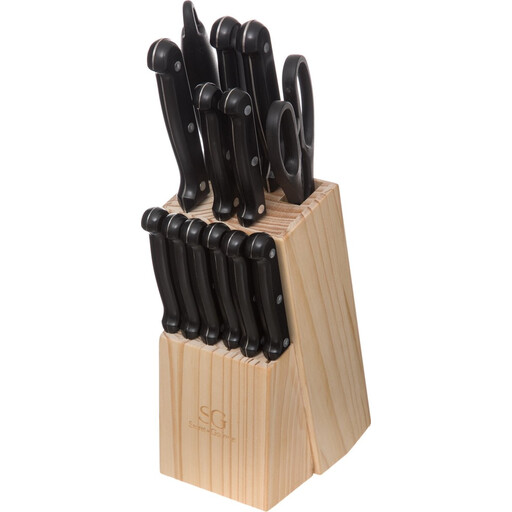
Why it suits this profile: This set includes a chef’s knife, bread knife, steak knives, scissors, honing steel and knife block, among other items. It provides a comprehensive starting point for households that do not yet have a complete basic set.
The contents are clearly specified: 13 pieces, including 11 knives. According to the product information, the set is not dishwasher-safe, making hand washing the recommended routine.
Popular knife shapes in one set, including a knife block, kitchen scissors and honing steel.
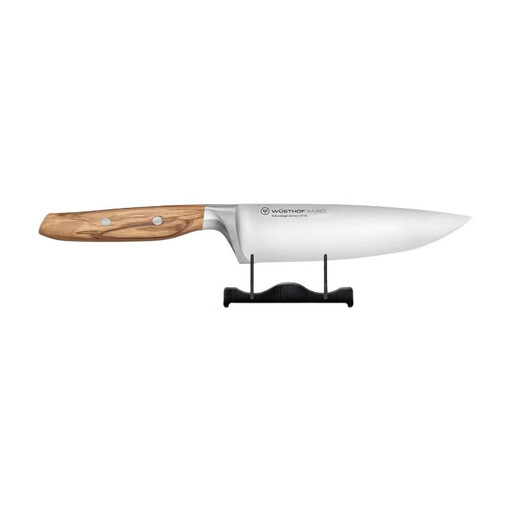
Why it suits this profile: This broad chef’s knife is designed for users looking for one versatile knife for vegetables, herbs, tomatoes, meat and transferring chopped ingredients.
The product description specifies X50CrMoV15 steel, a forged construction, a sharpening angle of 14 degrees per side and a hardness of 58 HRC. These details are more specific than simply claiming that the knife is “professional”.
20 cm blade; olive wood handle; half-bolster construction and broad cutting edge.
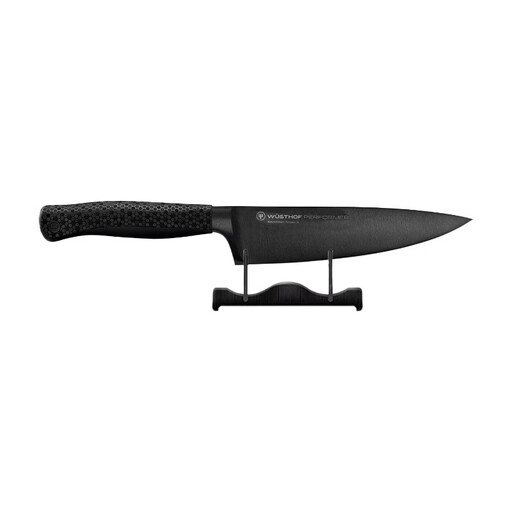
Why it suits this profile: The 20 cm blade and hexagonal non-slip handle are designed for cooks who cut frequently and with precision, both at home and in a busy kitchen.
The product information specifies an X50CrMoV15 blade, a DLC coating and a double-serrated edge. This makes the relevant construction details clearer than a general promise of durability.
DLC coating; 20 cm blade; grip with honeycomb pattern according to the product description.
Wash kitchen knives by hand if this is recommended by the manufacturer and dry them immediately. Use a honing steel only to realign the edge regularly; a genuinely blunt knife requires a suitable sharpening stone or professional sharpening service. Do not store knives loose in a kitchen drawer. This prevents contact with other metal objects and limits damage to the edge.
Pay attention to product differences: the Wüsthof Classic Chef's Knife with a 16 cm blade is not recommended for the dishwasher according to the product information. The 5five bread knives, on the other hand, are listed as dishwasher-safe, although hand washing may still be the more care-friendly option.
We have put together a complete, up-to-date list of products that fully meet these strict selection criteria and the applicable European safety regulations.
Start with a chef’s knife measuring 16 to 20 cm, depending on the size of your hands and the ingredients you usually prepare. Then add a bread knife and, if needed, a small paring knife. A knife set is practical if you also need steak knives and a knife block.
This depends on use, the type of steel and your chopping board. A honing steel can be used regularly to realign the edge. Once the knife no longer moves smoothly through vegetables or meat, it needs sharpening. Do not force the cut; this reduces control.
Some models are sold as dishwasher-safe, but always check the specific product description. Heat, moisture and contact with other items can put strain on the edge and handle. Hand washing and drying immediately are generally the more cautious care options.
