
Vandaag of morgen in huis

Kwaliteit gegarandeerd

Welkomstaanbiedingen ontgrendelen: GRATIS bezorging | Tot 80% korting | Gratis 30 dagen JoyPlus-proefperiode
Download de app
A good kitchen knife does not have to be expensive. Yet many home cooks pay for features that add little to everyday use. A shiny blade, eye-catching pattern or promise of extreme sharpness does not tell you enough on its own.
The right choice mainly depends on the type of knife, the blade finish, the handle and how you look after the knife. Below, you’ll find what to consider before buying an individual knife or a complete knife set.
Brands sometimes use percentages or terms such as “razor-sharp”. According to Wüsthof’s own research, a particular sharpening technique can make a knife 20% sharper on average than standard knives. That is a brand claim, not a universal measure for every type of use.
More important is the combination of steel type, sharpening angle, chopping board and maintenance. A sharp knife can quickly become blunt when used on glass, stone or a hard bamboo board. So don’t just check the claim. Also look at:
A 15-piece set may seem appealing, but it can contain several steak knives or accessories that have little to do with food preparation. For everyday cooking, three knives are often enough: a chef’s knife, a bread knife and a paring or vegetable knife.
A knife block also takes up space on the worktop. Check the contents, dimensions and how the knives are stored. A smaller knife set may be more practical than an extensive set with unused components.
Stainless steel knives are generally practical for everyday use, but “stainless” does not mean the knife requires no maintenance. Salt, acids and prolonged exposure to moisture can affect the finish. Damascus kitchen knives often have a striking pattern, but some models require hand washing and immediate drying.
Also check for conflicting product information. A knife may be described as dishwasher-safe in the general product details, while hand washing is recommended for a longer service life.
Choose a knife based on the tasks you perform:
A longer blade is not automatically more practical. In a compact kitchen or when working with smaller ingredients, a 16 or 17 cm knife may feel more comfortable than a 20 cm chef’s knife.
Pay attention to the difference between stainless steel, high-carbon stainless steel and Damascus steel. High-carbon steel can support a hard, sharp edge, but requires careful drying. Damascus often refers to a layered or decorative steel construction; the pattern alone says nothing about the knife’s overall cutting performance.
A knife forged from a single piece of steel or with a full tang can provide a strong connection between the blade and handle. Also check the exact product information: not every knife with the same brand name has the same construction or care instructions.
An ergonomic handle should feel secure in your hand without twisting. Consider the material, the transition between blade and handle and the overall balance. If you cook for long periods, you’ll notice the difference between a heavy knife and a lightweight model more quickly.
Do not store sharp knives loose in a kitchen drawer. Use a knife block, protective sheath or suitable magnetic knife strip. A knife block not only protects the edge, but also reduces the risk of your hand brushing against a blade.
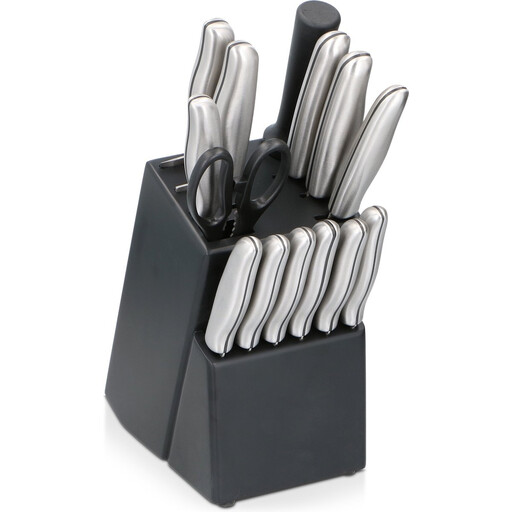
Why it suits this profile: This set offers several knife shapes and a knife block for anyone looking to equip their kitchen in one go.
The contents are clearly specified: 13 knives, a pair of scissors and a block. This lets you see in advance exactly which components you’ll receive.
15 pieces, stainless steel knives, santoku, bread and paring knives, plus a black knife block.

Why it suits this profile: This santoku knife is designed for buyers who pay attention to the type of steel, sharpening angle and how the handle feels in the hand.
The specification lists X50CrMoV15 steel, a 17 cm blade, a double bevel of 14° and hand washing as the recommended care method.
Forged from a single piece of steel, with a synthetic handle and a partially protected grip for control when sharpening.
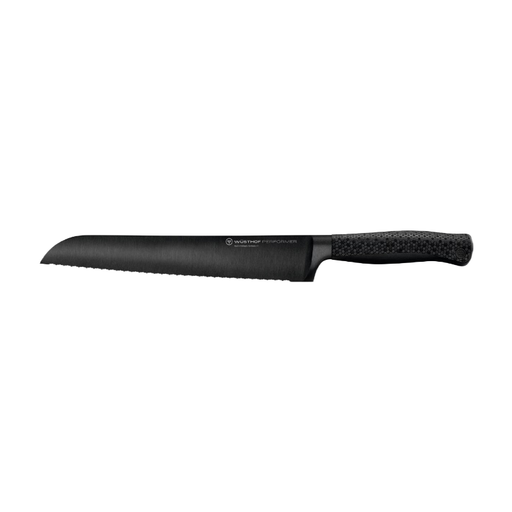
Why it suits this profile: Bakers, larger households and keen home cooks can benefit from a long bread knife for different crusts and soft foods.
Its purpose is clearly defined: a 23 cm serrated blade for bread and soft ingredients. This knife is not intended to be an all-purpose chef’s knife.
Damascus steel according to the product information, an ergonomic handle with a honeycomb structure and a total length of 34.9 cm.
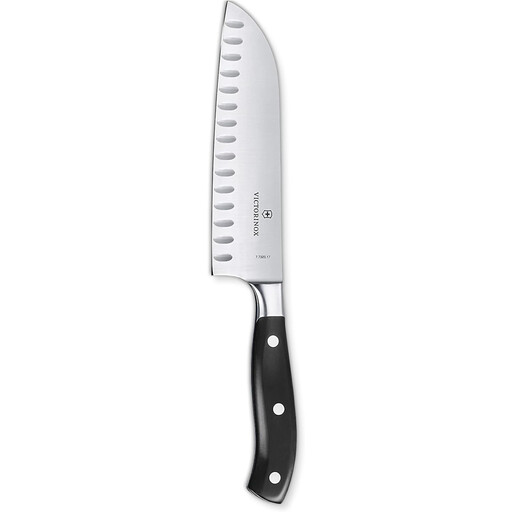
Why it suits this profile: This Victorinox knife is ideal for cooks looking for a compact all-rounder for vegetables, meat and fish.
The 17 cm length is clearly stated. According to the product description, the indentations in the blade are designed to help prevent meat and fish from sticking.
Stainless steel blade, ergonomic plastic handle and a santoku shape for a range of cutting tasks.
We’ve put together a complete, up-to-date list of products that fully meet these strict selection criteria and the applicable European safety regulations.
Ideally, wash kitchen knives immediately after use with lukewarm water and a mild washing-up liquid. Dry the blade straight away, especially with Damascus kitchen knives and high-carbon steel. Use a suitable whetstone or honing steel according to the manufacturer’s instructions.
A serrated bread knife needs to be sharpened differently from a smooth-edged chef’s knife. Don’t replace a blunt knife straight away: first check whether professional sharpening or correct honing could restore it. Store each knife so that the blade does not come into contact with other cutlery or hard surfaces.
For most households, a chef’s knife or santoku knife, a bread knife and a paring knife are enough. Add a vegetable knife or utility knife if you often make small or precise cuts. A knife set is particularly useful when you need several types of knife and suitable storage.
The life of the cutting edge depends on use, steel, sharpening angle and the surface you cut on. Use wood or plastic, avoid glass and ceramic, and store knives separately. Hand washing and regular maintenance help keep the edge useful for longer.
No. A more expensive knife may offer extra attention to construction, balance or finish, but its value depends on your cooking style. First compare the blade length, handle, care instructions and the contents of any knife set. That way, you’ll pay for features you will actually use.
