
Vandaag of morgen in huis

Kwaliteit gegarandeerd

Welkomstaanbiedingen ontgrendelen: GRATIS bezorging | Tot 80% korting | Gratis 30 dagen JoyPlus-proefperiode
Download de app
A sharp kitchen knife makes everyday cooking easier. However, it can be difficult to work out online which kitchen knives are worth the money. A knife set may contain lots of pieces, but not every knife will be used equally often. Terms such as “extra sharp”, “professional” or “rust-resistant” only mean something when you check the specifications.
The three most common pitfalls:
A chef’s knife measuring around 18 to 20 cm is suitable for vegetables, herbs, meat and larger ingredients. The broad blade can also be useful for sliding chopped food from the chopping board into the pan.
A santoku knife often has a slightly different shape and is suitable for finely chopping vegetables, herbs, fish and meat. Always check the stated blade length. For the Wüsthof Classic Ikon Santoku, for example, it is 17 cm.
Other knives are more practical for specific tasks:
Many stainless steel kitchen knives require less maintenance than carbon steel versions, but “stainless” does not mean that you can leave a knife wet indefinitely. Wash the knife after use and dry it immediately.
Look out for the following details:
According to Wüsthof’s own product information, certain models are sharpened to an angle of 14 degrees and finished using laser-guided techniques. This is a product specification from the brand, not a universal guarantee of a particular cutting experience.
A knife does not stay sharp by itself. Use a stable chopping board and avoid glass, stone and ceramic as cutting surfaces. These can put more strain on the edge and blunt it faster.
Also check the following:
A knife block keeps knives neatly stored, but it does take up worktop space. Individual knives are more flexible if you already have a good storage solution.
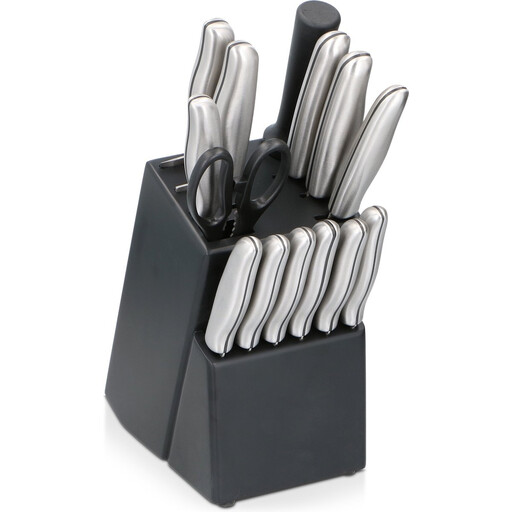
Why it suits this profile: This kitchen knife set offers several knives and accessories in one package, which is convenient when setting up a kitchen from scratch or if you have very few knives.
The contents are clearly specified: 13 knives, a knife block and a pair of scissors. However, check that you will actually use all the listed knife types.
13 kitchen knives, a pair of scissors and a black knife block; the product information lists, among others, a chef’s knife, bread knife, santoku knife and steak knives.
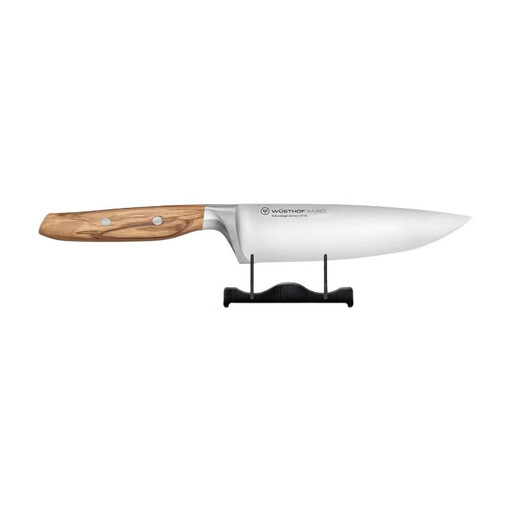
Why it suits this profile: An individual chef’s knife is a sensible choice if you mainly use one versatile knife and want to invest specifically in its materials, balance and finish.
You do not pay for unused items in a large knife set. The specifications state X50CrMoV15 steel, a 20 cm blade and 58 HRC.
Forged from a single piece of steel, with a broad blade and, according to the product information, a 14-degree cutting angle. Hand washing is recommended.
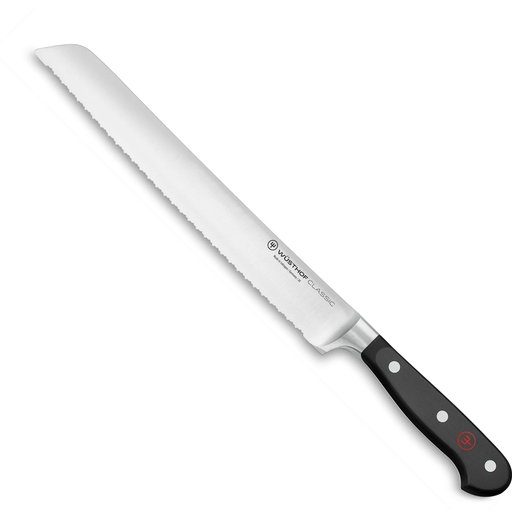
Why it suits this profile: This individual bread knife is ideal for households where bread, hard vegetables, fruit with skins or crispy foods are cut every day.
A serrated edge means you do not have to use a smooth-edged chef’s knife for a task it is less suited to. The product page states that this model is not dishwasher-safe.
Serrated stainless steel blade measuring 23 cm; suitable for bread and ingredients with a tough outer skin.
We have put together a complete, up-to-date list of products that fully meet these strict selection criteria and the applicable European safety regulations.
Wash kitchen knives immediately after use if the product information recommends hand washing. Dry the blade and handle thoroughly before storing the knife. Do not leave knives loose in an overfilled cutlery drawer: this can damage the edge and increases the risk of coming into contact with the blade.
Only use a honing steel or sharpener if it is suitable for the cutting angle and type of knife. A serrated bread knife needs to be sharpened differently from a smooth-edged chef’s knife. Replace a knife if the blade is damaged or the handle is no longer firmly attached.
For most households, a chef’s knife, a small vegetable or paring knife and a bread knife are sufficient. Add steak knives or a santoku knife if you use those functions regularly. A knife set is particularly practical if you want to buy several knives and storage in one purchase.
That varies by model. According to the product information, some 5five knives are described as dishwasher-safe. Hand washing is recommended for various Wüsthof models, or they are explicitly not dishwasher-safe. Always check the care instructions for the specific product.
It depends on how often you use it, your chopping board and how well you maintain it. A knife used every day will need maintenance sooner than one that only comes out of the drawer occasionally. Do not cut on hard surfaces or use a knife to prise food loose. A suitable storage place and timely sharpening help keep cutting performance at its best.
