
Vandaag of morgen in huis

Kwaliteit gegarandeerd

Welkomstaanbiedingen ontgrendelen: GRATIS bezorging | Tot 80% korting | Gratis 30 dagen JoyPlus-proefperiode
Download de app
A good kitchen knife makes chopping vegetables, preparing meat and serving bread more straightforward. Yet it can be difficult to see past marketing terms such as “extra sharp”, “professional” and “stainless”. Not every knife is suited to every task, and a large knife set is not automatically practical.
The Joybuy Product Recommendation Officer helps you assess the key differences. This means you can avoid paying for knives you will hardly use, a block that takes up too much space or a blade whose care instructions do not suit your habits.
A kitchen knife set can seem appealing because of the number of pieces. However, check which knives are actually included. A complete set might contain a chef’s knife, bread knife, santoku knife, steak knives, paring knives, kitchen scissors and a knife sharpener. If you mainly need a chef’s knife and a bread knife, several specialist knives may end up unused in the knife block.
Also look at the difference between the number of knives and the number of pieces. A 15-piece set could, for example, contain 13 knives, a block and a pair of scissors.
According to brands’ own product information, knives may have a sharp edge or long-lasting sharpness. This does not guarantee the same cutting experience in every kitchen. How long an edge lasts also depends on the chopping board, cutting technique and care.
A hard glass or stone surface can put more strain on the edge. It is better to use a suitable wooden or plastic chopping board and avoid storing knives loose in a kitchen drawer. A knife block or protective sheath helps limit contact with other kitchen utensils.
“Stainless steel” does not tell you everything about the blade’s thickness, balance or handle. Also consider the blade length, weight and how the handle feels in your hand. A lightweight santoku knife can be comfortable for fine chopping, while a heavier cleaver offers more control when working with firm ingredients.
For products with a wooden handle or an edition that is not dishwasher-safe, hand washing is often the practical choice. Always check the care information on the product page.
Stainless steel knives are popular for everyday use because they are relatively easy to maintain. Manufacturers may also mention features such as rust resistance or a sharp edge. Be precise when presenting this information: according to the brand’s product description, a particular knife is suitable for everyday cutting, but its actual lifespan is also affected by use and care.
Pay attention to these points:
For example, according to the product information, the 13-piece 5five knife set is not dishwasher-safe. The individual 5five santoku knife and 5five bread knife, on the other hand, are listed as dishwasher-safe. This difference can be important if you have little time for hand washing.
The shape determines what you use a knife for:
According to the specifications, the 5five santoku knife has a total length of 32 cm and a blade length of 18 cm. The 5five bread knife edition is 33 cm long. Compare these measurements with the space available in your kitchen drawer or knife block.
A sturdy handle with a good grip helps you cut with control. Consider the material, shape and whether the knife is forged from a single piece, where this is stated. These are verifiable product specifications, but comfort remains partly a matter of personal preference.
A knife block keeps kitchen knives together and prevents sharp blades from lying loose in a drawer. However, check the block’s dimensions and contents. A large block takes up space on the worktop; a compact set is more convenient in a smaller Dutch kitchen.
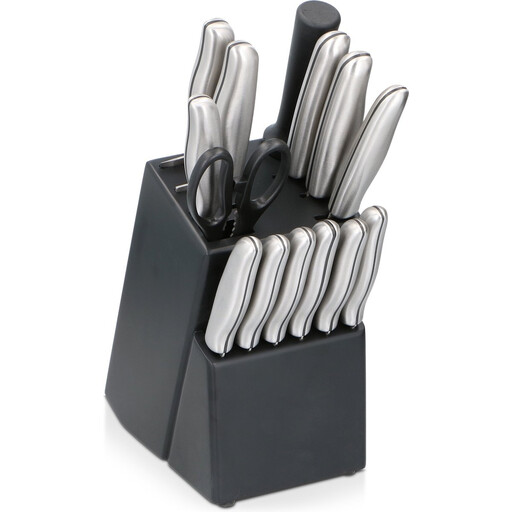
Why it suits this profile: This set provides a broad selection for a household looking to buy several types of kitchen knives without having to search for each one separately. It includes 13 knives, a block and a pair of scissors.
The contents are clearly specified: 15 pieces in total, including a chef’s knife, bread knife, santoku knife and steak knives. This lets you decide in advance whether the selection suits your cooking style.
Stainless steel knives, a knife block included and a weight of 3.50 kg according to the product specifications.
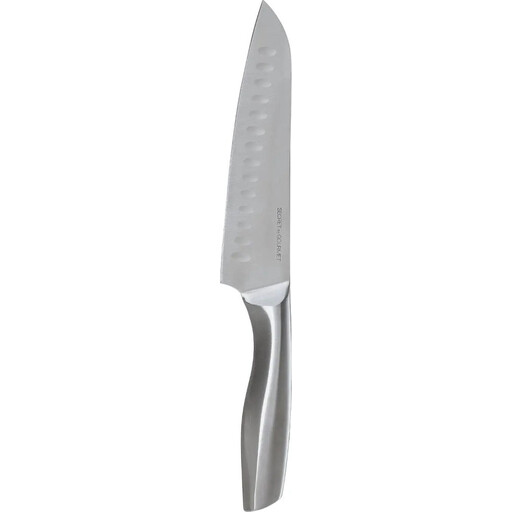
Why it suits this profile: A home cook who would rather choose one specific knife than a large kitchen knife set gets a santoku knife with clearly stated measurements and a fully forged construction, according to the product information.
The length is clearly stated: 32 cm in total, with an 18 cm blade. It is also described as dishwasher-safe, although hand washing is often gentler on the edge.
Stainless steel, a product weight of 180 grams and a fully forged construction according to the stated specifications.
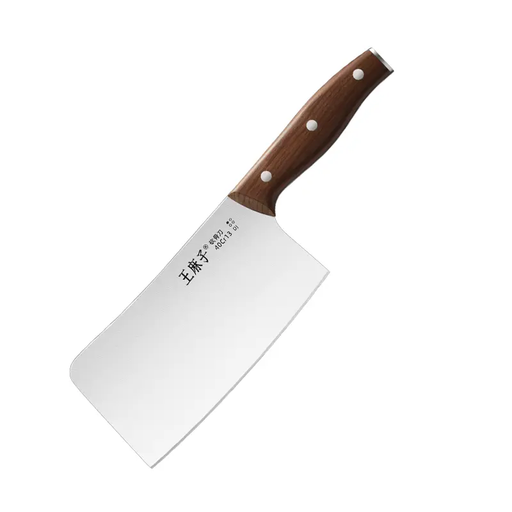
Why it suits this profile: This cleaver is designed for demanding tasks such as cutting up poultry, ribs and bones. It is therefore a useful addition for users who regularly prepare meat-intensive dishes.
The product description explicitly mentions use with bones, ribs and poultry. This makes it clearer what the cleaver is designed for and that it is not a replacement for a universal chef’s knife.
According to the product description, the cleaver is made from high-carbon steel and has an ergonomic, non-slip handle. Use it only on a suitable, stable chopping board.
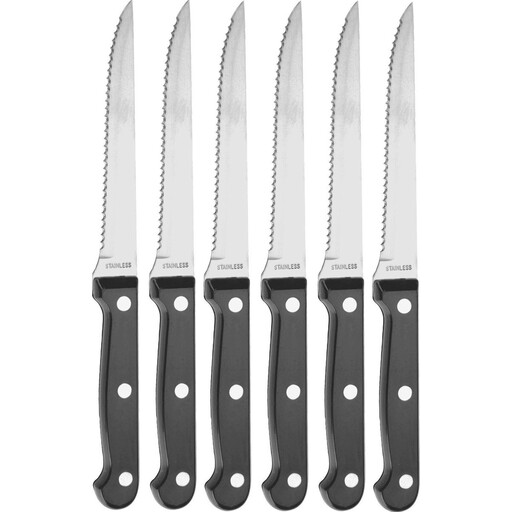
Why it suits this profile: This set of six steak knives is practical when several people are eating meat at the table at the same time. You do not need to buy a complete kitchen knife set for this purpose.
The purpose and quantity are clear: six steak knives for use at the table. You are not paying for knives designed for a different function.
Stainless steel blades, plastic handles and dishwasher-safe construction according to the product details.
Wash sharp kitchen knives according to the manufacturer’s instructions. If hand washing is recommended, rinse the knife briefly, dry it immediately and store it safely. Only use a sharpener that is suitable for the type of blade. A blunt knife may require more pressure, giving you less control while cutting.
Use a bread knife, steak knife or cleaver for the task it was designed for. A bread knife is not intended for bones, and a lightweight chef’s knife is not a substitute for a cleaver. Also check regularly that the handle is firmly attached. Keep all knives out of children’s reach.
We have put together a complete, up-to-date list of products that fully meet these strict selection criteria and the applicable European safety regulations.
A practical starting point is a chef’s knife for general cutting, a bread knife for hard crusts and a small paring knife for fruit and vegetables. If you often prepare Asian dishes, you could choose a santoku knife. A knife set is particularly useful when its contents match your cooking routine.
This varies according to the type of steel, use, chopping board and care. A brand’s claims about long-lasting sharpness come from that brand’s product information and do not represent a fixed service life. Regularly sharpening the knife correctly and cleaning it by hand can help keep the edge usable.
Some models are dishwasher-safe according to the product description, while others are not. Check this for each product. Even when dishwasher use is permitted, hand washing followed by immediate drying can help keep the blade and handle in good condition for longer.
