
Vandaag of morgen in huis

Kwaliteit gegarandeerd

Welkomstaanbiedingen ontgrendelen: GRATIS bezorging | Tot 80% korting | Gratis 30 dagen JoyPlus-proefperiode
Download de app
A blunt kitchen knife is unpleasant to use, requires more force, and won’t cut ingredients as neatly. Yet a high price tag is no guarantee that a knife will suit your cooking style. Home cooks, hobby chefs and professional chefs alike should look beyond terms like “extra sharp” or “professional”.
1. Focusing only on sharpness
A knife may feel sharp when new, but how long it stays that way also depends on the steel, the grind angle and how you maintain it. A thin blade often cuts smoothly, but can be more vulnerable to misuse. Always check the material and care information.
2. Buying a knife set with knives you’ll never use
A large set may look appealing, but it often includes knives you rarely reach for. A chef’s knife, vegetable knife, bread knife and a small paring knife are more practical for most households than a block packed with similar blades. Look at what’s actually in the set, not just the number of pieces.
3. Assuming a dishwasher-safe knife is maintenance-free
“Dishwasher safe” doesn’t mean the cutting edge will stay in the same condition for long. Hot water, dishwasher tablets and contact with other cutlery can affect both the blade and the handle. For most stainless steel kitchen knives, hand washing with mild washing-up liquid remains the sensible choice, unless the manufacturer explicitly states otherwise.
A chef’s knife of 16 to 20 cm is suitable for cutting vegetables, herbs, fruit, fish and meat. A 16 cm blade generally offers more control on a smaller chopping board. A 20 cm knife has more cutting surface and can be handy for large vegetables or bigger cuts of meat.
A Santoku knife usually has a wider, relatively straight cutting edge and is good for fine chopping and mincing. The dimples on some blades can help prevent slices of food from sticking, but the effect depends on the ingredient and your cutting technique.
For specific tasks, a carving knife or vegetable knife can be more practical than one all-purpose blade. A carving knife often has a longer, narrower blade; a vegetable knife is shorter and more manoeuvrable.
Many stainless steel kitchen knives use steel such as X50CrMoV15. This designation tells you something about the steel’s composition, but not on its own how long a knife will stay sharp. The heat treatment, grind angle and blade thickness also play a part.
A forged knife is shaped from a single piece of steel. A full-tang construction means the steel runs all the way through the handle. This can contribute to balance and sturdiness, but it doesn’t automatically make a knife right for every user.
Also look for concrete information about the grind angle. Wüsthof states a grind of 14 degrees per side on several models. According to Wüsthof’s product description, this grind helps deliver a sharp cutting edge. This is a brand claim, not a universal guarantee of longevity.
A handle should feel secure and suit your grip. A non-slip texture can give extra control, while a smooth plastic handle is easy to clean. Check whether the knife is suitable for left- and right-handed use if that matters to you.
Use kitchen knives on a wooden or plastic chopping board. Glass, stone and metal can damage the cutting edge more quickly. Wash the knife by hand where possible, dry it straight away and store it in a knife block, a protective sheath or a drawer insert. A honing steel can maintain the edge; for larger corrections, you’ll need a suitable whetstone or sharpener.
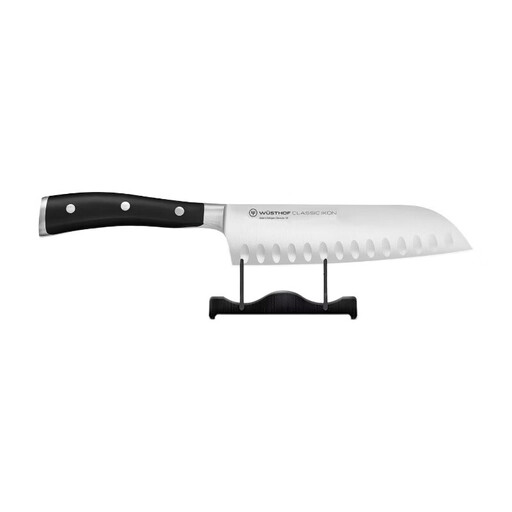
Why it suits this profile: A compact chef’s knife for everyday preparation of herbs, vegetables, fruit, fish and meat. The 16 cm length offers control without taking up too much space on your chopping board.
The product information mentions X50CrMoV15 stainless steel, a half bolster and a grind of 14 degrees per side. It also clearly states that hand washing is recommended.
16 cm blade; suitable for left- and right-handed use; plastic handle; granton edge according to the product description.
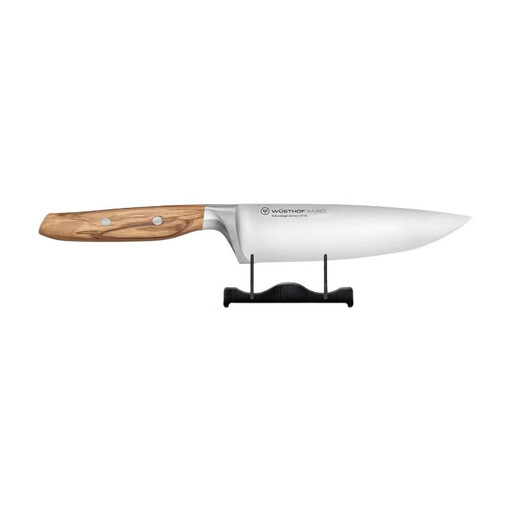
Why it suits this profile: A longer chef’s knife for those who regularly prepare large vegetables, meat and herbs, and who value a broad cutting edge for moving ingredients around the board.
According to Wüsthof’s product description, the knife is forged from a single piece of X50CrMoV15 steel. The stated 14-degree cutting edge and half bolster provide verifiable specifications alongside general sharpness claims.
20 cm blade; stainless steel; olive wood handle measuring 9.5 cm; designed for slicing, chopping and fine cutting.
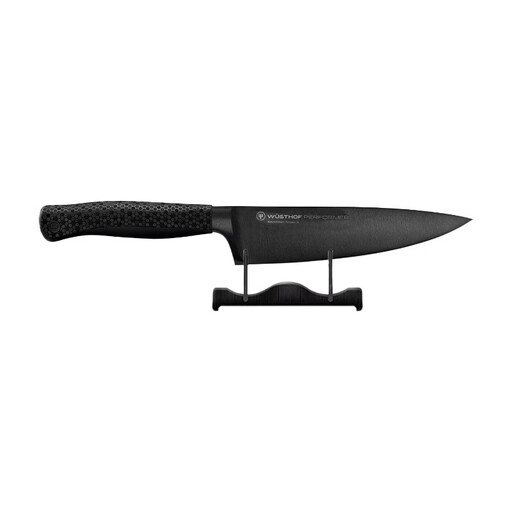
Why it suits this profile: The 20 cm length and honeycomb-textured grip are well suited to lots of cutting work and users who value control.
The product information specifically mentions X50CrMoV15 steel, a DLC coating and a hexagonal grip. Do check whether the described double serrated structure suits your cutting technique.
20 cm blade; non-slip honeycomb pattern on the handle; black DLC coating according to the product description.
We’ve put together a full, up-to-date list of products that fully meet these strict selection criteria and comply with current European safety regulations.
The lifespan depends on the steel, the grind angle, the chopping board and how you care for it. Wash the knife by hand, dry it straight away and avoid hard surfaces. Regular honing or sharpening helps maintain the cutting edge, but replace a knife when the blade is damaged or the handle no longer feels secure.
That depends on what’s included. A set is practical when you need several types of knives, a pair of scissors and a sharpener. If you mainly cut vegetables, herbs and meat, one chef’s knife and perhaps a smaller vegetable knife may be enough. Compare the individual pieces, materials and storage space before you buy.
A sharp knife requires less pressure, but it’s still a cutting tool that needs careful handling. Cut away from your body, keep your fingers curled under, and never leave a knife loose in a full sink. Store it in a knife block, protective sheath or drawer insert, and keep it out of reach of children.
