
Vandaag of morgen in huis

Kwaliteit gegarandeerd

Welkomstaanbiedingen ontgrendelen: GRATIS bezorging | Tot 80% korting | Gratis 30 dagen JoyPlus-proefperiode
Download de app
A kitchen knife seems simple: a blade, a handle and a cutting edge. Yet knives differ greatly in use, maintenance and suitability. A large chef’s knife is handy for vegetables and meat, but less suitable for bread. A cleaver can handle bones, while a santoku knife is particularly good for fine slicing and chopping.
If you only pay attention to words like “extra sharp” or “professional”, you could end up buying a knife that doesn’t suit your cooking style. So focus on verifiable features such as blade length, steel type, handle, grind angle and care instructions.
“Razor sharp” or “extra sharp” says little without information about the steel, the grind angle and maintenance. Every kitchen knife loses its sharpness with use. A stainless steel kitchen knife only remains practically usable if you wash it by hand, dry it and regularly hone or sharpen it.
Also check whether a brand claim is clearly presented as such. According to Wüsthof’s own product information, the Classic Ikon santoku knife is sharpened using laser-guided technology and has an edge of 14 degrees per side. That is a product specification; it does not mean the knife stays permanently sharp without maintenance.
A 20 cm blade gives more cutting surface, but also requires more space and control. For a smaller kitchen or someone who mainly cuts vegetables, fruit and herbs, 16 or 17 cm may feel more comfortable. Don’t just look at the total length: the balance between blade, handle and weight determines how the knife feels.
A dishwasher uses heat, water pressure and detergent. This can put extra strain on the cutting edge and handle. Some knives are described as dishwasher-safe in the product description, but for other models hand washing is strongly recommended. Always follow the manufacturer’s instructions and dry the knife immediately after washing.
The right shape depends on the task:
A blade length of 16 cm offers a good balance between manoeuvrability and versatility. A 20 cm chef’s knife can be handy when you often prepare large vegetables, melons or pieces of meat.
X50CrMoV15 is a commonly used stainless steel. This steel is mentioned in the product information for the Wüsthof Classic Chef’s Knife. Rust resistance does not mean the knife is completely maintenance-free: prolonged soaking, acids and moisture can damage the surface.
Look out for these points:
A half bolster can, according to the product description, make it easier to sharpen the full edge. A granton edge with dimples can, according to the manufacturer, help prevent sliced food from sticking to the blade. See this as a design feature, not a guarantee for every ingredient.
An ergonomic synthetic handle is practical when you are cutting for long periods. Check whether the knife is suitable for left- and right-handed use and whether the connection between handle and blade is sturdy.
Use a wooden or plastic chopping board. Glass, stone and metal are hard on the cutting edge. Store the knife in a knife block, protective sheath or drawer insert. Only use a honing steel if it matches the grind angle and hardness of the knife; for actual sharpening, a suitable whetstone or professional sharpening service is needed.
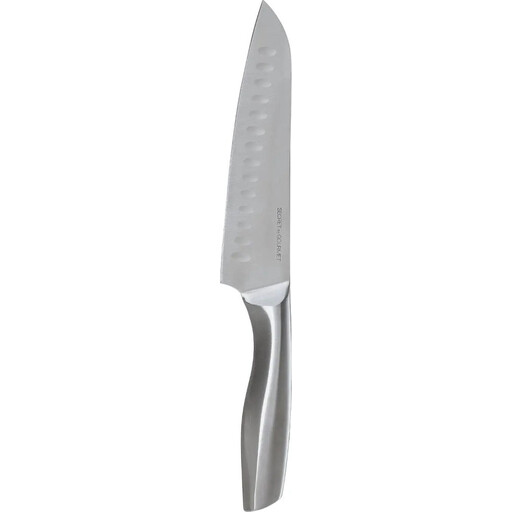
Why this fits: A practical option for daily cutting of vegetables, fruit and meat, without having to buy multiple knives straight away.
The product information mentions stainless steel, a sturdy handle and dishwasher safety. Do check the exact fit and cutting feel for your hand.
Forged model with a total length of 32 cm, an 18 cm blade and a weight of 180 grams.

Why this fits: For home cooks who value a precise cut, an ergonomic handle and a compact santoku knife.
The described 14° cutting edge and hand-finishing make the specification more concrete than just a general sharpness claim. Hand washing remains recommended.
X50CrMoV15 high-carbon stainless steel, a synthetic handle and a 17 cm blade.
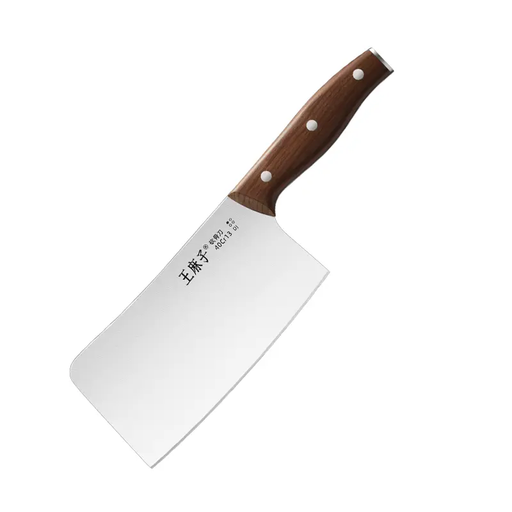
Why this fits: For cooks who regularly prepare poultry, ribs or tough ingredients and need a cleaver for the job.
A cleaver is not a replacement for a fine chef’s knife. Only use it on a suitable chopping board and check the product specifications for bones and hard parts.
Forged version with a weight-oriented design according to the product description, intended for heavy cutting tasks.
For daily cooking, a Wüsthof Classic Chef’s Knife of 16 cm could also be a good fit. According to the product information, this model has a blade made of X50CrMoV15 steel, a synthetic handle, a half bolster and a grind angle of 14 degrees per side. If you prefer a longer chef’s knife, you can look at the Wüsthof Gourmet of 20 cm. For bread, a 5five bread knife of 33 or 34 cm makes more sense; for the table, a set of six steak knives is more suitable than a large kitchen knife.
Browse a current selection of steel cutting knives and compare blade length, material, handle and intended use before making your choice.
A chef’s knife of 16 to 20 cm is generally versatile for vegetables, herbs, meat and fish. Choose 16 or 17 cm if you mainly want manoeuvrability; 20 cm offers more cutting surface for large ingredients.
Wash the knife according to the instructions, dry it immediately and use a wooden or plastic chopping board. Store the knife protected and regularly use a suitable honing steel or whetstone. Avoid glass, stone and metal as cutting surfaces.
Not always. A budget model can be sufficient for occasional cooking. A more expensive knife may become more interesting when you cook often and value a specific steel type, balance, handle and precisely specified grind angle. Look at use and maintenance, not just the price or brand name.
