
Vandaag of morgen in huis

Kwaliteit gegarandeerd

Welkomstaanbiedingen ontgrendelen: GRATIS bezorging | Tot 80% korting | Gratis 30 dagen JoyPlus-proefperiode
Download de app
A kitchen knife may seem simple, but you often only notice the difference between a comfortable knife and a poor purchase during everyday use. A blunt blade requires more pressure, a poorly designed handle reduces control, and choosing the wrong length can make precision work unnecessarily difficult.
For home chefs, cooking enthusiasts and professional cooks, the choice is therefore about more than just the brand or appearance. Pay particular attention to the type of knife, blade length, steel, handle and maintenance. Below, you’ll find the key points to consider, along with some specific recommendations based on verifiable product specifications.
Words such as “extra sharp” or “professional” mean little on their own. It’s better to check whether the manufacturer provides information about the type of steel, sharpening angle and how the blade has been finished. A kitchen knife also won’t stay sharp by itself. The chopping board, cleaning method and storage conditions all have a major impact on the lifespan of the edge.
A 16 cm kitchen knife is manoeuvrable and suitable for smaller ingredients and compact worktops. A 20 cm kitchen knife offers more cutting surface for large vegetables, meat and herbs, but also requires more space and control. A 17 cm kitchen knife sits practically in between and is often chosen for santoku knives.
When a product is described as dishwasher-safe, that doesn’t automatically mean this method will keep its sharpness and finish in optimum condition over the long term. Heat, moisture and contact with other items can put strain on the edge. For many high-quality knives, washing by hand with warm water and mild washing-up liquid, drying immediately and storing the knife safely is a sensible routine.
A chef’s knife generally has a curved edge that allows you to rock the blade while chopping. It is suitable for vegetables, herbs, meat and fish. A santoku knife usually has a straighter edge and a broader, often lighter shape. This makes it well suited to slicing, chopping and transferring ingredients.
A bread knife with a serrated edge is designed for bread and products with a firm exterior and soft interior. Don’t use a smooth kitchen knife for this purpose: it can squash the bread and become blunt more quickly. Steak knives are designed for use at the table and are not a substitute for a chef’s knife.
A stainless steel kitchen knife is less prone to rust during normal use, but it still needs to be cleaned and dried. Many Wüsthof models use X50CrMoV15 steel. Always check the exact material details on the product page, as specifications can vary between ranges.
With a forged kitchen knife, the blade is formed from a single piece of steel. A full-tang construction extends into the handle and can contribute to balance and strength. This doesn’t automatically make a knife suitable for everyone: weight, grip and your personal cutting technique remain important.
An ergonomic handle should sit securely in your hand without requiring you to grip it tightly. Consider the shape, material and protection at the point where the handle meets the blade. A stated sharpening angle, such as 14 degrees per side, is more useful than a general claim about long-lasting sharpness. According to Wüsthof’s own information, certain knives are sharpened using laser-controlled precision and finished by hand. Treat this as a brand product specification, not a universal guarantee of service life.
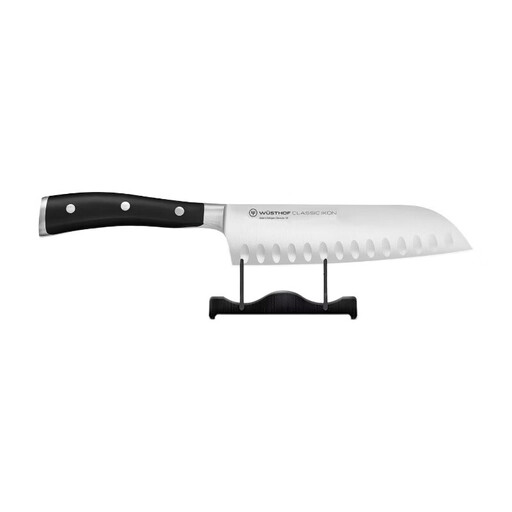
Why it suits this profile: The 16 cm blade length is easy to handle for everyday preparation in a smaller Dutch kitchen. The knife is suitable for herbs, vegetables, fruit, fish and meat.
The product information specifies X50CrMoV15 stainless steel, a half bolster and a sharpening angle of 14 degrees per side. This allows you to compare specifications instead of relying solely on marketing claims.
Ergonomic plastic handle, suitable for left- and right-handed use, with dimples in the blade to help reduce sliced food sticking to it.

Why it suits this profile: This Japanese kitchen knife, with a 17 cm blade, is well suited to users who want to finely slice vegetables, herbs, fish and meat with a compact, broad blade shape.
The stated specifications include X50CrMoV15 high-carbon stainless steel, a synthetic handle and hand washing for care. This makes it easier to distinguish between the material, use and maintenance requirements.
17 cm blade, approximately 170 grams and a partially protected handle that allows sharpening across a larger section of the edge.
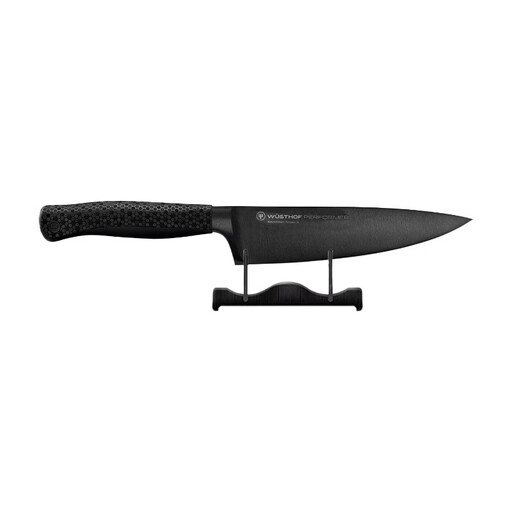
Why it suits this profile: The 20 cm blade offers extra reach for large vegetables, spacious chopping boards and frequent cooking. The hexagonal handle is designed to provide control during extended use.
The product details specify more than just a black appearance: they also mention X50CrMoV15 steel, a DLC coating and a blade length of 20 cm. However, always check the care instructions for your particular model.
20 cm blade, total length of approximately 31,90 cm and a fibreglass-reinforced hexagonal handle, according to the product description.
A single chef’s knife is often enough if you mainly prepare vegetables, herbs, meat and fish. Add a bread knife or a set of steak knives later if you genuinely use those functions. A kitchen knife set can be more convenient when setting up a new kitchen or replacing several knives at once.
When choosing a set, check what it actually contains. According to the product information, the 5five 13-piece knife set includes a chef’s knife, bread knife, three other knives, six steak knives, kitchen scissors, a sharpener and a wooden block. The set is not dishwasher-safe. A smaller Wüsthof Classic 3-piece set consists of a chef’s knife, bread knife and paring knife. This way, you won’t pay for knives that end up unused in a drawer.
We’ve put together a complete, up-to-date list of products that fully meet these strict selection criteria and the applicable European safety regulations.
For many households, 16 to 20 cm is a useful range. A 16 cm kitchen knife offers greater manoeuvrability, while 20 cm provides more reach when working with large ingredients. A 17 cm santoku knife is a mid-sized option with a broad edge.
This depends on the steel, sharpening angle, use and maintenance. A knife used on a hard surface or placed in the dishwasher can become blunt more quickly. Regular, correct honing and periodic sharpening help maintain cutting performance, but no edge stays sharp indefinitely.
Some product descriptions state that a knife is dishwasher-safe, but hand washing is generally the more cautious choice for preserving the blade and handle. Always check the specific care instructions on the product page.
